


The short version
- Epic plans for its new Epic Games Launcher to support as many Linux distributions as possible, naming SteamOS, Fedora, CachyOS and Omarchy.
- The statement came from Jake Jones, Epic's communications director, speaking to GamingOnLinux on November 6.
- An AppImage version, which runs on most Linux systems, returns this month.
- Fortnite isn't part of the announcement. Epic's anti-cheat still keeps it off Linux and the Steam Deck.
What Epic said
Epic's new launcher is still in preview on Linux. Asked by GamingOnLinux which systems it will run on, Jones said Epic plans to support "as many Linux distributions as possible". He named Fedora, SteamOS, Cachy and Omarchy, and said more would follow.
He also said Epic is "testing and evaluating packaging formats", and that it will bring back the AppImage build in November. That's a small detail with a big effect. The Linux preview first shipped as an AppImage, a single file that runs on almost any Linux system, but it was swapped for a .deb package that only suits Debian and Ubuntu-style systems. Epic's own FAQ says Fedora support is "coming soon".
SteamOS, the system on the Steam Deck, is based on Arch Linux, not Debian. So the .deb didn't help Deck owners. An AppImage would.
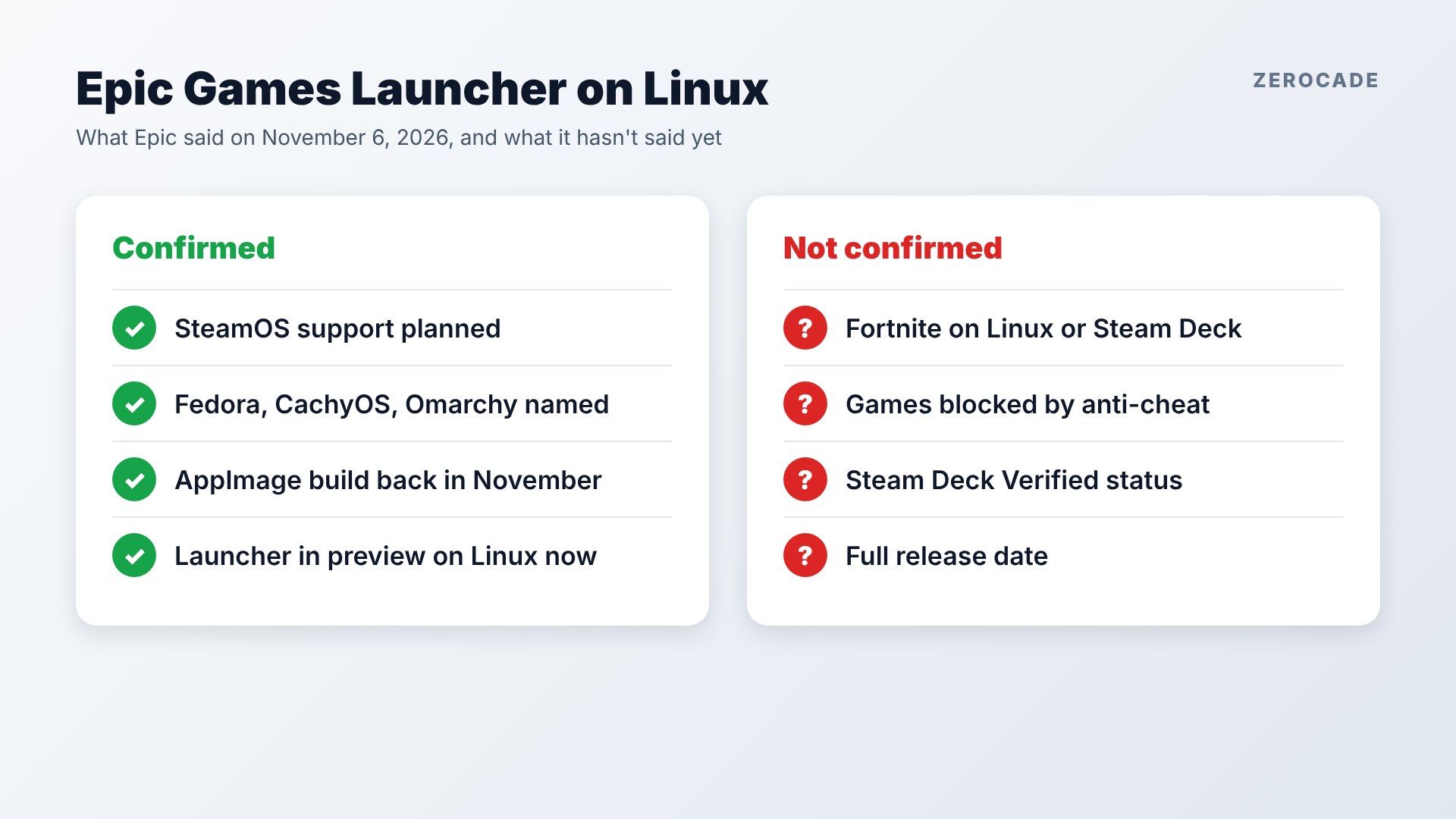
Image: Zerocade
Why this matters for Steam Deck owners
The Steam Deck runs Windows games through Proton, Valve's compatibility layer. Games bought on Steam work through it with a click. Games bought on the Epic Games Store don't. To play them on a Deck today, most people install a third-party launcher such as Heroic or Lutris in the Deck's desktop mode, sign in to Epic there, and add the games to Steam by hand.
That works, but it takes setup and some patience. An official launcher that runs on SteamOS could make Epic games far simpler to install and update on the Deck, and on Valve's other SteamOS hardware. It matters beyond handhelds too. Plenty of Indian PC players grab Epic's weekly free games, and anyone running Linux on a laptop or desktop would get the same launcher.
There's a catch: Epic hasn't said how the launcher will run Windows games. Its own app may be native to Linux, but almost every game in its store is a Windows game, so it will still need Proton or Wine underneath. Notebookcheck points out that Epic hasn't explained its approach.

Image: Valve
What it doesn't include
- Fortnite. Epic's biggest game is not mentioned. Fortnite uses Epic's own kernel-level anti-cheat, which doesn't run on Linux. Our explainer on why Fortnite isn't on Linux covers why that's so hard to fix.
- Other anti-cheat games. Epic said nothing about multiplayer games whose anti-cheat hasn't been switched on for Linux.
- Steam Deck Verified status. Nothing yet on whether the launcher itself will be tested by Valve or easy to add from game mode.
- A full release date. The only date is the AppImage this month.
A bigger shift for Linux gaming
Epic has long kept Fortnite off Linux, and until this year its store had no Linux app at all. A launcher built to run on several distributions is a real change, and it comes as other stores move the same way. GOG announced a native Linux version of its GOG Galaxy app at its first showcase this week.
The reason is simple: the Steam Deck and other SteamOS handhelds have made Linux a real gaming platform, and stores that ignore it risk losing those players to Steam. Our report on the Steam Deck store page has the current prices.
What to watch
Watch for the AppImage build later this month, and for Epic to say how it handles Windows games on Linux. If it ends up as simple as adding a shortcut in game mode, the Steam Deck's biggest store gap closes. Fortnite, on paper, stays the one big exception.