
The short version
- Intel CEO Lip-Bu Tan said on November 18 that Intel has signed its first outside customer for 18A. CTO Pushkar Ranade later said the deal is for 18A-P, the upgraded version. The customer wasn't named.
- Separately, Microsoft is the first company to announce it will use Intel's EMIB chip packaging, for its own Azure data-centre chips, plus a multi-year deal for Xeon server CPUs.
- It's the clearest sign yet that Intel's foundry business, which makes chips for other companies, can win paying customers.
- For gamers, 18A-P is the process behind Intel's next desktop chips, Nova Lake. Today's Core Ultra 7 270K Plus sells for around ₹35,000 in India.
What Tan said
Tan spoke at the TomorrowX Summit in Austin, Texas, on Wednesday. "And then 18A, I'm involved in production and we just signed the first customer," he said, according to CNBC. He didn't say who.
Pushkar Ranade, Intel's chief technology officer, then clarified on X that the deal is for 18A-P. Intel's shares rose 2.6% in after-hours trading, TNW reports.
The name is the big unknown. Apple was reported in May to be close to a deal with Intel, and analyst Ben Bajarin of Creative Strategies has named Apple, Nvidia and the big cloud companies as likely candidates. Japanese chip designer Socionext also said in August it would use 18A-P. Intel hasn't said whether this new customer is any of them, so treat every name as a guess.
The Microsoft deal
The Microsoft news came the same day, in an official Intel release. Microsoft calls it an "expanded, long-term agreement", with three parts:
- EMIB packaging for chips Azure designs itself. Microsoft is the first company to publicly announce it'll use Intel Foundry's EMIB.
- A multi-year Xeon supply deal, including Intel's next-generation Diamond Rapids server CPUs.
- Joint work on Xeon systems with CXL memory, a way of attaching extra memory to a server over a fast link.
"Our customers need infrastructure built around the workloads that matter to them," said Saurabh Dighe, corporate vice president of Azure System & Architecture at Microsoft. The release doesn't say which Azure chip will use EMIB, which factory process makes it, or when it ships, as TechTimes points out. Reports that Microsoft's Maia AI chips or Cobalt CPUs are the ones involved aren't confirmed.
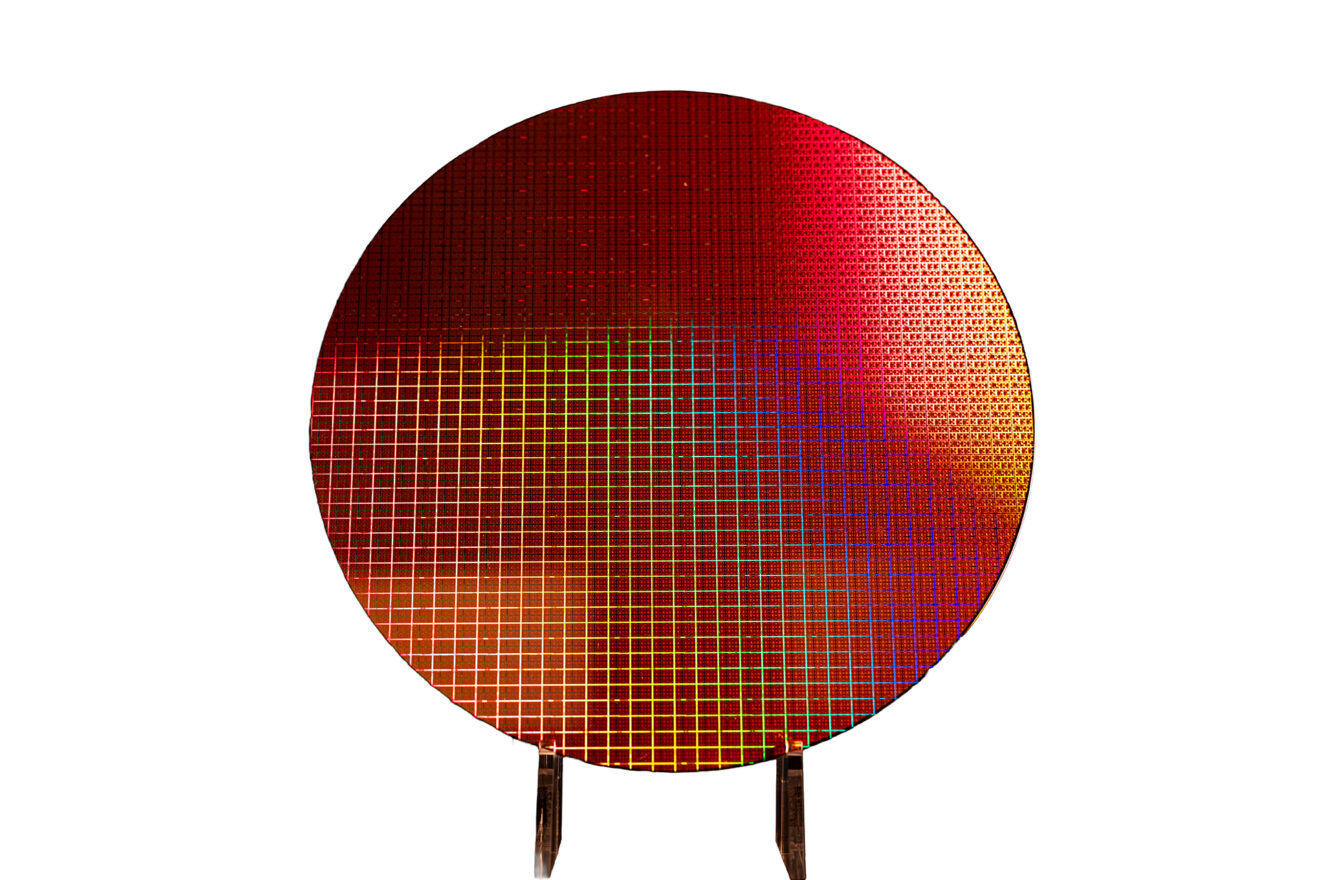
Image: Intel
What 18A and 18A-P are
18A is Intel's most advanced chipmaking process, the recipe its factories use to print transistors onto silicon wafers. It brings two big changes at once:
- RibbonFET transistors, where the gate wraps all the way around the channel to control current more precisely. The industry calls this gate-all-around.
- PowerVia, which moves the power wiring to the back of the chip so the front is free for signal wiring.
Intel claims 18A delivers up to 18% more performance at the same power than Intel 3, or 38% less power at the same performance. Its first product was Panther Lake, the Core Ultra Series 3 laptop chips launched at CES in January, for which Intel claimed up to 77% better gaming performance than Lunar Lake on integrated graphics.
18A-P is the improved version. It entered risk production, the early trial stage, in June 2026. Intel claims 9% more performance at the same power than 18A, or 18% less power, and it follows the same design rules, so chips can move across easily. Intel's own Nova Lake desktop CPUs and Diamond Rapids Xeons are expected to use it, as we covered when Intel confirmed Nova Lake's process and showed Diamond Rapids.
What EMIB is
Modern big chips are often several smaller dies joined in one package. The hard part is connecting them with fast, short links.

Image: Intel
EMIB (Embedded Multi-die Interconnect Bridge) uses a small piece of silicon buried in the package base, bridging only the edges where two dies meet. Intel has mass-produced it since 2017. The rival approach, TSMC's CoWoS, sits the dies on a large silicon layer called an interposer, which costs more and is in short supply because Nvidia's AI accelerators use so much of it.
According to Bernstein estimates cited by TechTimes, EMIB costs in the low hundreds of dollars per chip, against about $900-1,000 for CoWoS on an Nvidia Rubin-class accelerator. TrendForce says EMIB can also build bigger packages: about 6 times the size of a single chip exposure, against CoWoS-S at about 3.3 times.
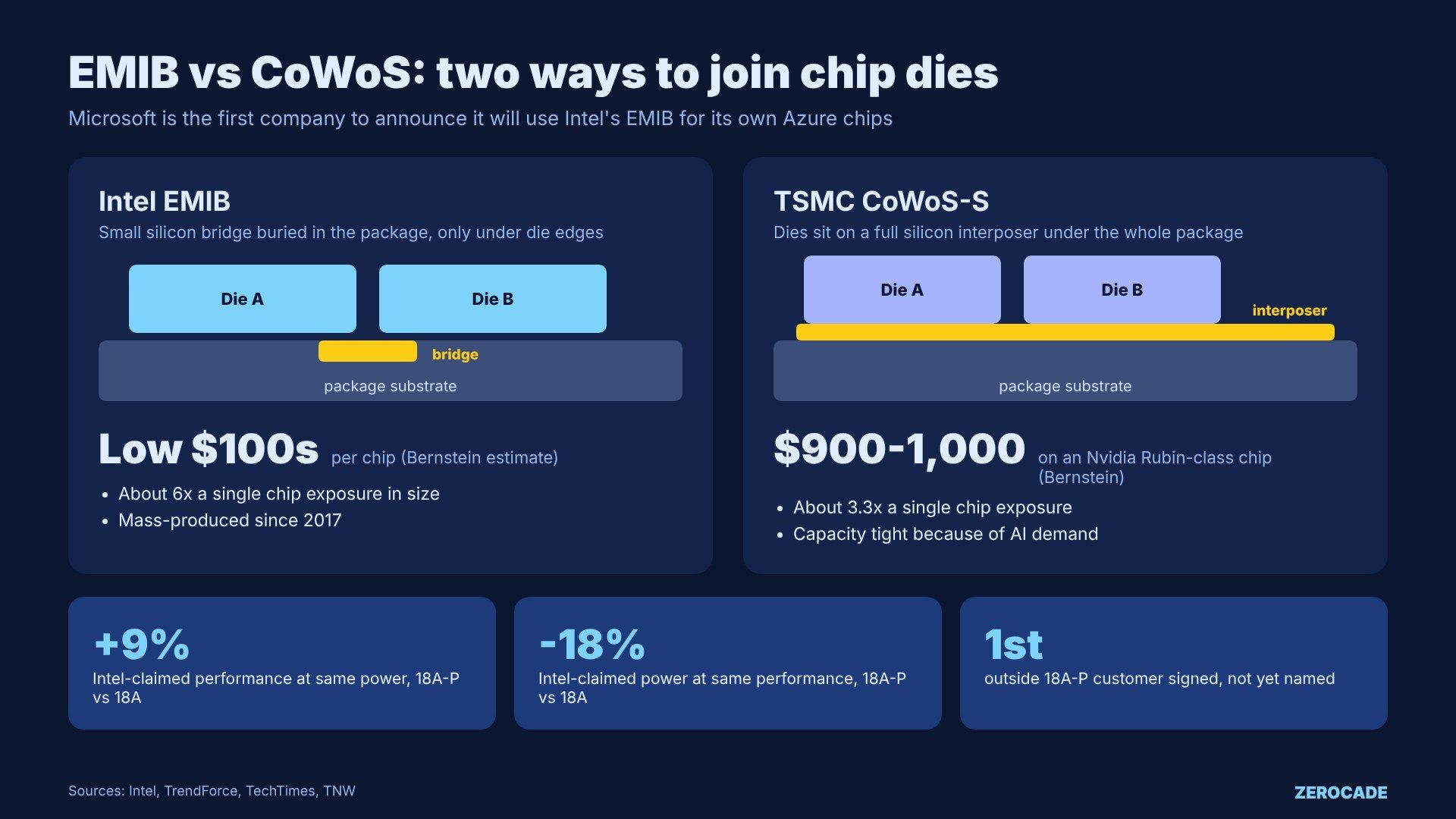
Image: Zerocade
Why it matters for Intel
Intel Foundry has spent years losing money while Intel tried to catch TSMC, and it has needed outside customers to fill its factories. Its third-quarter results showed foundry revenue up 58% to $6.7 billion, but the unit is still loss-making. The US government also took a stake of about 10% in Intel in August 2025.
Yield, the share of chips on each wafer that actually work, is the number everyone watches. A report cited by TrendForce puts 18A yields around 70%, but Intel hasn't confirmed that. CFO David Zinsner said in October 2025 that yields were "adequate" for supply but not yet where Intel needs them, with industry-standard levels expected in 2027.
On paper, a signed 18A-P customer and a big-name packaging deal suggest the technology is now good enough for others to bet on. The names and volumes will decide how big a win it really is.
What it means for gamers
Directly, not much yet: these deals are for other companies' chips and data-centre hardware. Indirectly, a busier, healthier foundry helps pay for the factories that build Intel's own CPUs. Nova Lake on 18A-P is Intel's next big desktop launch, and a leak suggests a 12 P-core gaming chip could follow on the same process.
For now, Intel's current gaming chips are on older processes. The Core Ultra 7 270K Plus is listed at about ₹34,800-35,500 at Indian retailers this week.
What to watch
Watch for Intel or the customer naming the 18A-P deal, for which Azure chip uses EMIB, and for Intel's CES 2027 plans for Nova Lake.