

The short version
- Philips has launched the Evnia 27M4N8500V, a 26.5-inch 1440p 360Hz QD-OLED gaming monitor, on JD.com in China for 3,499 yuan (about $525).
- Its extras are about protecting the panel: an AI presence sensor that dims the screen when you walk away, a fanless graphene heatsink, pixel orbiting and, in China, three years of burn-in cover.
- The catches are a single DisplayPort 1.4 input, 15W USB-C charging and a True Black 400 HDR rating, a step down from its predecessor's True Black 500.
- It isn't sold in India yet. Rivals you can buy here start around ₹66,000 to ₹72,000 for 360Hz QD-OLEDs from MSI and Alienware.
What Philips launched
The 27M4N8500V went on sale through JD.com, reported by China's 17173 on November 12 and by Notebookcheck on November 13. Chinese site IT之家 first previewed it back in September. Philips Australia also has an official product page for it, but with no price or release date, and Philips hasn't confirmed launches in the US, UK or India.
It's an Evnia 8000 series monitor, and a follow-up to the 27M2N8500, which has dropped to around $399 in the US.
| Philips Evnia 27M4N8500V | |
|---|---|
| Panel | 26.5-inch QD-OLED, 2560x1440 |
| Refresh rate | 360Hz, 0.03ms grey-to-grey |
| Brightness | 250 nits typical, 1,000 nits peak HDR |
| HDR | VESA DisplayHDR True Black 400 |
| Colour | 99% DCI-P3, 98% Adobe RGB, Delta E under 2 |
| Coating | Anti-reflective, 1.3% reflectance, 3H hardness |
| Ports | 2x HDMI 2.1, 1x DisplayPort 1.4, USB-C (15W), 2x USB-A |
| Stand | Height, tilt, swivel and pivot |
| Extras | 2x 5W speakers, Ambiglow rear lighting, 24.5-inch 1080p mode |
| Price | 3,499 yuan (about $525), China only |
That 24.5-inch mode is a nod to esports players: it shrinks the image to a 1080p window, the size many CS2 and Valorant pros use, so the whole screen sits in your view without moving your eyes.

Image: Philips
The burn-in kit
OLED's big weakness is burn-in: leave a static image like a HUD or taskbar on screen long enough and it can leave a faint ghost. Philips stacks several defences:
- AI PowerSensor 3. A small camera-style sensor, processed on a chip inside the monitor, checks whether you're sitting there. Walk away and it dims or switches off the screen. Philips says it doesn't store or upload any video.
- A fanless heatsink. Graphene and aluminium spread heat from the panel, which also monitors its own temperature. Heat speeds up OLED wear.
- Pixel orbiting. The panel actually has 2576x1456 pixels, slightly more than 1440p, so it can shift the image a few pixels at a time without cropping anything.
- An ambient light sensor, which adjusts brightness and colour temperature to the room.
- Three years of burn-in cover, reported for China. Philips hasn't said whether that will apply in other markets.
The burn-in warranty matters most. Dell and MSI already offer three years of burn-in cover on their 360Hz QD-OLEDs, so Philips is matching them rather than leading.
The catches
On paper, three things hold it back.
One DisplayPort 1.4. At 1440p and 360Hz, DP 1.4 needs Display Stream Compression (DSC), a visually lossless squeeze that works fine with modern graphics cards but can complicate things like custom resolutions. Newer rivals, like LG's 480Hz 27GX790A, use DisplayPort 2.1.
15W USB-C. That's enough for a phone, not a laptop. MSI's 271QRX delivers 90W over USB-C and adds a KVM switch.
True Black 400, not 500. The older 27M2N8500 is listed with True Black 500 on Philips' Singapore site. The new model's 250-nit full-screen brightness and 1,000-nit peak point to the same Samsung Display panel used across 2024 and 2025 monitors, not Samsung's brighter new Penta Tandem panels. Our Penta Tandem QD-OLED explainer covers what those add. Neither Philips nor any report has confirmed the exact panel, so that's an inference.

Image: Samsung Display
Why 26.5 inches?
That's not a new size. Samsung Display sells this panel as "27-inch QHD 360Hz", and almost every monitor built on it lists 26.5 inches as the actual viewable diagonal, including MSI's 271QRX and ASUS's XG27ACDNG. Dell rounds its Alienware to 26.7 inches.
The panel uses QD-OLED's triangular subpixel layout, with green sitting above red and blue. That can leave a faint colour fringe on sharp text. Reviewers found it much reduced on this generation of 27-inch panels, but not gone, so on paper it's a better pick for games than for all-day spreadsheets. Samsung's newer V-Stripe layout, which fixes this with a standard RGB stripe, is only on a 34-inch ultrawide so far.
How it compares
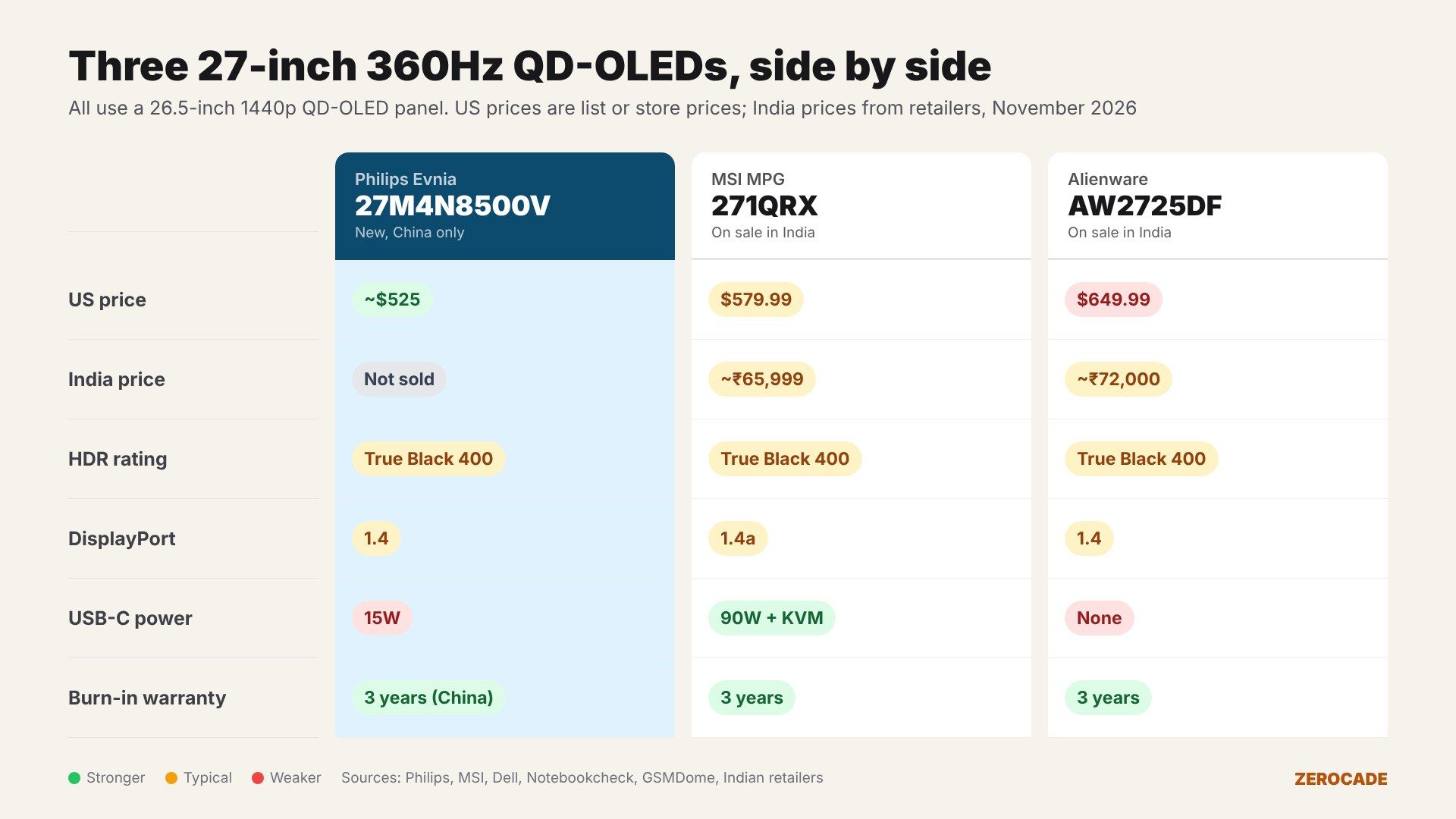
Image: Zerocade
At about $525, the Philips sits below the Alienware AW2725DF's $649.99 list price and MSI's $579.99 store price, but those two regularly drop in sales. The AW2725DF has been as low as $499.99, and LG's 480Hz 27GX790A hit $467.97 in August.
In India, you can't buy the 27M4N8500V. Converted directly, 3,499 yuan is about ₹43,000, but an official Indian price would almost certainly be higher after duties and margins. For comparison:
- Alienware AW2725DF: around ₹72,000 at Indian retailers
- MSI MPG 271QRX: listed around ₹65,999, often out of stock
- Samsung Odyssey OLED G6 (G60SD): around ₹81,000
- LG UltraGear 27GX790A (480Hz WOLED): around ₹87,000
Philips' India site currently lists no Evnia monitors at all, so a launch here isn't guaranteed.
What to watch
Watch for Philips to announce global pricing, and whether the three-year burn-in cover comes with it. Without that warranty, a $525 OLED with DP 1.4 and a True Black 400 rating has a harder time against an Alienware on sale.