
The short version
- Dynamic pricing means a price changes quickly based on demand, time or stock. Personalised pricing goes further: different people see different prices for the same thing at the same time.
- Sony is hiring a Senior Director, Digital Games Monetization for PlayStation Store, paying $251,000 to $376,600 a year (about ₹2.4 crore to ₹3.6 crore). The listing mentions driving "Intelligent Pricing" and "Targeted Offers".
- Since late 2025, trackers have logged PS Store tests where some accounts got bigger discounts than others, up to about 28% off in one case. Sony hasn't commented.
- It isn't illegal in most places, but regulators like the UK's CMA say shoppers must be told clearly.
What the job listing says
The listing was spotted by The Game Post on October 29, 2026 and picked up by Push Square on October 31. The role is based in San Mateo, California, reports to the head of PlayStation Store, and covers how games are priced and promoted on the store.
The phrase that caught attention was "Intelligent Pricing". On its own, a job ad proves nothing about what Sony will launch. But it uses the same idea as test codes that have already appeared on the store, so it's a fair sign that Sony sees smarter pricing as a long-term part of PlayStation Store, not a short experiment.
Dynamic vs personalised: what's the difference?
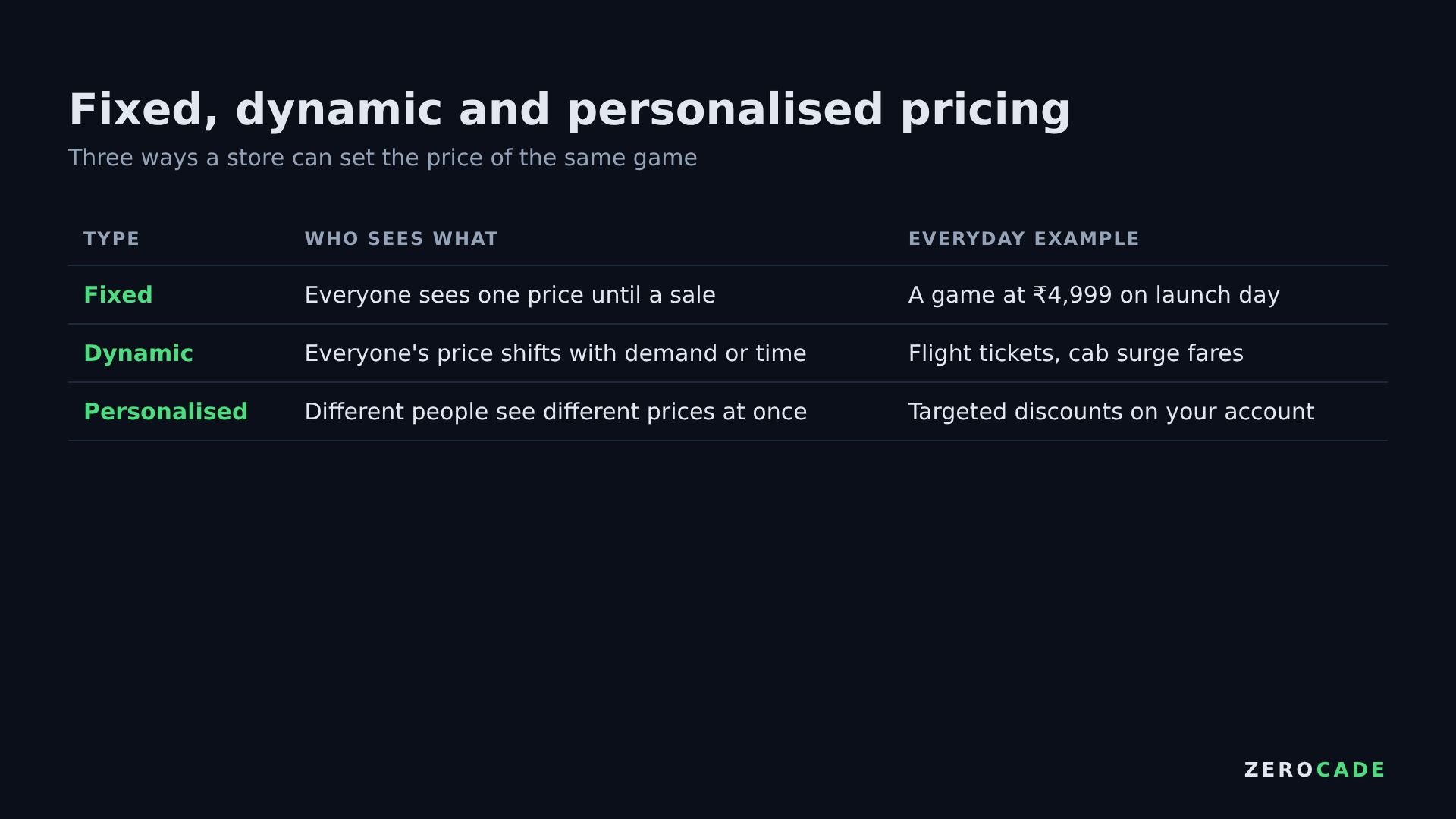
Image: Zerocade
These terms get mixed up, so here's the simple version.
Fixed pricing is what most of us expect. A game costs ₹4,999, everyone sees ₹4,999, and it changes only when a sale starts.
Dynamic pricing changes the price for everyone based on conditions. Flight tickets and cab fares are the classic examples: the price rises when lots of people want a seat or a ride. The UK's Competition and Markets Authority (CMA) describes it as prices being adjusted rapidly in response to demand.
Personalised pricing (sometimes called targeted offers) shows different prices to different people at the same moment. The store uses what it knows about you, such as what you've bought, how often you shop, or whether you wishlisted a game, to decide which offer to show.
What players have seen on the PS Store looks more like the third one: tests where one account gets a bigger discount than another.
What's been spotted on the PS Store
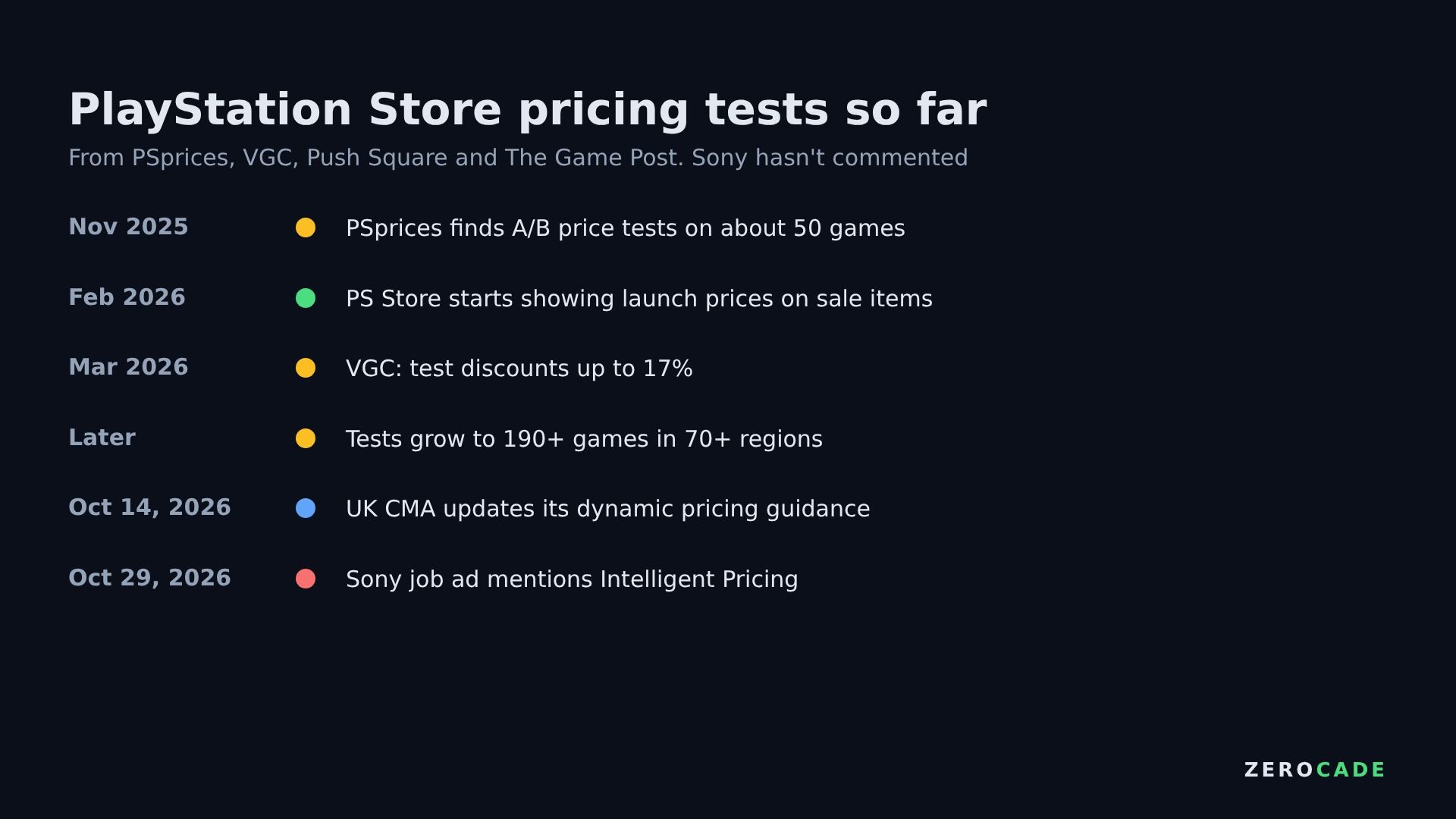
Image: Zerocade
The tests were first flagged by the price tracker PSprices in November 2025. It found A/B tests (two versions shown to two groups of players) on about 50 games across 30 regions, which later grew to 190+ games in 70+ regions. The store's own data carried codes like IPT_PILOT and IPT_LTM. "IPT" neatly fits the "Intelligent Pricing" name in Sony's new job ad.
A few examples:
- Helldivers 2 dropped from $39.99 to $28.89 for some accounts, about 27.8% off, while others saw full price.
- Push Square found Assassin's Creed Unity at £3.74 when logged out, but £9.99 when logged in.
- In a US spring sale, Astro Bot showed 34% off for some players and 55% off for others.
VGC reported in March 2026 that discounts in the tests went up to about 17%, and that the US and Japan weren't part of them at that point. In February 2026, Sony started showing a game's launch price next to sale prices, which helps you see how good a deal really is.
Sony has never publicly explained the tests. Its UK terms for the PlayStation Upgrader programme do say it may run "targeted offers", so the idea isn't new to its legal fine print.
Is it allowed?
In most countries, yes, as long as it isn't deceptive. The CMA updated its guidance on October 14, 2026. Its line is that dynamic pricing isn't banned, but companies must be upfront about it, and under UK consumer law firms can be fined up to 10% of their global turnover for misleading shoppers.
India doesn't have a specific rule on personalised pricing for digital stores. The Consumer Protection Act does cover unfair trade practices and misleading prices, but there's no ruling on game store A/B tests.
Why stores do this
The pitch is simple: a discount that's big enough to make you buy, but no bigger. A player who would never pay ₹3,999 might buy at ₹2,499. A player who was going to buy anyway at ₹3,999 doesn't "need" the extra cut. Personalised offers let a store try to charge each person close to what they're willing to pay.
On paper, that can mean better deals for lapsed players or people on a budget. It can also mean loyal fans who buy at launch quietly pay more. That's why transparency matters so much here.
How to check you're getting the best price
- Compare logged in and logged out. Open the game's page on the PS Store website in a private browser window and compare it with what your account sees.
- Use a price tracker like PSprices, which logs historic lows and region-by-region prices.
- Check the launch price line that Sony now shows on sale items.
- Wishlist the game so you get a notification when it goes on sale.
If you notice two very different prices for the same game, screenshot both. That kind of evidence is exactly what trackers and regulators use.