

The short version
- Integrated graphics, or an iGPU, is a graphics processor built into the same chip package as the CPU. There's no separate graphics card.
- An iGPU shares the laptop's normal RAM with the CPU, instead of having its own fast VRAM. That shared, slower memory is its biggest limit.
- The newest iGPUs, like Intel's Arc B390 and AMD's Radeon 8060S, are strong enough that laptop makers now pitch them for 1080p gaming.
- A dedicated graphics card is still much faster for demanding games. An iGPU wins on price, battery life, heat and weight.
A laptop with no graphics card, sold for gaming
On November 6, MSI's Venture 15 AI+ went on sale in Europe for €1,199.95 (about ₹1.23 lakh), according to Notebookcheck. It has a 15.6-inch 144Hz screen, 16GB of RAM, a 512GB SSD and a 60Wh battery, and weighs about 2kg. MSI hasn't announced it for India.
What it doesn't have is a graphics card. Its Intel Core Ultra X7 358H processor, part of Intel's Panther Lake family, has Arc B390 graphics built in. Notebookcheck says that's enough for many recent AAA games at 1080p with settings turned down.
A few years ago, that claim would have been a stretch for any laptop without an Nvidia or AMD card. To see why it isn't now, it helps to know what an iGPU actually is.
What an integrated GPU is
Every PC needs a GPU, the chip that draws everything you see on screen. There are two ways to include one:
- A dedicated GPU (or discrete GPU) is a separate chip, either on a graphics card in a desktop or soldered onto a gaming laptop's motherboard. It talks to the CPU over a PCIe link.
- An integrated GPU sits inside the processor package, next to the CPU cores. Intel calls the graphics blocks Xe cores. AMD measures them in compute units (CUs).
You've almost certainly used an iGPU. Most office laptops, the Steam Deck and other handhelds all rely on one. The PS5 and Xbox Series X are built the same way: one AMD chip holds both the CPU and the GPU.
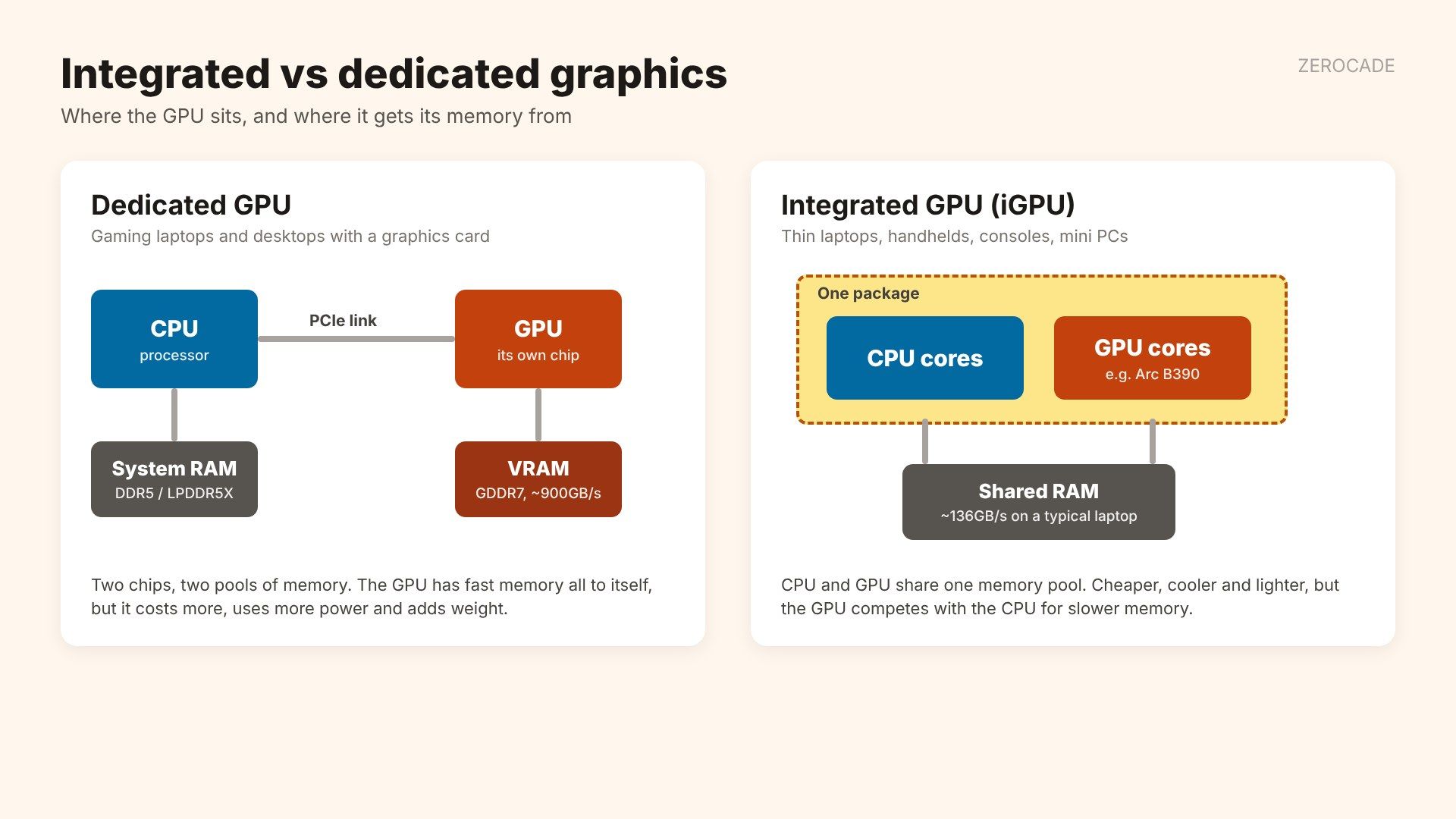
Image: Zerocade
Memory: the iGPU's biggest weakness
A graphics card comes with its own VRAM, very fast memory reserved for the GPU. The RTX 5070 Ti, for example, has 16GB of GDDR7 on a 256-bit bus, which moves about 896GB per second. Our guide on what VRAM is explains why that speed matters for textures and high resolutions.
An iGPU has no VRAM of its own. It borrows part of the laptop's main RAM, which the CPU is also using. Laptop memory is much slower. A typical thin laptop with LPDDR5X-8533 memory on a 128-bit bus manages about 136GB per second, roughly a sixth of that RTX 5070 Ti figure, and the CPU takes some of that too.
That's why iGPUs struggle most at high resolutions and with heavy textures. Those are exactly the jobs that need lots of memory bandwidth.
There's an upside. Because the memory is shared, an iGPU can use far more of it than most graphics cards have. AMD's Ryzen AI Max+ 395 supports up to 128GB of what AMD calls "unified memory", and its graphics can be given a large chunk of that. That's useful for AI models, less so for games.
How the latest iGPUs compare
| iGPU | Found in | Graphics cores | Who it's for |
|---|---|---|---|
| Intel Arc B370 | Core Ultra 5 338H | Fewer than B390 | Mainstream thin laptops |
| Intel Arc B390 | Core Ultra X7 358H, 368H; X9 378H, 388H | 12 Xe3 cores | Thin laptops pitched at light gaming |
| AMD Radeon 890M | Ryzen AI 9 HX 470 and others | 16 CUs | Premium thin laptops |
| AMD Radeon 8060S | Ryzen AI Max+ 395 | 40 CUs | Big-chip laptops and mini PCs |
Intel claims the Core Ultra X9 388H is up to 77% faster in games than last year's Core Ultra 9 288V. That's an average across 45 games at 1080p high with upscaling, in Intel's own tests. Intel also says some Series 3 chips have up to 50% more graphics cores than before.
AMD, in its own tests, says a Ryzen AI 9 HX 470 laptop with Radeon 890M graphics averages up to 27% faster than an Intel Core Ultra 9 386H at 1080p low. Its examples are Forza Horizon 5, Cyberpunk 2077 and Hogwarts Legacy. These are company numbers. On paper, the Arc B390 and Radeon 890M sit in the same class, while the 8060S, with 40 CUs and a much wider memory bus, is a step above both.

Image: AMD
Why iGPUs got so much better
Three things changed:
- Smaller, denser chips. Newer manufacturing lets Intel and AMD fit more graphics cores into the same package. Splitting chips into tiles and chiplets helps too, since the graphics part can be made on whatever process suits it.
- Faster laptop memory. LPDDR5X is much quicker than the DDR4 of a few years ago, which eases the bandwidth problem.
- Upscaling. Tools like Intel's XeSS, AMD's FSR and Sony's PSSR let a GPU render at a lower resolution and rebuild a sharper image. For an iGPU, that's often the difference between playable and not.
Integrated or dedicated: which do you need?
An iGPU makes sense if you mostly work, study and stream, and play esports titles, older games or lighter new ones at 1080p. You'll get a lighter laptop, longer battery life and less fan noise.
A dedicated GPU still makes sense for the latest big releases at high settings, for 1440p or 4K, or for ray tracing. Even a mid-range laptop graphics card has its own VRAM and a far bigger power budget than any iGPU. With graphics card prices rising, though, a strong iGPU is a more tempting middle ground than it used to be.
If you're shopping in India, look for the GPU name on the spec sheet, not just the processor. "Intel Core Ultra" can mean Arc B390 or a much weaker chip, and only the X7 and X9 H-series models in Intel's list carry the B390.