
The short version
- A photo shared on X by the leaker momomo_us appears to show an Intel Core Ultra 4000 "Nova Lake-H" laptop processor.
- It reportedly has 16 CPU cores: 4 P-cores, 8 E-cores and 4 low-power E-cores, plus 18MB of cache and 4 Xe graphics cores.
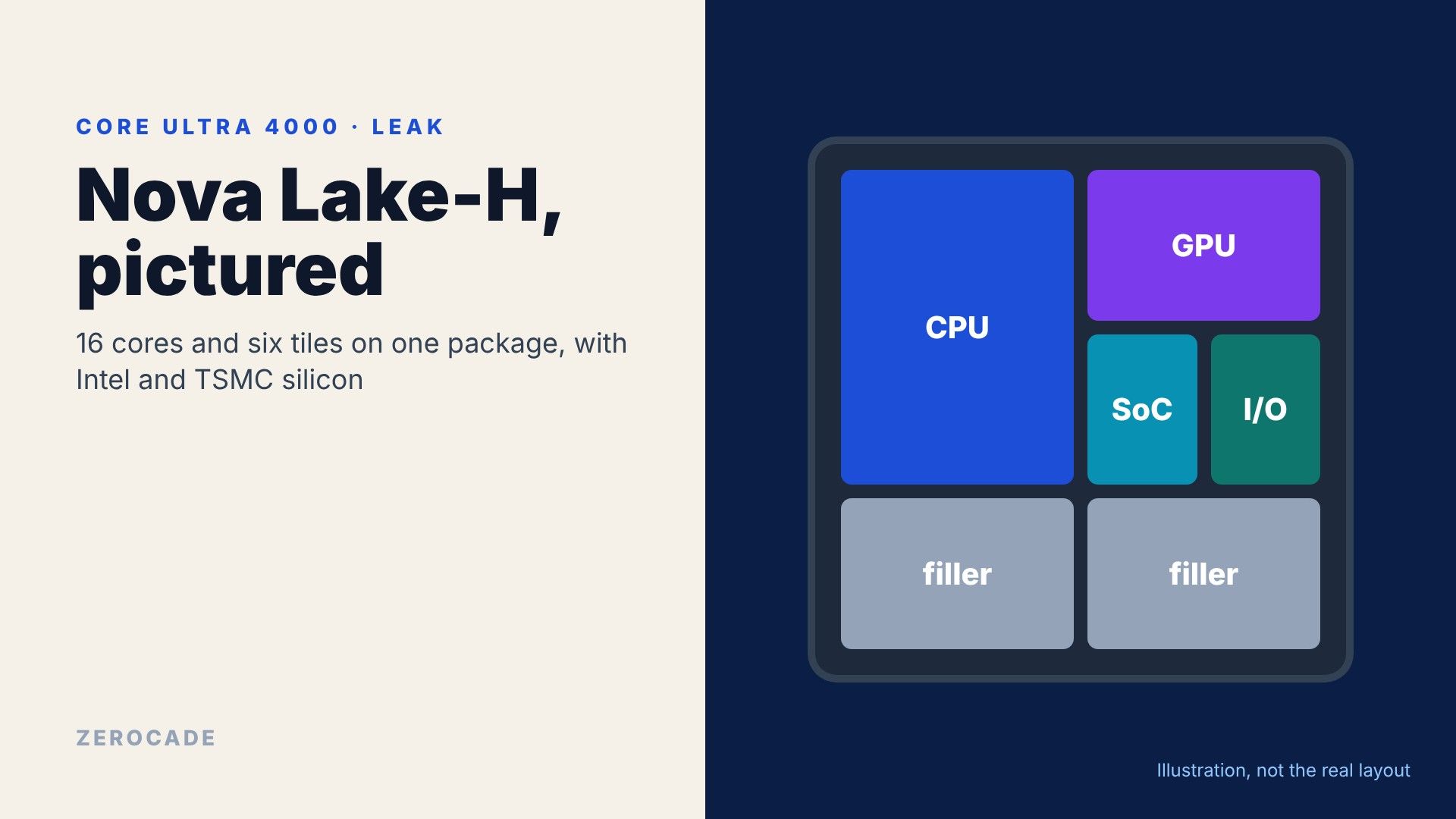
- The package reportedly has six tiles, with the CPU cores on TSMC's N2P process and other tiles on Intel's 18A-P and Intel 3. Two tiles may be filler.
- Intel hasn't announced Nova Lake-H. Treat the details as a leak. The photo is low resolution, and the tile layout is partly reporters' inference.
What the leak shows
The image surfaced on November 6 and was covered by Club386 and TechPowerUp. It shows a processor package with several separate pieces of silicon, called tiles, sitting side by side. Intel uses tiles instead of one large chip so it can build each part on the process that suits it. Our explainer on CPU tiles and chiplets covers how that works.
According to the reports, this Nova Lake-H chip has:
| Part | Reported detail |
|---|---|
| P-cores (performance) | 4 |
| E-cores (efficiency) | 8 |
| LP-E cores (low power) | 4 |
| Total CPU cores | 16 |
| Cache | 18MB |
| Graphics | 4 Xe cores |
| Tiles | 6, two of them reportedly filler |
| Package size | About 276mm² (earlier rumour) |
The six tiles
Club386 lays out the tiles using what's already known from earlier rumours, especially from the YouTube channel Moore's Law Is Dead. In that reading:
- Compute tile (about 55mm²): the P-cores and E-cores, made by TSMC on N2P.
- Hub or SoC tile (about 72mm²): the four low-power E-cores and other always-on parts, on Intel's 18A-P.
- Graphics tile (about 26mm²): the four Xe graphics cores, on Intel 3-E.
- Peripheral tile (about 58mm²): display, PCIe and other connections, on 18A-P.
- Two filler tiles (about 21mm² and 45mm²): reportedly blank silicon that keeps the package even and helps with cooling and mounting.
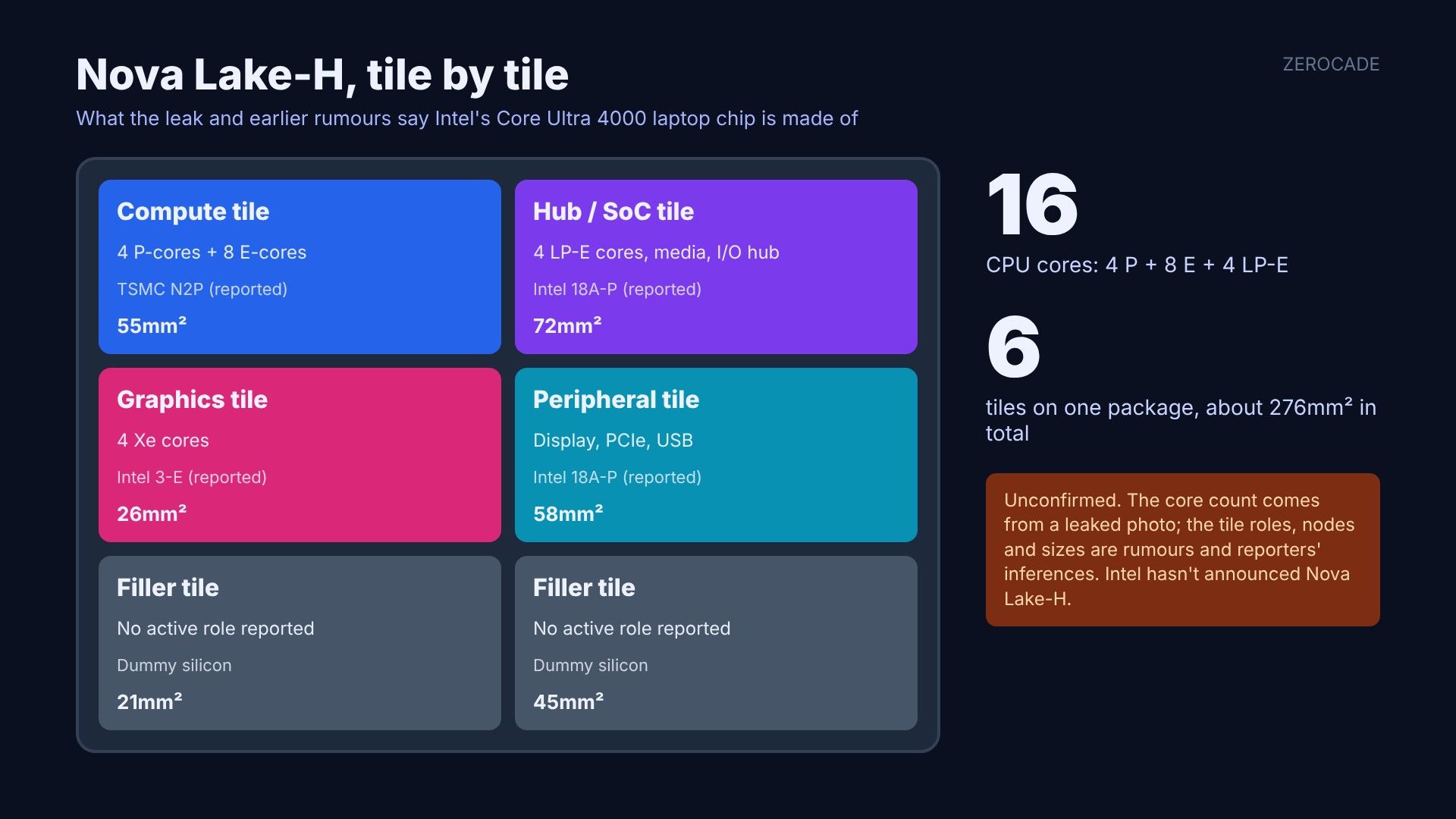
Image: Zerocade
The filler tiles are the interesting part. A rumoured higher-end chip, the Core Ultra 4970H, is said to have 12 Xe graphics cores. If that's true, some of those spaces might hold active silicon on bigger models, such as a larger graphics tile. That's speculation for now.
How it compares with Panther Lake
Panther Lake, sold as Core Ultra Series 3, launched in early 2026 and makes its main CPU tile on Intel's own 18A process. Our guide to Intel's chip codenames shows where each generation fits.
If the reports are right, Nova Lake-H moves the most important tile, the CPU cores, back to TSMC. Intel has only confirmed that Nova Lake uses 18A-P for some of its silicon, which we covered in an earlier post. It hasn't said which tiles TSMC makes. Using both factories isn't new for Intel: Arrow Lake and Lunar Lake also relied on TSMC for key tiles.
What it could mean for gaming laptops
On paper, 16 cores in an H-series chip is a strong mid-range configuration, but four Xe graphics cores is small. Most gaming laptops pair H-series Intel chips with a separate Nvidia or AMD graphics card, so the built-in graphics matter less there. The 12-core graphics version would matter more for thin laptops without a separate GPU.
Laptop prices are the other question. Memory costs have climbed sharply this year, which already pushes up laptop prices in India. Our post on Microsoft's leaked AI PC tiers shows Core Ultra Series 4 is already on Microsoft's slides.
What's still unknown
- Clock speeds, power limits and performance.
- Which tiles are really made where. The node list is partly inferred.
- Launch timing. Nova Lake is widely expected to be shown around CES 2027 in January, but Intel hasn't given dates for laptop models.
Until Intel confirms any of this, treat the 16-core layout as likely but unofficial, and the node list as an informed guess.