

The short version
- Leaker Jaykihn says Intel's Nova Lake-S desktop processors will limit their maximum core speed to 5.1GHz whenever the chip is above 90°C.
- That limit is said to be separate from normal thermal throttling at the chip's 100°C maximum, and, like that maximum, it can't be raised by users.
- The leak is marked preliminary, and Intel hasn't commented. Treat it as a rumour.
- In practice, it would make good cooling more important than ever if you want Nova Lake's full boost speeds.
What the leak says
Jaykihn posted the claim on X on November 4. In short, Nova Lake-S desktop chips will "universally" limit their top core frequency to 5.1GHz when they run above 90°C. The post calls this separate from the usual TjMax behaviour at 100°C, and says the 90°C threshold can't be shifted upwards.
TjMax is the highest temperature a chip is allowed to reach. When it gets there, the processor cuts its speed sharply to protect itself. Our guide to thermal throttling explains how that works. What's new here is a second, gentler step 10°C earlier: the chip keeps running, but its cores can't go faster than 5.1GHz until it cools down.
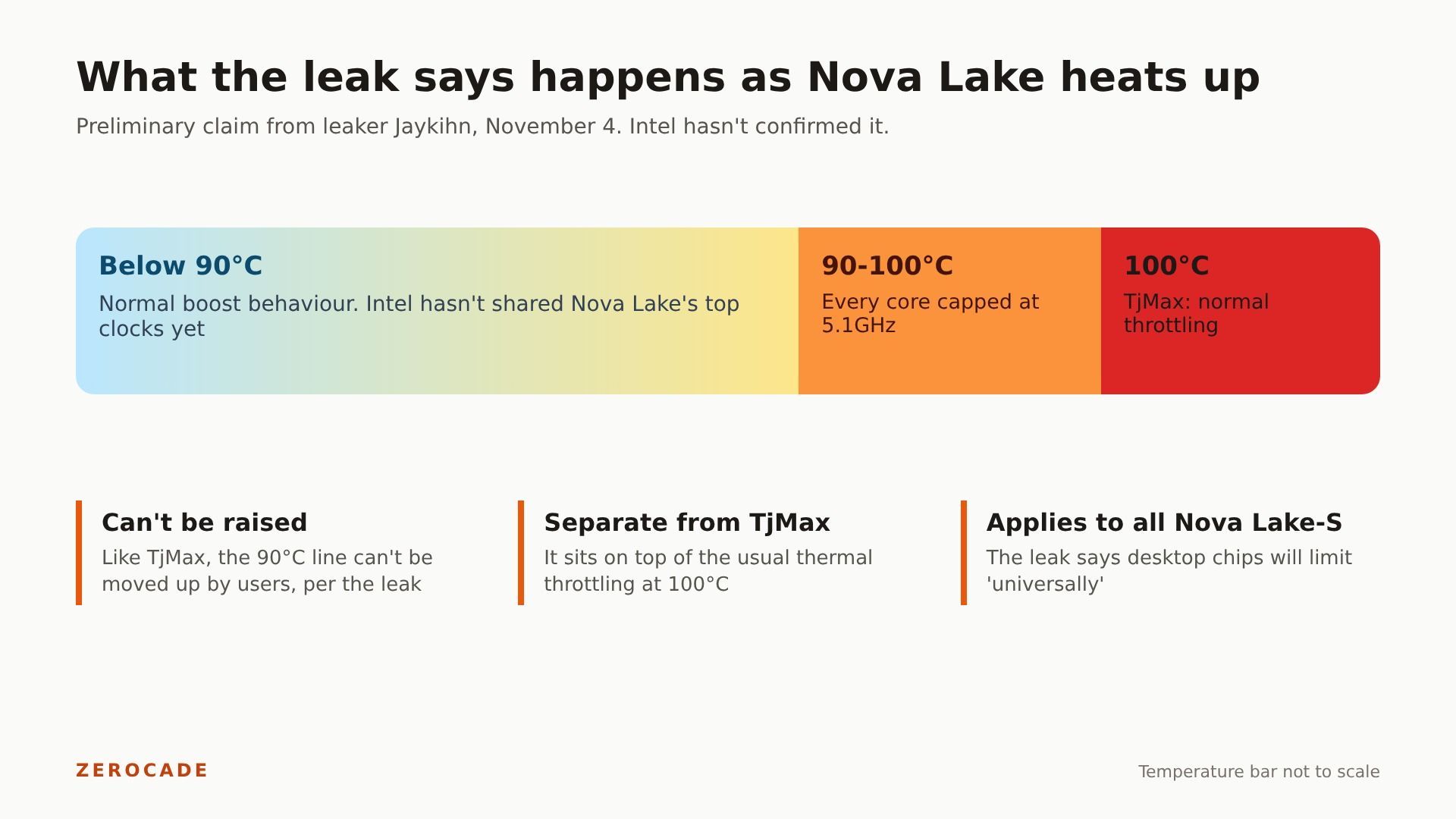
Image: Zerocade
Tom's Hardware, Wccftech and Notebookcheck all reported the claim and describe Jaykihn as a reliable Intel leaker. All three are working from the same single post, though, and none has independent confirmation.
How much does 5.1GHz matter?
It depends on what Nova Lake can do when it's cool, and Intel hasn't said. For comparison, today's flagships, Intel's Core Ultra 9 285K (Arrow Lake) and AMD's Ryzen 9 9950X, both boost to 5.7GHz. The 285K launched at $589 (about ₹56,000).
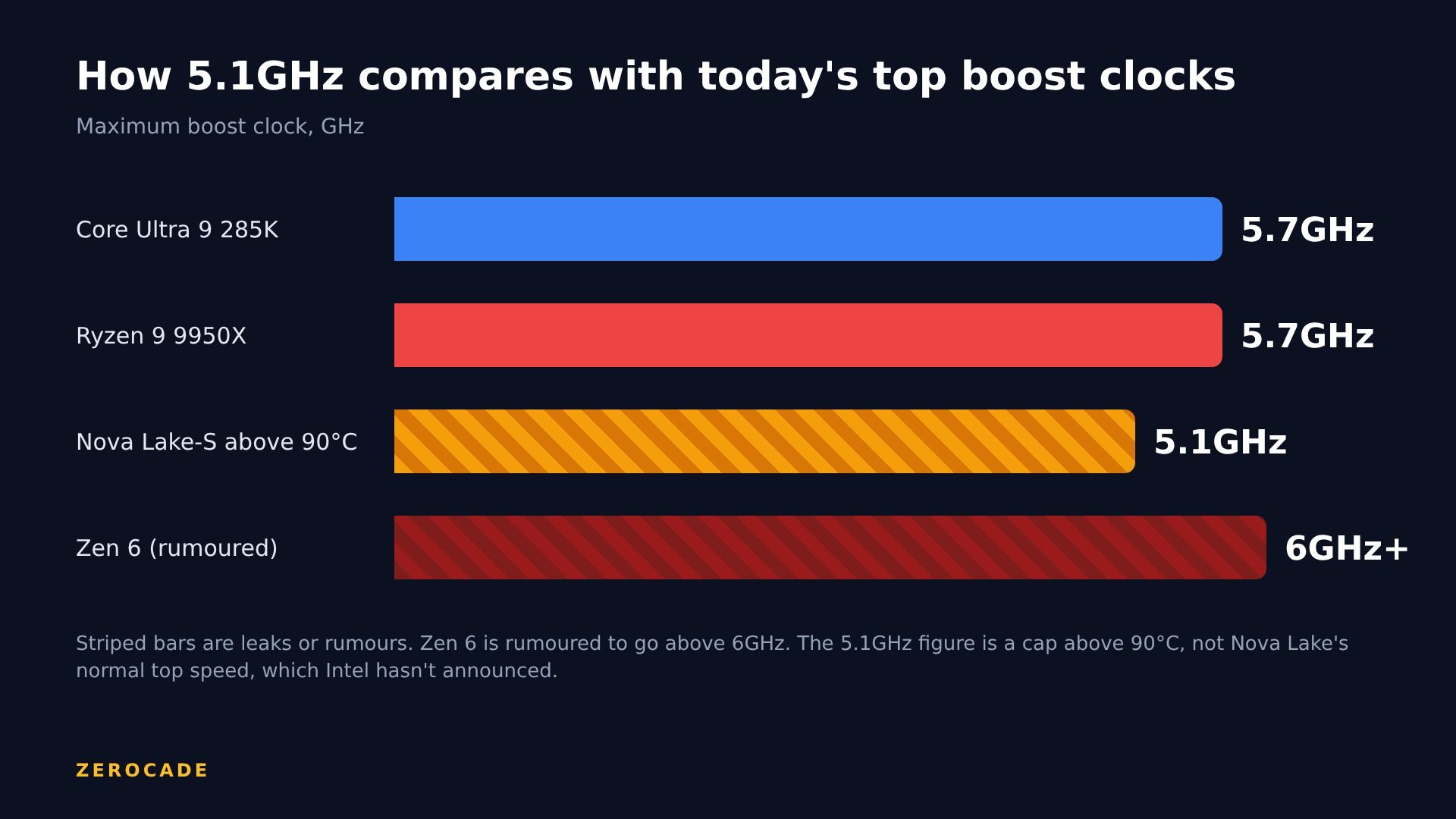
Image: Zerocade
If Nova Lake's top models boost well past 5.1GHz, a hot chip could lose a noticeable chunk of its peak speed. Tom's Hardware points out that AMD's next-generation Zen 6 desktop chips are rumoured to go above 6GHz, which could give AMD up to a 20% clock speed lead over a Nova Lake chip stuck at its cap.
There are reasons not to panic, though. Notebookcheck notes Nova Lake is expected to bring clear gains in IPC, the work a chip does per clock cycle, which could make up some of the difference. And plenty of games never push a desktop CPU anywhere near 90°C.
Why would Intel do this?
Nobody has an official answer, so these are educated guesses from the outlets that covered it.
Reliability. Notebookcheck suggests Intel may want to avoid a repeat of the Raptor Lake problems, when some 13th and 14th Gen chips degraded over time. Holding clocks down when a chip is very hot would reduce stress on it.
It's similar to something Intel already does. Tom's Hardware compares it to Thermal Velocity Boost, an existing Intel feature that adds a little extra clock speed, typically 100 to 300MHz, only when the chip is below a set temperature. The difference is that the Nova Lake rule would be a hard 5.1GHz ceiling, not a small bonus taken away.
It may rarely kick in. Tom's also notes Nova Lake's compute tiles are reportedly made on TSMC's N2P process without backside power delivery, which could make them easier to cool than some feared. Wccftech takes the other side, pointing to earlier reports that Nova Lake could run hot because of its 52-core top models and versions with extra cache, called bLLC.
When Nova Lake arrives
Intel has confirmed that parts of Nova Lake use its 18A-P process, which we covered in our post on Intel's Nova Lake confirmation. Notebookcheck expects a full reveal at CES 2027 in January. Tom's Hardware reports the first Core Ultra 4000 chips could launch at the very end of 2026 or early 2027, with the 52-core flagship and bLLC versions not until around summer 2027. Our guide to Intel's chip codenames explains where Nova Lake fits.
What it would mean for you
If the leak is right, cooling becomes part of the performance you pay for. A cheap cooler that lets the chip sit above 90°C under load would cost real speed, not just risk throttling. On paper, a solid air cooler or a 240mm or larger liquid cooler would be the safer bet for any high-end Nova Lake build.
Nothing here is final. The leak itself is labelled preliminary, and Intel could change the rule before launch. Watch for Intel's CES announcements in January, where official clock speeds should settle how much this cap really matters.