

The short version
- Old PC games break because the PCs and Windows versions they were built for are gone. They expect old graphics systems, old copy protection and much slower processors.
- Fixes usually come in layers: an emulator that pretends to be an old PC, a wrapper that translates old graphics code, a DRM-free build without disc checks, and patches for things like resolution and controllers.
- A restored release goes further, for example putting back better-quality video, as GOG did with Wing Commander: Prophecy this week.
- GOG's Preservation Program labels games that it has fixed and promises to keep working on future PCs.
Why a 1990s game won't just run
On a console, a game is made for one fixed machine. A PC game is made for whatever PCs existed when it came out, and those have changed enormously. A game from 1997 has never met a modern graphics card, a 64-bit version of Windows or a processor with 16 cores.
Here's what typically goes wrong.
It was written for DOS. Many games before the late 90s ran on MS-DOS, not Windows. Modern 64-bit Windows can't run DOS programs at all.
It talks to graphics hardware that no longer exists. Many late-90s games used 3dfx Glide, a graphics system for 3dfx's Voodoo cards, or very early versions of Microsoft's DirectX. Today's graphics drivers don't support Glide, and old DirectX code often misbehaves.
Its copy protection is now blocked. Disc-check systems like SafeDisc installed a low-level driver on your PC. Microsoft stopped those drivers from running in Windows 10 for security reasons, so many disc-based games from that era refuse to start even if you have the original CD.
It assumes a slow processor. Some old games tie their game speed to how fast the CPU runs. On a modern chip, they can run far too fast to play.
It looks and controls like 1997. Even when it runs, you might get a tiny 640x480 picture stretched across a 4K screen, and controls built for a keyboard or a joystick, with no support for a modern gamepad.
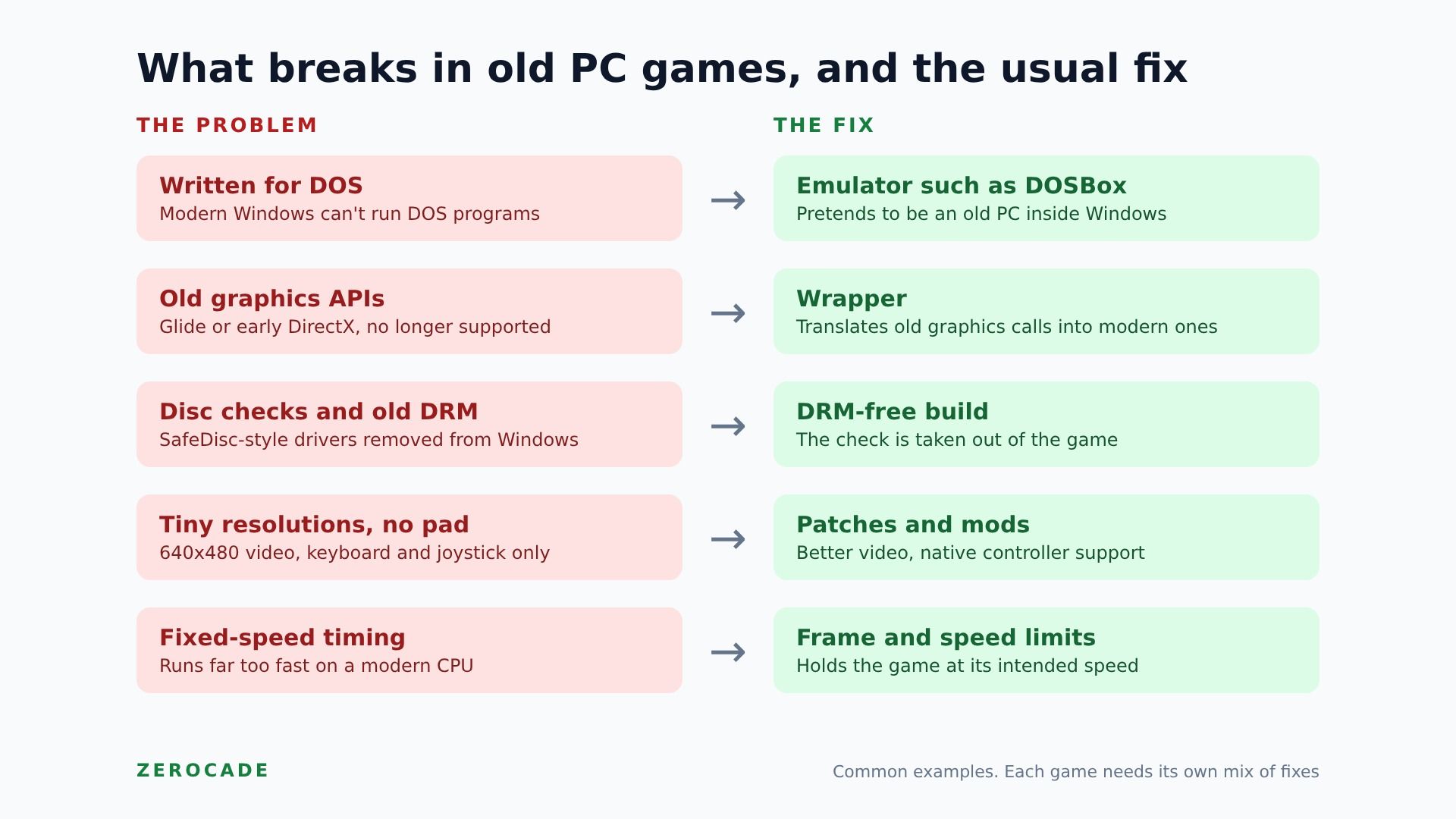
Image: Zerocade
The tools that fix them
Emulators. For DOS games, the common answer is DOSBox, an emulator that pretends to be an old DOS PC inside modern Windows, macOS or Linux. Point-and-click adventure games often use ScummVM, which replaces the original game engine entirely. Our guide on whether emulation is legal covers where the legal lines are.
Wrappers. A wrapper sits between the game and your graphics card. The game asks for Glide or old DirectX, and the wrapper quietly translates those requests into something modern drivers understand. Community tools like nGlide and dgVoodoo do this, and they often make old games look sharper than they ever did.
DRM-free builds. If the copy protection is the problem, the cleanest fix is a version of the game with the check removed. This is the whole basis of GOG, which sells games without DRM. It's the opposite approach to tools like Denuvo in modern games.
Patches and mods. Fans have spent decades fixing their favourite games, adding widescreen support, higher resolutions and controller support. When a game's source code is released, fans can go further and build a "source port", a rewritten version that runs natively on modern systems.
What "restored" adds
Getting a game to start is one thing. A restoration tries to make it feel right on modern hardware, sometimes better than the original.
GOG's work on Wing Commander: Prophecy, released on November 5, is a good example. GOG says it combined long-running fan mods with its own tools, worked with EA senior producer Jim Vessella, and got the game playing EA's digitised master copies of its video cutscenes. It also added native controller support. GOG has also fixed Nox, Westwood's 2000 action RPG, which had problems running on modern machines.
Restoration is different from a remaster. A remaster usually rebuilds art, sound or more on top of the old game. A restoration keeps the original game and fixes what stands between it and your PC. Our guide to remasters, remakes and ports explains those labels.
What GOG's Preservation Program is
GOG describes its Preservation Program as an official stamp on classic games that GOG has improved, with a commitment from GOG to keep them compatible with future PCs. So far it counts over 1,700 fixes across more than 300 games.

Image: GOG
That promise to maintain matters most. A fix that works on Windows 11 today could break with a future update. A label that commits a company to keep testing is more useful than a one-off patch.
GOG also keeps the original version available in its new Anniversary Editions. Each one includes the updated game plus the original "Legacy" build, so nothing is lost if a fix changes something you liked.
What to check before buying an old game
- Does it say how it runs? Store pages often mention DOSBox, ScummVM or fixes for modern systems. That's a good sign.
- Is it DRM-free? Old disc protection is one of the most common reasons classics fail.
- Does it support your controller and screen? Check the store page or community forums for widescreen and gamepad support before you pay.
If an old favourite is missing from modern stores, it may be stuck on rights issues rather than technical ones. That's a separate problem, and one restoration alone can't solve.