
The short version
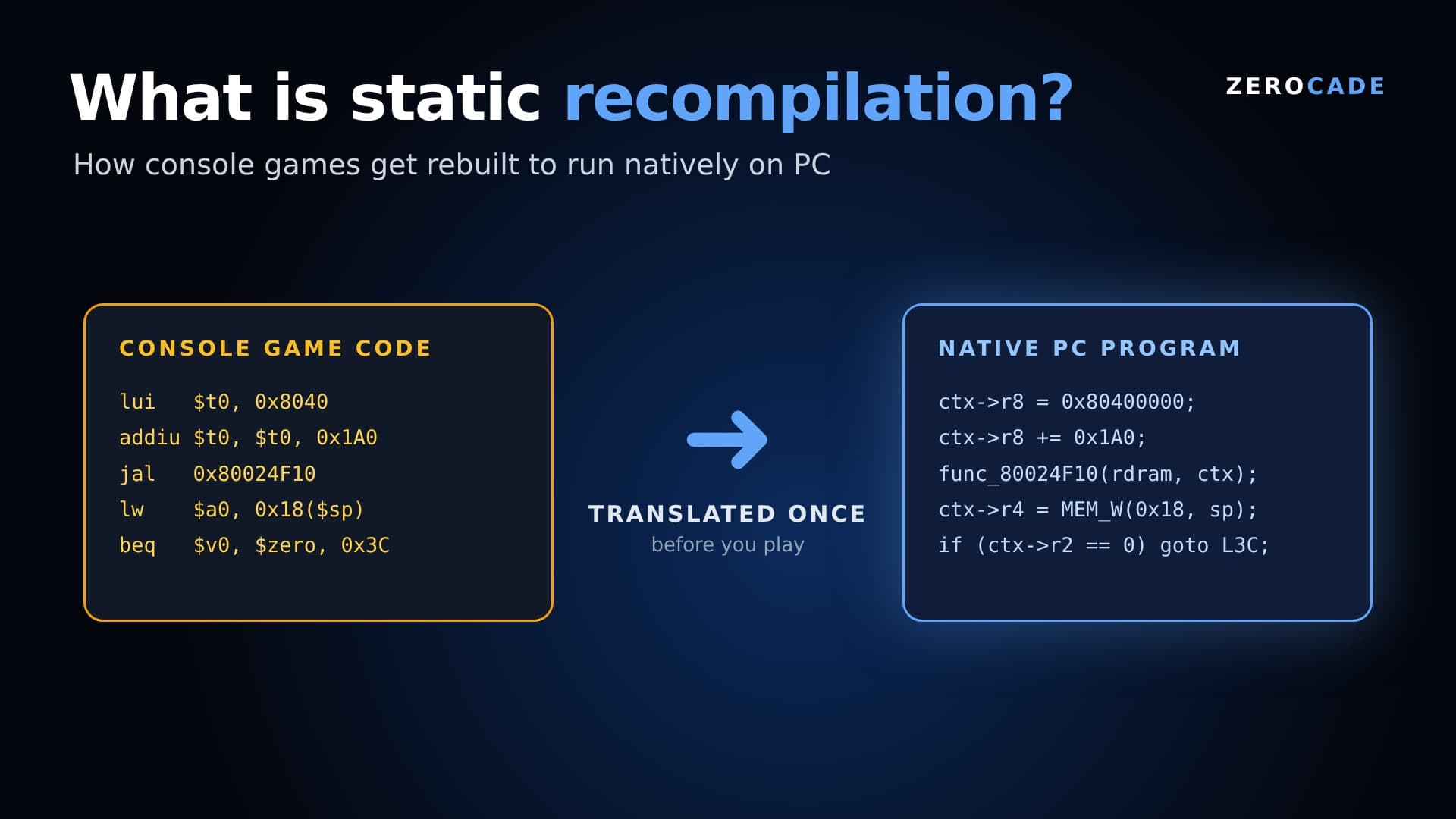
- Static recompilation translates a console game's code into a native PC program, once, before you play.
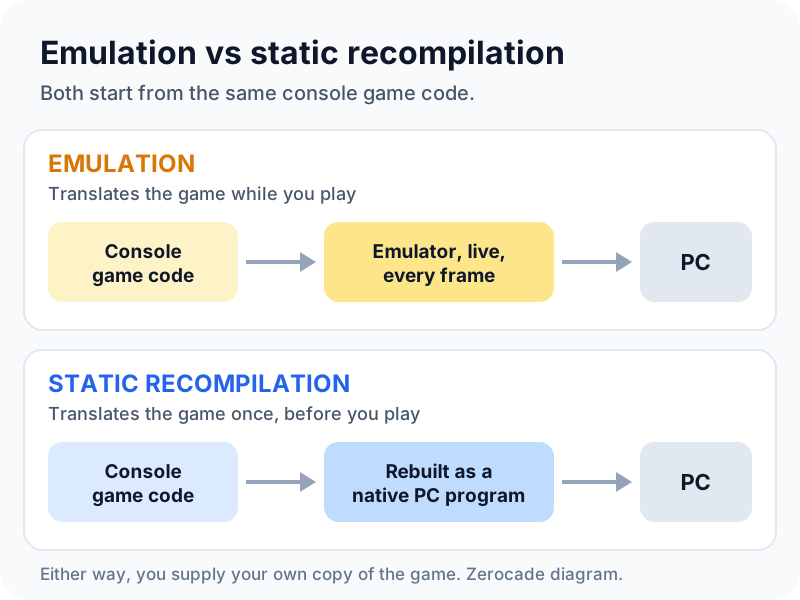
- Emulation does that translation while the game runs, which takes a lot more processing power.
- Fan projects like Zelda 64: Recompiled already work this way, and a Super Mario Odyssey project is in progress.
- Xbox has just formed Xbox Labs in response to games being "rapidly decompiled and rebuilt" for hardware they were never made for.
Emulation, the usual way
A console game is written for one specific chip. To run it on a PC, an emulator pretends to be that console. It reads each instruction the game gives and works out what a PC should do instead, live, every frame.
That works for a huge range of games, but it costs a lot of performance. It's why emulating newer consoles needs a powerful PC.
Recompilation does the work up front
Static recompilation translates the game's code ahead of time instead. The N64Recomp tool, for example, turns each piece of an N64 game into C code. That code can then be built for a modern PC, like any other program.
The result runs natively, so it's fast and easy to improve. Zelda 64: Recompiled, a fan port of Majora's Mask, supports any aspect ratio and any frame rate.
The catch is that each port only works for one game. The project's own page says it "is not an emulator and it cannot run any arbitrary ROM."
Not every port is a recompilation
Some projects are wrappers instead. The Azimuth wrapper for Forza Horizon 2 leaves the Xbox One game's code alone. It translates the game's requests for Xbox system features and graphics into ones Windows understands.
AnyPS5 is closer to emulation: it translates PS5 code and graphics as the game runs.
Why it's suddenly everywhere
Recompilation used to be slow, careful fan work. Now AI coding tools are speeding up the slow parts, and a Super Mario Odyssey port reportedly hits nearly 60fps on an RTX 3050 laptop in its opening area.
Xbox CEO Asha Sharma says these experiments challenge old ideas about how software and hardware fit together. Her new Labs team, led by CTO Scott Van Vliet, will "build in the open".
None of these projects include the game itself, so you need your own legal copy. Publishers often dislike fan ports, so some may not stay up long.
What to watch: what Xbox Labs builds first, and how Nintendo responds to the Mario Odyssey port.
Images: Zerocade.