


The short version
- A leaker claims AMD's future Siren Halo chip, a Zen 6 CPU with RDNA 5 graphics in its big Ryzen AI Max line, will have dedicated GDDR7 video memory. AMD hasn't said anything about it.
- Today's Halo chips, like Strix Halo, share one pool of laptop memory between the CPU and graphics. Siren Halo would reportedly keep that system memory and add separate, faster memory for graphics.
- On paper, that could double or quadruple graphics memory bandwidth. The cost is a smaller, fixed graphics memory pool and more expensive laptops.
- Treat it as an early rumour: the leaker is new, there are no specs, and Siren Halo is likely years away. Strix Halo laptops start at ₹1,99,990 in India today.
What the leak says
The claim comes from X account Gotou_kai3, who posted on November 12 that "Siren Halo has dedicated GD7 VRAM". GD7 is shorthand for GDDR7, the graphics memory used on Nvidia's RTX 50 cards.
When asked whether that meant one shared pool of GDDR7, the leaker said regular LPDDR laptop memory would still be there. So the claim is two separate pools:
- LPDDR system memory for the CPU and the rest of the system, as now.
- GDDR7 video memory dedicated to graphics.
That's all. There's no bus width, no capacity, no speed, no core or graphics unit count, and no launch date. It's also unclear whether the CPU could use the GDDR7 at all.
Where Siren Halo fits
AMD's Halo chips are its biggest laptop processors, built to put near-desktop graphics in a laptop or mini PC without a separate graphics card:
| Chip | Status | CPU / graphics | Memory |
|---|---|---|---|
| Strix Halo (Ryzen AI Max+ 395) | Out since early 2025 | 16 Zen 5 cores, 40 RDNA 3.5 units | Up to 128GB shared LPDDR5X, 256GB/s |
| Gorgon Halo (Ryzen AI Max 400) | Official, May 2026 | Same design, faster clocks | Up to 192GB shared LPDDR5X |
| Medusa Halo | Rumoured, 2027 at the earliest | Zen 6, RDNA 5 | Rumoured LPDDR6, around 460GB/s |
| Siren Halo | Rumoured | Zen 6, RDNA 5 | Rumoured LPDDR plus dedicated GDDR7 |
Wccftech describes Siren Halo as the true successor to Medusa Halo. Given that Medusa Halo itself isn't expected before late 2027, Siren Halo is likely 2028 or later, though no leak has given a date. Our Gorgon Halo explainer covers the current chips in detail.
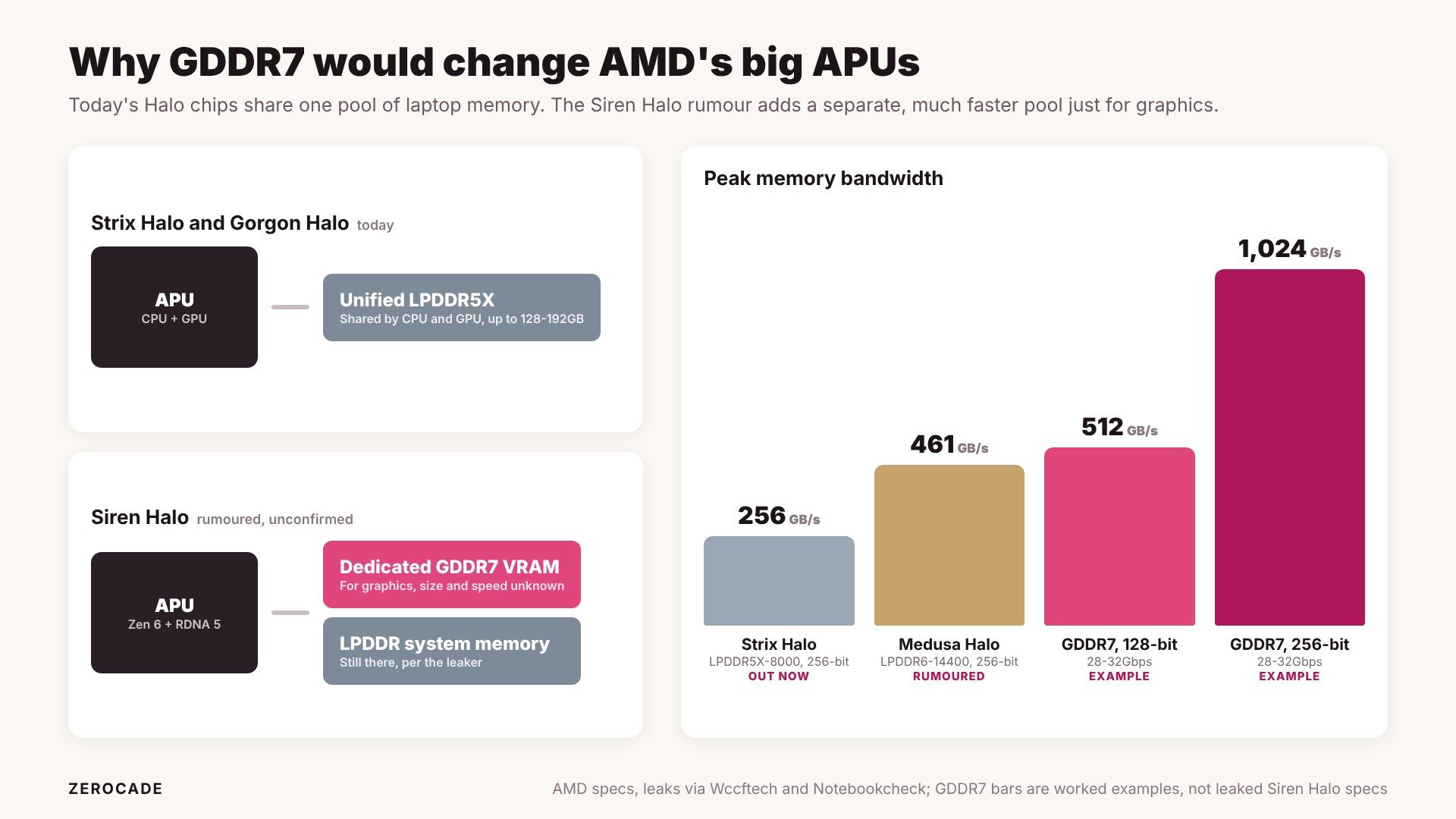
Image: Zerocade
Why GDDR7 would matter
Graphics performance on these chips is often held back by memory bandwidth: how fast data moves between the memory and the graphics processor. Laptop LPDDR memory is designed for low power and large capacity, not raw speed.
Here's the maths. Bandwidth is the bus width in bits, divided by 8, multiplied by the data rate:
- Strix Halo: 256-bit LPDDR5X at 8,000MT/s gives 256GB/s.
- GDDR7 on a 128-bit bus at 28-32Gbps gives 448-512GB/s, roughly double.
- GDDR7 on a 256-bit bus at 28-32Gbps gives 896-1,024GB/s, roughly four times as much.
Those GDDR7 figures are our worked examples, not leaked specs. For comparison, the PS5 has 448GB/s of shared GDDR6. Our unified memory explainer covers why today's laptops can game without a separate graphics card at all.
Image: ASUS
The trade-offs
GDDR7 isn't a free upgrade:
- Less flexible memory. Strix Halo's big selling point is that up to 96GB of its shared memory can go to graphics, and Gorgon Halo allows up to 160GB. That's huge for running local AI models. A fixed GDDR7 pool, built from 2GB or 3GB chips, would likely be far smaller. Wccftech flags this as the main downside.
- Cost. GDDR7 is expensive and scarce. In September, TrendForce relayed reports that a 3GB GDDR7 chip costs around $60-70. Our GDDR7 explainer explains why.
- Power and space. GDDR7 draws more power than LPDDR and needs room on the board next to the chip, which is hard in a thin laptop or handheld.
There's precedent for the idea. Intel's Kaby Lake-G chips in 2018 paired an Intel CPU with AMD Radeon graphics and their own 4GB of HBM2 memory, alongside normal system RAM. And AMD has been preparing: in September it added a "GDDR7" memory type to its Linux graphics driver, believed to be for RDNA 5.
How much to trust it
On paper, this is a moderate-confidence rumour at best:
- The leaker is new. UK site Club386 called Gotou an emerging leaker without a track record in October. Their earlier leak, on AMD's Ryzen Z3 handheld chips, is still unconfirmed.
- It's one post with no specs and no corroboration from established leakers yet.
- It's plausible. AMD's Linux GDDR7 work fits, and Wccftech rates the claim as "probable".
What Halo machines cost now
Strix Halo is still expensive, which is worth knowing before waiting years for Siren Halo:
- ASUS ROG Flow Z13: from ₹1,99,990 in India, and about ₹3,79,990 for the top Ryzen AI Max+ 395 with 128GB.
- HP ZBook Ultra G1a: $4,296 to $8,250 in the US. HP India lists it without a price.
- Framework Desktop: launched at $1,999 with 128GB, now listed at $3,449 as memory prices climb.

Image: HP
What to watch
Watch for established leakers to back up or knock down the GDDR7 claim, and for more AMD Linux patches mentioning GDDR7 support in its APUs. Medusa Halo comes first, so its memory setup will tell us a lot about where AMD is heading.