

The short version
- GDDR7 is the newest graphics memory, used on every RTX 50 card. It's faster than GDDR6 because it sends more data per clock tick.
- A card's VRAM comes from simple maths: one memory chip per 32 bits of memory bus, multiplied by the size of each chip.
- Most GDDR7 chips hold 2GB. Newer 3GB chips let the same card carry 50% more memory, which is how a 16GB RTX 5080 could become a 24GB one.
- 3GB chips are newer and in short supply, and AI data centres are buying memory as fast as it's made. That's why higher-VRAM cards keep getting delayed or repriced.
Why this matters right now
A new report says Nvidia has shelved a 24GB version of the RTX 5080 because 3GB GDDR7 chips cost too much. We covered the original 24GB rumour last month. To see why chip size decides a card like that, you need to know how graphics memory is put together.
What GDDR7 is
GDDR stands for graphics double data rate. It's the fast memory soldered around a graphics chip that holds textures, geometry and everything else a game needs to draw a frame. Our VRAM explainer covers how much of it games need.
GDDR7 was standardised by JEDEC, the body that sets memory standards, in March 2024. Its big change is how it sends signals:
| Memory | Signalling | Data per two clock cycles | Used in |
|---|---|---|---|
| GDDR6 | NRZ, two voltage levels | 2 bits | RX 9000, RTX 40 (some), PS5 |
| GDDR6X | PAM4, four levels | 4 bits | RTX 4090, RTX 3080 |
| GDDR7 | PAM3, three levels | 3 bits | RTX 50 series |
Three voltage levels let GDDR7 carry 50% more data per cycle than GDDR6, while staying easier to run reliably at high speed than four-level GDDR6X. Shipping cards run at 28Gbps, or 30Gbps on the RTX 5080. Samsung has 3GB chips reaching 40Gbps, and SK hynix is working towards 48Gbps.

Image: Micron
The maths behind your card's VRAM
Every GDDR7 chip connects to the graphics chip with a 32-bit channel. So the memory bus decides how many chips a card can have, and the chip size decides how much memory that adds up to.
- Count the chips: bus width ÷ 32. A 256-bit bus has room for 8 chips.
- Add up the memory: chips × chip size. Eight 2GB chips make 16GB.
- Work out the bandwidth: bus width × speed ÷ 8. 256 bits at 30Gbps gives 960GB/s.
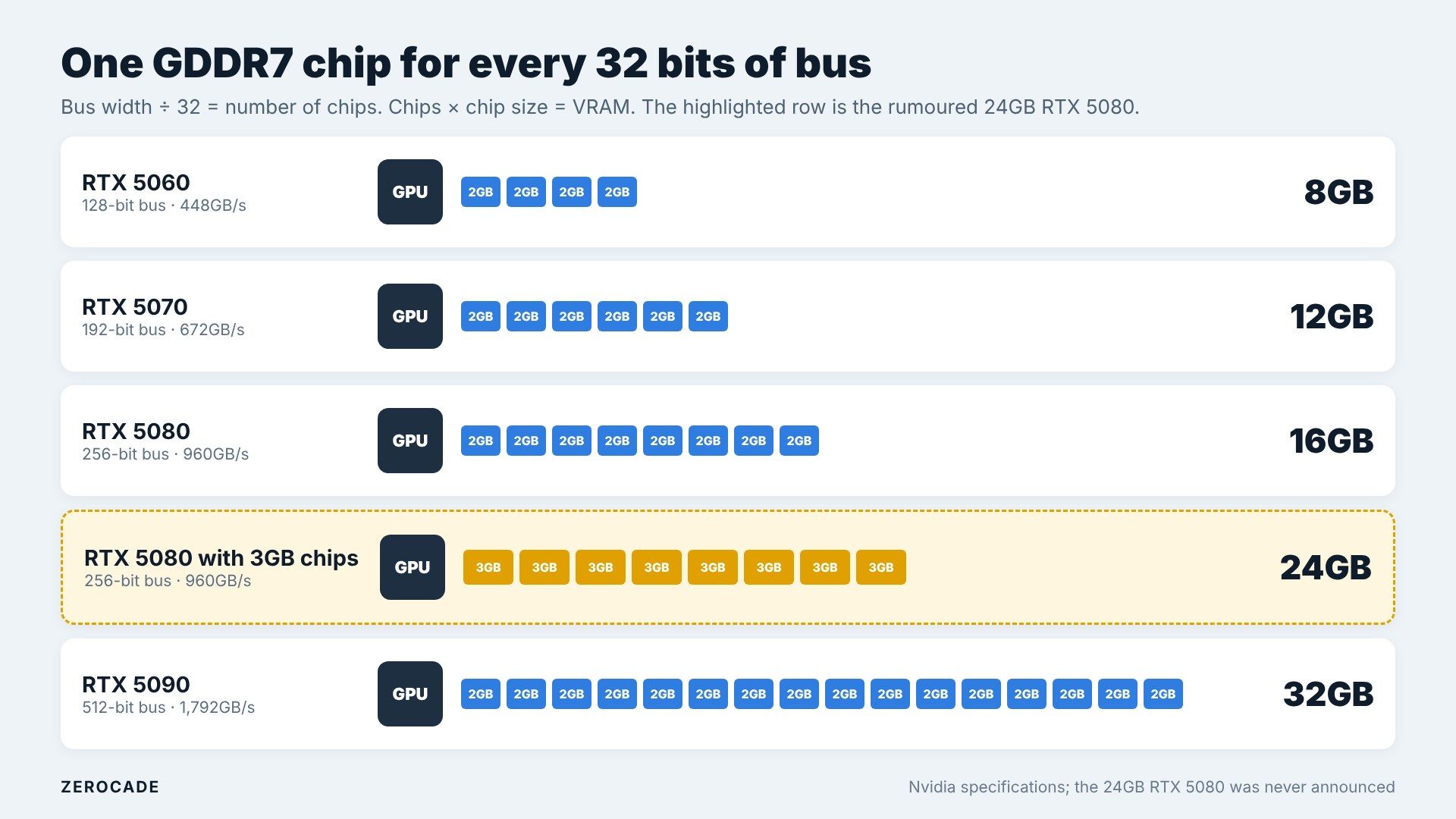
Image: Zerocade
Here's how that works on Nvidia's current cards:
| Card | Bus | Chips | VRAM | Bandwidth |
|---|---|---|---|---|
| RTX 5060 | 128-bit | 4 × 2GB | 8GB | 448GB/s |
| RTX 5070 | 192-bit | 6 × 2GB | 12GB | 672GB/s |
| RTX 5080 | 256-bit | 8 × 2GB | 16GB | 960GB/s |
| RTX 5090 | 512-bit | 16 × 2GB | 32GB | 1,792GB/s |
This is why card makers can't simply add 4GB to a card. The bus is part of the graphics chip itself. To get more memory, you need either bigger chips or two chips per channel.
Clamshell mode: two chips per channel
There's a workaround called clamshell mode. Each 32-bit channel is split between two chips, one on the front of the circuit board and one on the back.
The RTX 5060 Ti 16GB does exactly this: a 128-bit bus with eight 2GB chips instead of four. Memory doubles, but bandwidth stays at 448GB/s, because the bus is no wider. It also adds cost and makes the board more complex to cool.
Why 3GB chips change things
3GB chips (also called 24Gb, since memory is counted in gigabits) fit 50% more memory into the same package and the same 32-bit channel. No board redesign, no wider bus:
- RTX 5080: 8 × 3GB = 24GB, with the same 960GB/s bandwidth.
- RTX 5090 Laptop: already uses 8 × 3GB for 24GB on a 256-bit bus.
- RTX PRO 6000: 96GB, reportedly from 32 × 3GB chips in clamshell mode.
Samsung announced the first 24Gb GDDR7 in October 2024, and by April 2026 Samsung, SK hynix and Micron were all making them. They're built on the newest production lines, though, and those are in heavy demand. In September, TrendForce relayed reports that a 3GB chip costs about $60-70, against roughly $20 for a 2GB chip. That's around three times the price for 50% more memory, or roughly $320-400 more across the eight chips on one RTX 5080.

Image: SK hynix
Why memory prices hit graphics cards so hard
Memory makers are moving their best production lines to AI and server memory, where profits are higher. In January, Korean reports said GDDR6 and GDDR7 prices had risen several hundred per cent in months, and that memory now makes up a huge share of a graphics card's parts cost. Market tracker TrendForce said in September that graphics memory prices were still rising, with GDDR7 demand driven mainly by AI chips.
You can see it in shop prices. The RTX 5080 launched at ₹1,07,000 in India, but the cheapest in-stock listing we tracked last week was ₹2,69,000. Adding eight more gigabytes of the scarcest memory on top would push a 24GB card higher still.
AMD isn't immune. Its RX 9070 XT uses older GDDR6 on a 256-bit bus for 16GB, and leaks suggest next-gen consoles will move to 3GB GDDR7 chips too.
What to watch
When a new graphics card is announced, check two specs before the VRAM number: the bus width and the memory speed. Together they tell you the bandwidth, and whether the card used 3GB chips or clamshell mode to get its memory. And watch memory price reports from TrendForce: until graphics memory gets cheaper, 24GB mid-range cards will stay rare.