
The short version
- Chinese board partners, via the Channel Gate account, say Nvidia plans an RTX 5080 with 24GB of memory, launching in December 2026 or January 2027. Taiwan's Benchlife reported a Q1 2027 window on October 10. This is a rumour; Nvidia hasn't announced it.
- The same partners say the current 16GB RTX 5080 has been discontinued in China, and the 5080 is no longer listed on Nvidia's own marketplace.
- The trick is denser memory chips: 3GB GDDR7 modules instead of 2GB, on the same 256-bit bus.
- No price is known. With 16GB cards already at about ₹2,02,000 in India, don't expect a 24GB card to be cheap.
What's being reported
The latest claim came on October 30, 2026, from the Channel Gate account, which posts what Chinese add-in board makers (the companies like Asus, MSI and Zotac that build retail graphics cards) are hearing. Its message: Nvidia will swap the RTX 5080 16GB for a 24GB model, with a launch window of December to January.
This lines up with an earlier report. On October 10, Benchlife said a 24GB RTX 5080 was planned for the first quarter of 2027. Two sources pointing at the same card in roughly the same window makes this more than a one-off whisper. The exact date is still loose, though, and Nvidia doesn't comment on unannounced products.
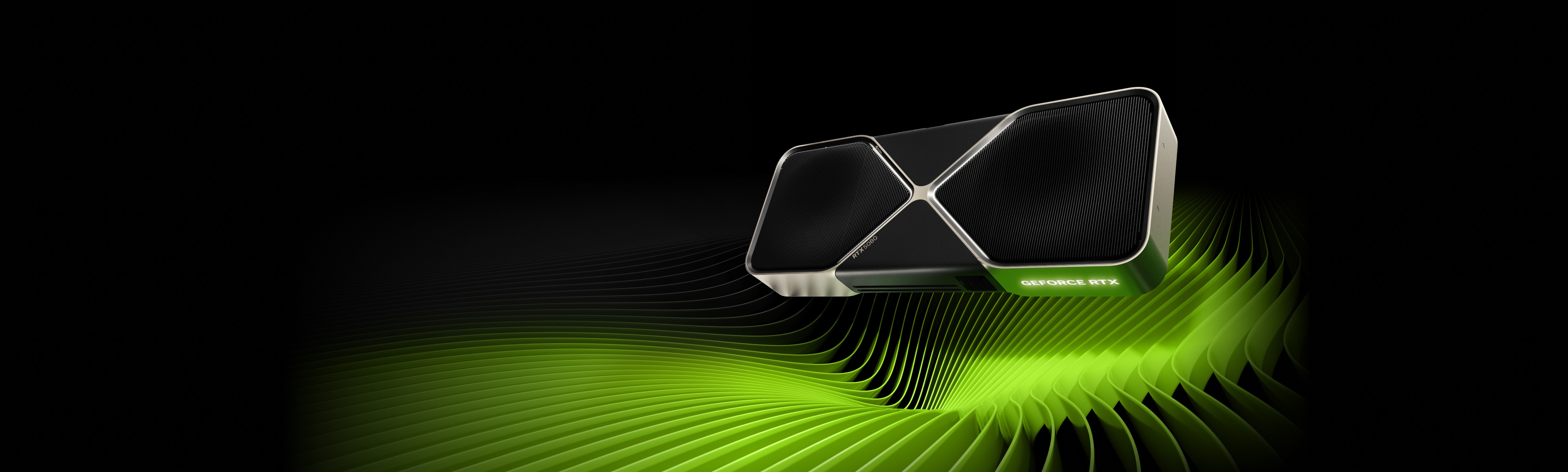
The context matters. The RTX 5080 has quietly gone from Nvidia's US marketplace, so the fastest GeForce card Nvidia itself lists is now the RTX 5070 Ti. The flagship RTX 5090 dropped off that listing in mid-October, though Nvidia has said the 5090 is not discontinued, just scarce. Reports say Nvidia is steering its biggest GB202 chips towards workstation RTX Pro cards.
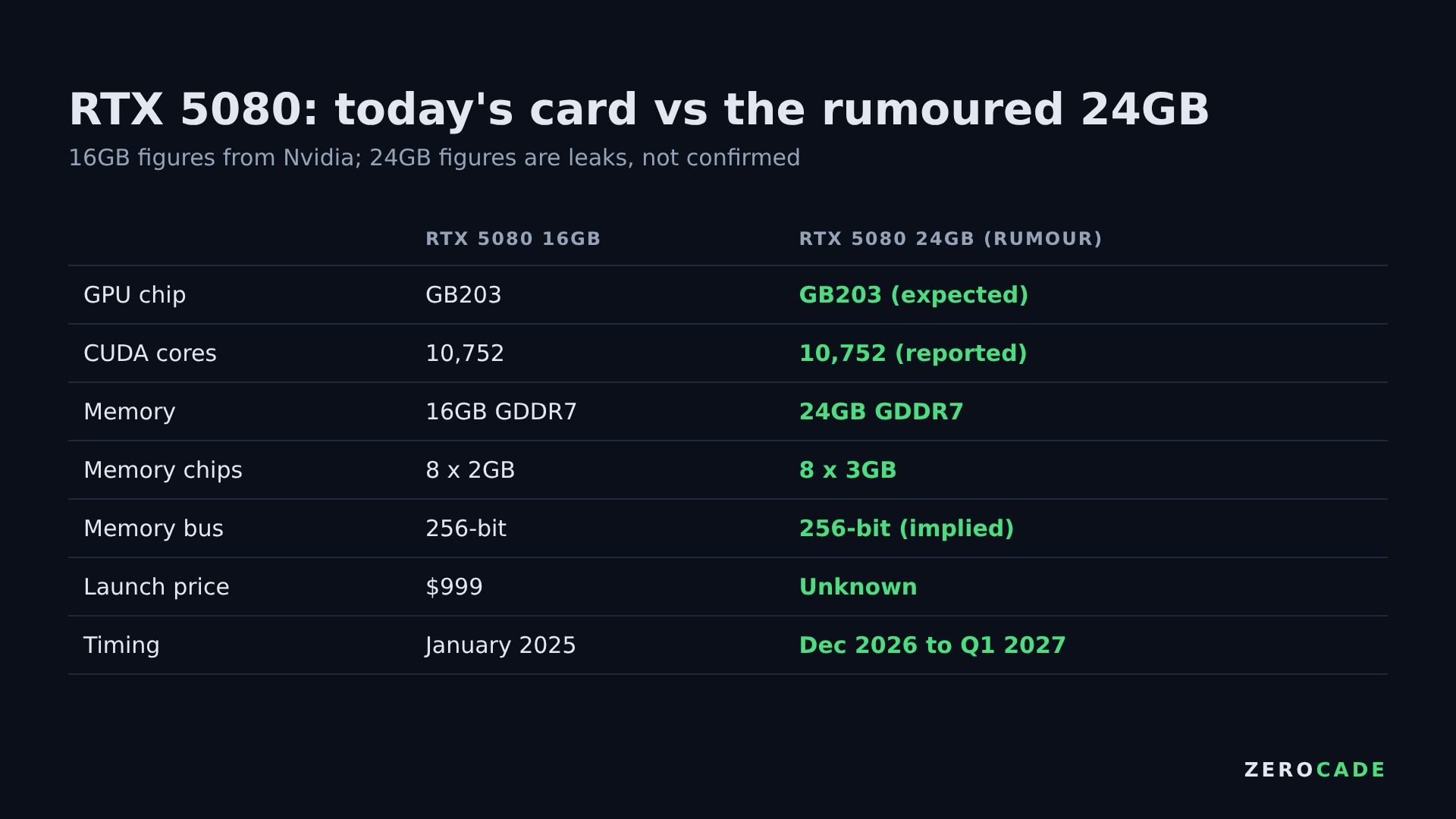
Image: Zerocade
How do you get 24GB on the same card?
A graphics card's memory is a ring of small chips around the GPU. Each one connects through a 32-bit slice of the memory bus. The RTX 5080's GB203 chip has a 256-bit bus, which means room for exactly eight memory chips.
Today each chip holds 2GB, so 8 × 2GB = 16GB. Samsung, SK hynix and Micron now make 3GB GDDR7 chips (Nvidia already uses them in the RTX 5090 laptop GPU and some RTX Pro cards). Put eight of those on the same board and you get 8 × 3GB = 24GB, with no change to the bus or the GPU.
That's why the rumour is plausible. Nvidia doesn't need a new chip. The leaks suggest the core stays the same, with 10,752 CUDA cores, so raw speed should be very close to today's 5080. What changes is how much the card can hold.
Does 24GB actually matter for games?
For most games at 1440p, 16GB is enough today. Where it starts to pinch is 4K with path tracing, high-resolution texture packs, and frame generation, which all eat video memory (VRAM). When a game runs out, it pulls data from slower system RAM and you get stutters or blurry textures that load late.
24GB gives a lot of headroom. On paper, it would make the 5080 a safer card to keep for four or five years. It would also appeal to people running local AI models, which can need far more memory than games, and that's partly why high-VRAM cards sell out.
What it won't do is make games run much faster where 16GB is already enough. If you're mostly at 1440p, the extra memory is insurance, not a speed boost.
Whatever happened to the RTX 50 Super?
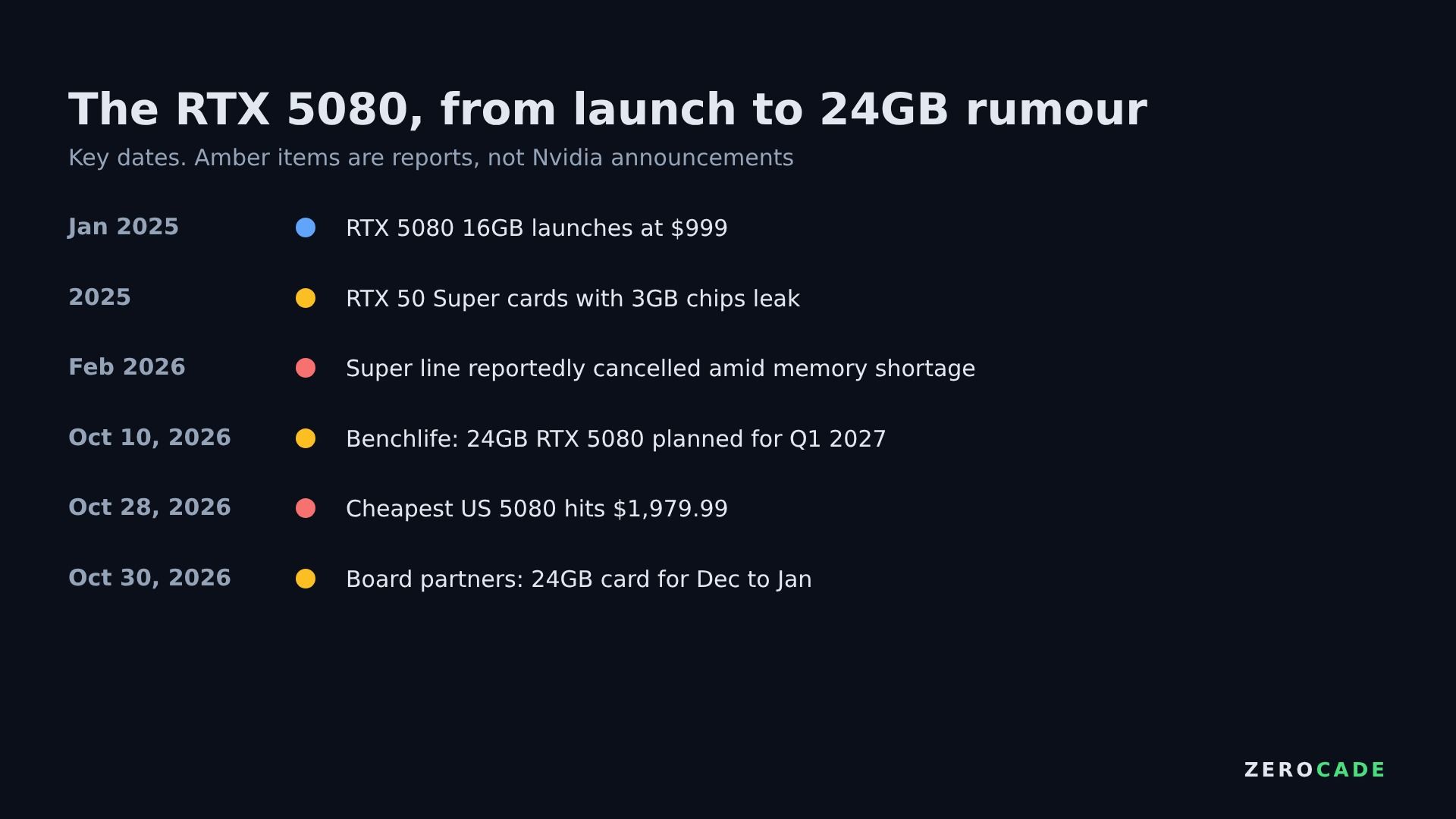
Image: Zerocade
A 24GB RTX 5080 sounds a lot like the RTX 5080 Super that leaks described back in 2025. That card was delayed, and in February 2026 it was reportedly cancelled, as a global memory shortage pushed up the price of GDDR7 and DRAM in general. Nvidia never officially announced or cancelled a Super line.
So if this card appears, it might not carry the Super name at all. The partners' claim is that it replaces the 16GB model rather than sitting above it, which is a different plan from a mid-life Super refresh.
What could it cost?
Nobody knows yet. Nvidia's launch price for the 16GB card was $999 (about ₹95,000 at today's rate), but the cheapest in-stock 5080 in the US hit $1,979.99 on October 28. US listings now run roughly $1,800 to $2,300. Wccftech guesses a 24GB card could land anywhere from $1,999 to $2,999, which is speculation, not a leak.
In India, price tracker GPU Prix had the cheapest in-stock 16GB card at ₹2,02,000 on October 28, against a 12-month median of about ₹1,59,500. We can't confirm any India price for a 24GB card, and since it uses more of the very memory that's in short supply, it's hard to see it undercutting today's cards.
What to watch for
If the December window is right, expect board partners' listings or box leaks to show up first, probably in China. Until then, if you're shopping for a high-end GPU, it's worth checking whether a 24GB 5080 is official before paying 2026 prices for a 16GB one.