
The short version
- A gaming laptop's speed is set mostly by power limits: how many watts the CPU and GPU are allowed to draw. Cooling decides how loud and hot the laptop gets while holding those limits.
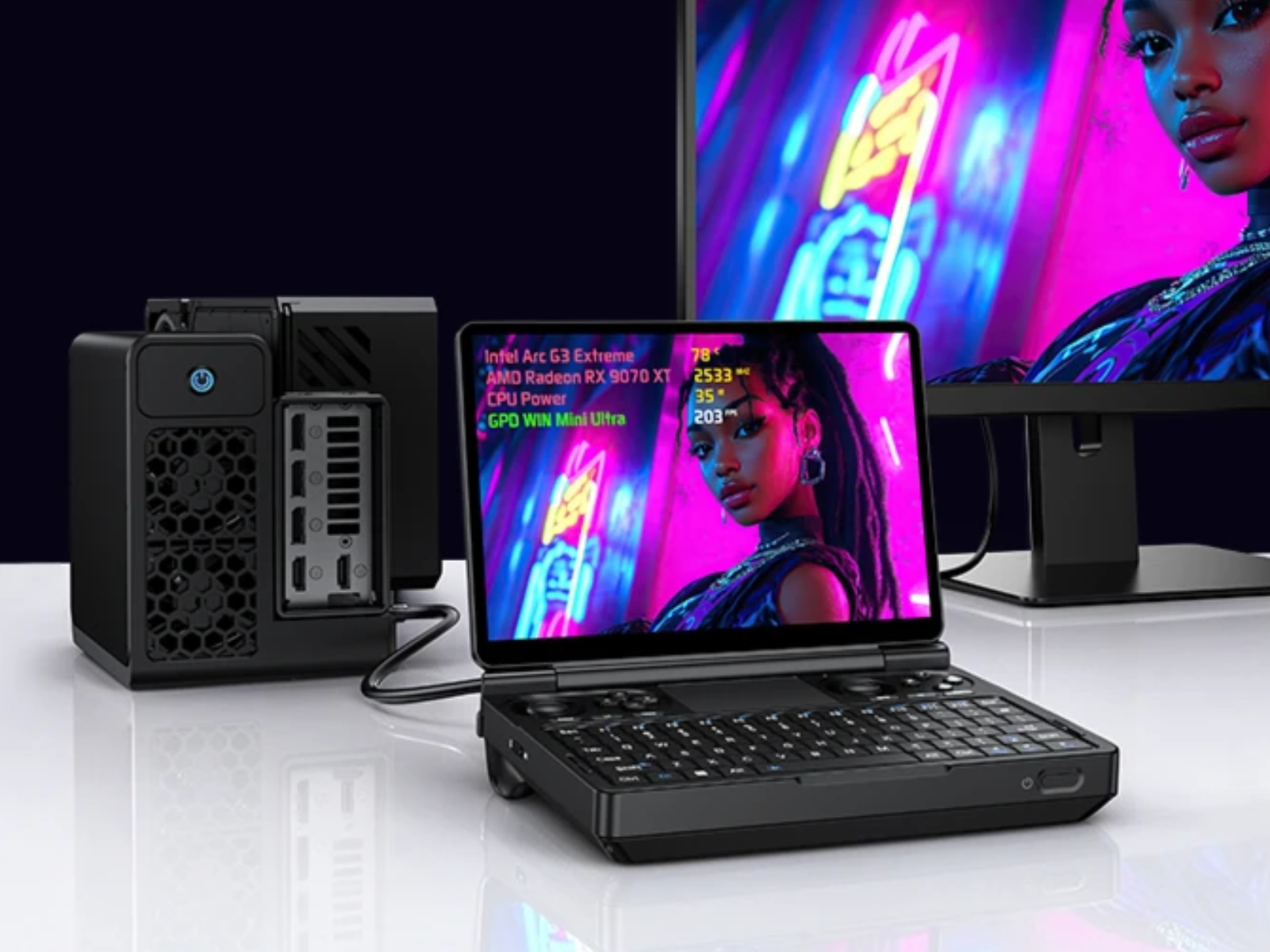
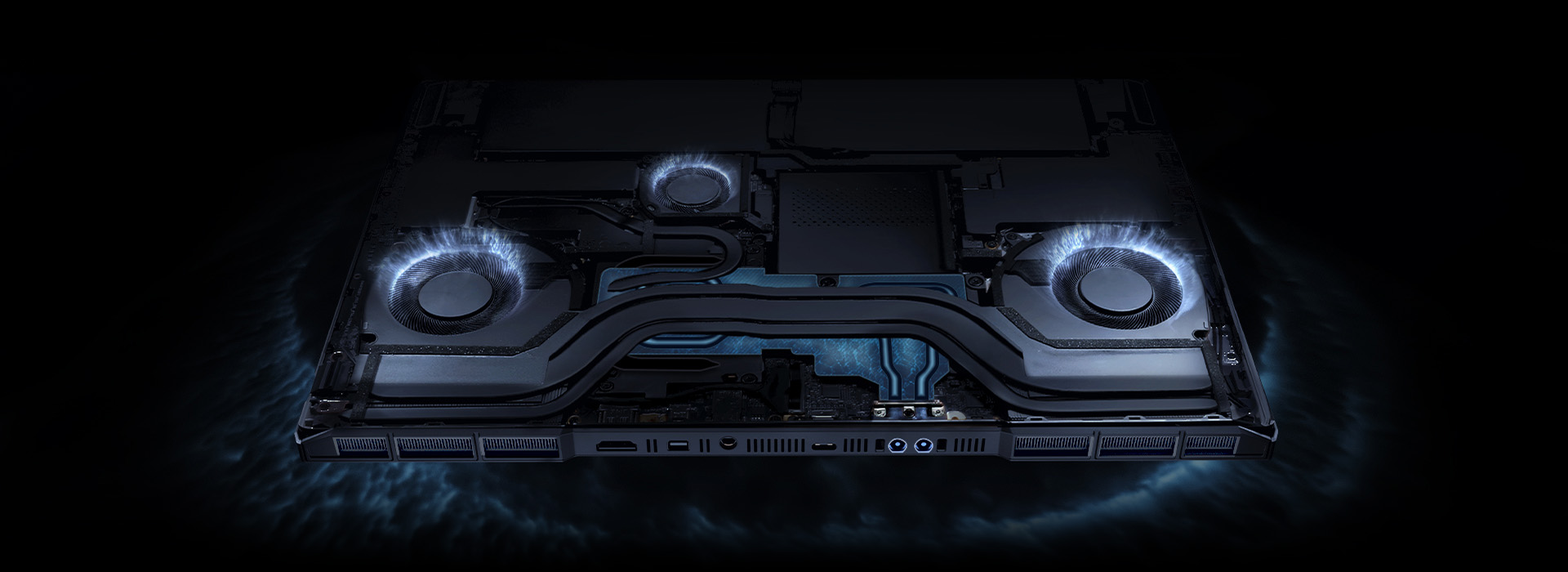
- XMG's Oasis is a small external box with a pump, a radiator and a 120mm fan. Coolant flows through two tubes into a metal pipe inside the laptop that's soldered to the heat pipes, then back out.
- In Notebookcheck's 2025 tests on the XMG Neo 16 E25, the Oasis cut peak noise from 55.4 to 50.5 dB(A) and raised Cyberpunk 2077 performance by about 3%, because the RTX 5090 was already at its 175W maximum.
- Neither XMG nor the Oasis is sold officially in India. The closest Indian example, Lenovo's liquid-cooled Legion 9i, launched here in January 2024 at ₹4,49,990.
Why this is in the news
Notebookcheck reviewed XMG's new Neo 16 M26 this week, with Intel's Core Ultra 9 290HX Plus and an RTX 5090 laptop GPU. The headline result: in its Balanced profile, the laptop stayed below 40 dB(A), quiet for this class of machine, while still keeping most of its gaming performance. That was on the laptop's own fans. Notebookcheck noted that you can connect XMG's external liquid cooler to make it quieter still, and that no other laptop maker offers that setup.
So it's worth looking at what that cooler actually does, and why it helps less than you might expect.
How laptop cooling normally works
Every gaming laptop moves heat in the same basic way:
- The chips make heat. The CPU and GPU sit under a metal cold plate, with thermal paste or liquid metal between them.
- Heat pipes carry it away. These are sealed copper tubes with a little liquid inside. The liquid boils at the hot end, the vapour travels to the cool end, condenses and flows back. Some laptops use a flat vapour chamber that works the same way over a wider area.
- Fans push it out. The heat pipes end in thin metal fins at the vents, and fans blow air through them.
The limit is that a thin laptop can only fit so many pipes, fins and fans. If heat comes in faster than it goes out, the chips get hotter, and the laptop either spins its fans louder or cuts power. Our explainer on thermal throttling covers that second part.
That's why gaming laptops have performance profiles. Each sets a power limit for the CPU and GPU, and the fans run as fast as needed to hold it. More watts means more speed and more noise.
 Image: XMG
How the Oasis plugs in
The Oasis adds a water loop on top of that normal system. According to XMG:
- Inside the laptop, a metal water tube is soldered to the heat pipes and runs over the CPU, GPU, voltage regulators and graphics memory. It holds about 20ml of coolant.
- On the back, a 2-in-1 quick-release connector lets you clip the tubes on and off. The latest version latches and seals itself so it doesn't drip when disconnected.
- The box holds a three-speed pump, a 160ml reservoir and a radiator with one 120mm RGB fan. The whole loop takes about 230ml of distilled water, and XMG includes a litre.
- Power comes from the laptop's own charger through a pass-through cable, which is why RTX 5080 and 5090 models ship with a 420W adapter.
- Safety: a flow sensor stops the pump if the tubes come off, and it's controlled over Bluetooth.
The Oasis Mk2 box measures 195 x 72 x 166mm and weighs 1.23kg filled. It costs €219 on its own from XMG's retailer Bestware.
The key point is that the laptop's fans and heat pipes still do most of the work. The loop is an extra exit for heat, so the fans can slow down. XMG says they drop to about half speed under load, with temperatures up to 15°C lower.
What it changes in tests
Notebookcheck tested the previous model, the Neo 16 E25 with an RTX 5090, with and without the Oasis in its fastest Overboost profile:
| Laptop fans only | With Oasis | |
|---|---|---|
| CPU power limit | 200W / 185W | 210W |
| GPU power | 175W | 175W |
| Peak noise | 55.4 dB(A) | 50.5 dB(A) |
| Cyberpunk 2077, QHD | 108.3 fps | 111.4 fps |
| Cinebench 2024 multi-core | 2,254 | 2,288 |
The GPU couldn't go faster because it was already at its 175W maximum, so gaming gained only a few frames. The real benefit was about 5 dB less noise, which is a clearly audible drop.
The CPU gains more. XMG's own figures for the new M26 show sustained CPU power in Cinebench rising from 159W to 199W with the Oasis, and CPU power in a combined CPU and GPU stress test going from 65W to 110W, while the RTX 5090 stays around 173W either way.
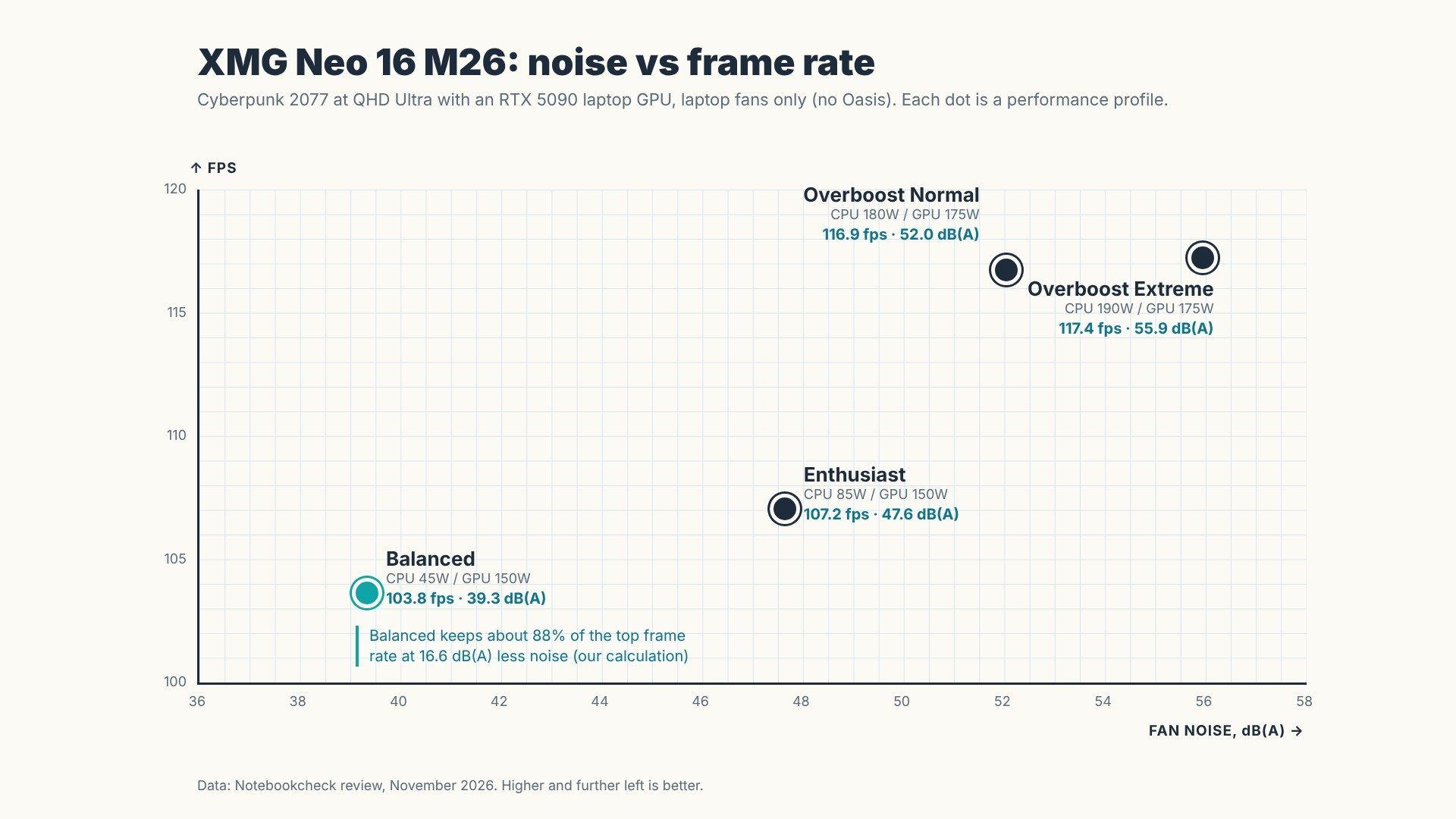 Image: Zerocade
That chart shows why the new review's quiet result matters more than the cooler. On air alone, the M26's Balanced profile ran the GPU at 150W and scored 103.8 fps at 39.3 dB(A), while the loudest profile reached 117.4 fps at 55.9 dB(A). By our calculation from those numbers, that's about 88% of the frame rate at a far lower noise level. Choosing a lower power limit does most of what liquid cooling does, for free.
Other ways laptop makers have tried this
- Asus ROG GX700 (2016): the first liquid-cooled laptop, which docked into a large base station with a pump and radiator to overclock a desktop GTX 980.
- Liquid metal (Asus, since 2019): not a water loop, but a replacement for thermal paste. Asus says it conducts heat about 17 times better and can lower temperatures by around 10°C. Many ROG laptops use it today.
- Lenovo Legion 9i (2023): a small loop built inside the laptop, made with Cooler Master, carrying about 10ml of coolant over the GPU and graphics memory. Tom's Hardware reported that a YouTuber's test found little difference with the pump on or off, apart from slowing how fast the graphics memory heated up. Lenovo's 2025 Legion 9i switched to a vapour chamber and four fans.
- Eluktronics (since 2023): sells US laptops with an external liquid unit and magnetic valve connectors, much like the Oasis.
- Colorful (August 2026): a China-only P16 Pro with a water-cooling dock, aimed at lower noise rather than more speed.
An external GPU, like Asus's ROG XG Mobile, is a different idea: it adds a whole graphics chip in a separate box rather than cooling the one inside.
 Image: Lenovo
What this means for buyers in India
XMG and its Oasis aren't sold officially in India. In Europe the Neo 16 M26 starts at €3,399, and Notebookcheck's top-spec review unit cost €5,800.
Lenovo's 16-inch Legion 9i with its built-in loop launched in India in January 2024 at ₹4,49,990 with an RTX 4090. Lenovo's air-cooled Legion Pro 7i with an RTX 5090 is listed at ₹2,49,990. On paper, the gap between those two prices says a lot about how much a liquid loop is worth.
For most buyers, the practical lesson is about settings rather than hardware. If a gaming laptop is too loud, a quieter performance profile usually costs only a small slice of frame rate.
What to watch next
Notebookcheck hasn't yet published tests of the new M26 with the Oasis connected, and XMG hasn't given a US price. If those numbers show a bigger gain on Intel's new CPU, external cooling will look more useful for heavy CPU work than for games.