

The short version
- A timed exclusive is a game that launches on one platform first and comes to others after an agreed period, usually 6 to 12 months. A console exclusive can still launch on PC on day one.
- These deals come in four main types: full exclusives, timed exclusives, content exclusives (extra missions, characters or early DLC) and marketing deals.
- Money changes hands. Court documents show Epic paid $115 million to keep Borderlands 3 off Steam for six months, and a US judge cited Sony paying to keep Final Fantasy XVI off Xbox.
- In 2026 both Sony and Xbox are moving back toward exclusives, so "it'll come to PC eventually" is no longer a safe bet. In India, that matters when you're choosing between a ₹69,990 PS5 and a PC.
Why this comes up now
When Sony revealed the Star Wars: Knights of the Old Republic Remake in September 2021, the PlayStation Blog said it would be "a console exclusive on PlayStation 5 at launch". With a re-reveal now rumoured for The Game Awards on December 10, that phrase is worth unpacking.
Read carefully, it promises three things. The game skips other consoles at first, so PC is allowed. The exclusivity applies at launch, so it ends at some point. And it doesn't say how long that point is. That's the typical shape of a timed exclusive.
The four kinds of exclusive
1. Full exclusives
The platform owner makes the game itself, or pays for it to exist at all. Sony's first-party games like Ghost of Yotei and Marvel's Wolverine fall here, as does Xbox's Gears of War: E-Day.
Third-party full exclusives are rarer. The best-known case is Bayonetta 2. PlatinumGames said in 2014 that the game wouldn't exist without Nintendo funding it, which is why it, and later Bayonetta 3, only appeared on Nintendo consoles.
2. Timed exclusives
A third-party game launches on one platform first, and the deal has an end date. The publisher keeps the rights and ships elsewhere later.
Phil Spencer put it simply when Microsoft signed Rise of the Tomb Raider in 2014: "Yes, the deal has a duration. I didn't buy it. I don't own the franchise." The game reached PC in February 2016 and PS4 in October 2016.
 Image: Square Enix
Final Fantasy XVI is a clean example. A PlayStation trailer in November 2022 said in small print that the game would be a "PS5 exclusive for six months". It launched on PS5 on June 22, 2023, but reached PC only on September 17, 2024, about 15 months later, and Xbox in June 2025. Six months was the minimum, not a promise.
3. Content exclusives
The whole game comes out everywhere, but one platform gets something extra. Spider-Man was a PlayStation-only hero in Marvel's Avengers in 2020, which the studio explained came down to its relationship with PlayStation and Marvel.
Call of Duty did this for years. From Black Ops 3 in 2015 until the deal ran out in November 2024, PlayStation players got map packs early, earlier beta access and timed exclusive operators and bundles. Since Microsoft bought Activision, it has promised the same content for every platform.
4. Marketing deals
These cost less and change nothing about the game. The platform holder's logo appears at the end of trailers, and its ads show the game. The PlayStation and Call of Duty partnership started as one of these and grew to include content. After it ended, Push Square reported that Sony put its money behind Battlefield 6 instead.
How long do exclusive windows last?
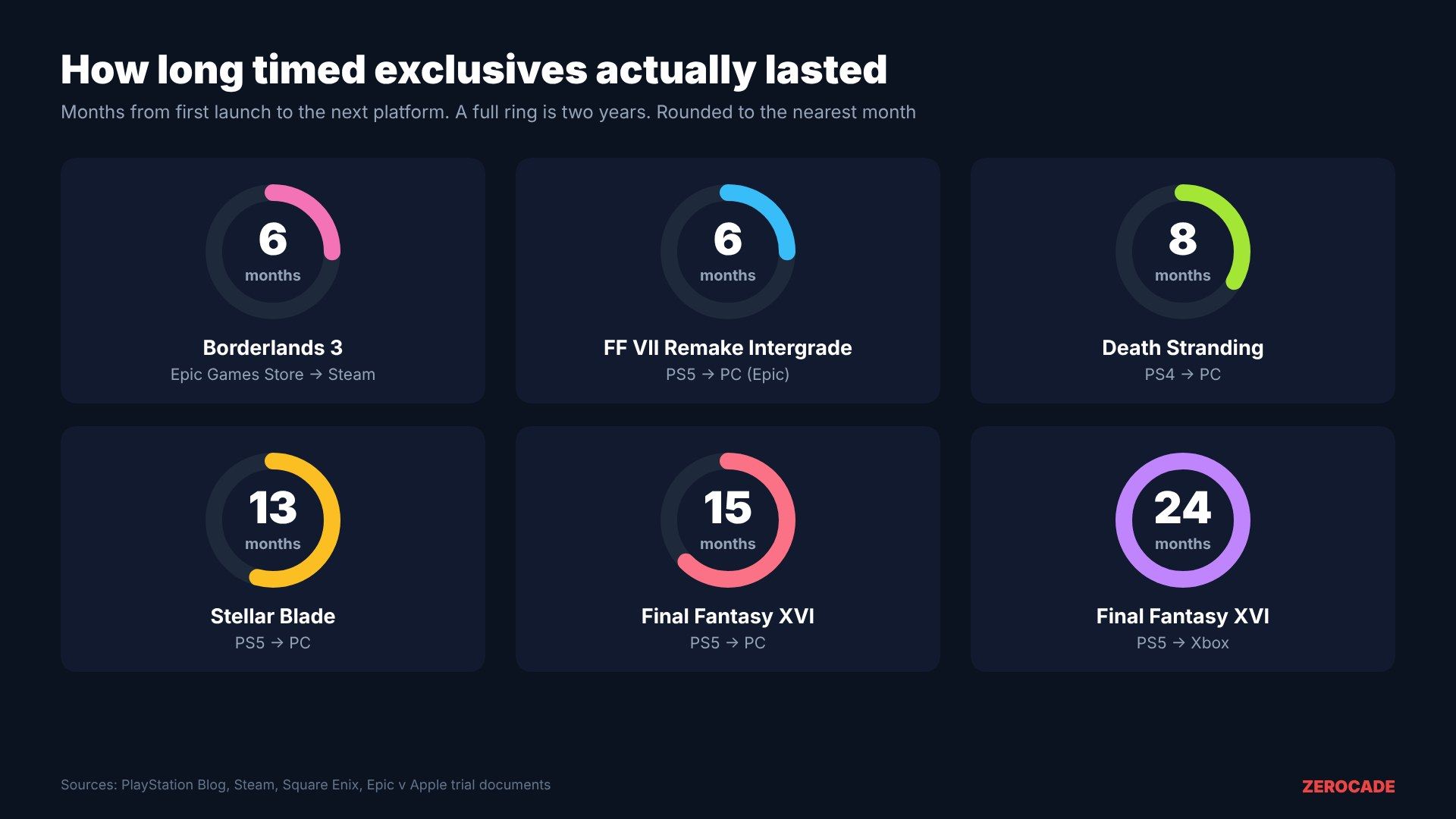 Image: Zerocade
Typical windows run from about six months to a year, but the real wait is often longer:
| Game | First launch | Next platform | Wait |
|---|---|---|---|
| Death Stranding | PS4, Nov 8, 2019 | PC, Jul 14, 2020 | About 8 months |
| Final Fantasy VII Remake Intergrade | PS5, Jun 10, 2021 | PC (Epic), Dec 16, 2021 | About 6 months |
| Final Fantasy XVI | PS5, Jun 22, 2023 | PC, Sep 17, 2024 | About 15 months |
| Stellar Blade | PS5, Apr 26, 2024 | PC, Jun 11, 2025 | About 13 months |
| Borderlands 3 (store exclusive) | Epic Games Store, Sep 2019 | Steam | 6 months |
Final Fantasy VII Remake shows how exclusive windows stack. It went from PS5 to the Epic Games Store, then six months later to Steam, and only reached Xbox and Switch 2 in January 2026.
Who pays whom, and how much
Platforms rarely publish these numbers, but court cases have revealed some.
Epic's PC exclusives came out during the Epic v Apple trial in 2021:
| Game | What Epic paid or guaranteed |
|---|---|
| Borderlands 3 (6 months) | $115 million in total, including an $80 million minimum guarantee |
| Metro Exodus | $37 million minimum guarantee; it earned back less than a third |
| Satisfactory | $11.5 million guarantee; it earned $11.6 million, the only one in that batch that paid off |
A "minimum guarantee" means Epic promises the publisher a set amount of sales revenue. If the game sells less, Epic covers the gap.
Console deals came up in the 2023 FTC case against Microsoft's Activision purchase. Judge Jacqueline Corley's ruling said Final Fantasy XVI was a PlayStation exclusive because Sony paid to keep it off Xbox. Phil Spencer testified that Sony had paid Bethesda to keep Deathloop and Ghostwire: Tokyo off Xbox, and that the fear of the same thing happening to Starfield was part of why Microsoft bought Bethesda. Microsoft still honoured those two PS5 deals after the purchase.
Microsoft also told Brazil's competition regulator in 2022 that Sony pays for "blocking rights" to keep some games off Game Pass. No dollar figures for Sony's console deals have been made public.
How to read the wording
 Image: Kojima Productions / 505 Games
Here's what the common phrases usually mean on paper:
- "Console exclusive" means other consoles are excluded, but PC often isn't. Gears of War: E-Day is an "Xbox console exclusive" and launched on PC the same day.
- "At launch" or "console launch exclusive" means it's timed, with no length promised.
- "PS5 exclusive for six months" sets a minimum window, often only in trailer small print.
- "Only on PS5" sounds permanent but hasn't always been. The PlayStation Blog headline for Stellar Blade said it "arrives only on PS5" in 2024, and it came to PC in 2025.
Neither the PlayStation Store nor the Xbox Store labels games as "timed", so the announcement wording is often all you get.
Why exclusives are coming back in 2026
For a few years the trend went the other way. Xbox brought Pentiment, Hi-Fi Rush, Grounded and Sea of Thieves to PS5 in 2024, then Indiana Jones and Forza Horizon 5 in 2025. Sony released many of its single-player games on PC.
2026 reversed both. In March, Bloomberg reported that Sony would stop porting its big single-player games to PC, with Ghost of Yotei staying on PS5. In June, Xbox said Gears of War: E-Day would be an Xbox console exclusive, and its leaders said Xbox needs "a reliable pipeline of exclusive games". In November, the "PlayStation Exclusive" badge reappeared on some PlayStation.com pages, as we reported earlier this month.
Third-party publishers are moving the other way. Square Enix has said it will pursue multiplatform releases "aggressively", and Final Fantasy VII Revelation is set to launch on every platform at once in spring 2027.
What this means if you're buying in India
Exclusives matter more here because consoles cost so much. Reliance Digital lists the PS5 standard edition at ₹69,990 and the digital edition at ₹64,990. Xbox Series S was ₹34,990 and Series X ₹55,990 before Microsoft's global price rise in August; new Indian prices haven't been confirmed.
PC has been the escape route from timed exclusives, and these games now sell for modest prices on Steam India:
| Former console exclusive | Steam India price |
|---|---|
| Final Fantasy VII Remake Intergrade | ₹2,499 |
| Final Fantasy XVI | ₹3,499 (₹1,399 in the current sale) |
| Stellar Blade | ₹4,799 (₹3,215 in a weekend deal ending Dec 1) |
| Death Stranding Director's Cut | ₹2,499 |
| Rise of the Tomb Raider | ₹1,499 |
Prices were checked on November 21. The catch in 2026 is that the escape route is narrowing. Sony's own big single-player games may no longer come to PC, so if Ghost of Yotei or Wolverine is the reason you want to play, a PS5 is the safer buy.
What to watch next
At The Game Awards, listen for the exact wording. "Console exclusive at launch" means you'll probably get it elsewhere later. "Only on" plus a first-party studio means you probably won't. And before buying a console for one third-party game, check whether the deal is timed, since the PC version may arrive cheaper a year later.