

The short version
- Atlus producer Kazuhisa Wada says large RPGs like Persona take five years or more to make. Persona 6 has reportedly been in development since around 2021 and still has no release date.
- A big game goes through pre-production (working out what the game is), production (building it), then testing and polish. Production is the longest and most expensive part.
- Teams and budgets have grown hugely. Persona 5 had about 70 people. Spider-Man 2 peaked at 264 developers and cost around $300 million.
- Studios that reuse engines, worlds and teams ship much faster. Sega's RGG Studio released 10 new Like a Dragon games in the time Rockstar released two.
Why this is in the news
In an interview in Sega Sammy's own investor series, reported on November 20, Wada said large-scale RPGs like Persona "take five years or more to develop", which is why there can be long gaps between numbered entries. He confirmed the team's current project is Persona 6, said it "is not the end", and promised that fans won't have to wait as long for the next one.
Persona 6 was revealed at the Xbox Games Showcase in June, for Xbox Series X|S and PC first with day-one Game Pass, and PS5 and Steam later. There's no release window. Persona 5 came out in Japan in 2016, so by the time 6 arrives the gap will be more than a decade.
 Image: Atlus
The stages of making a game
Every studio names them a little differently, but the broad stages are the same.
- Concept. A small group decides what the game is: genre, setting, the core idea. This can overlap with the end of the previous game.
- Pre-production. Still a fairly small team, building prototypes to test whether the ideas are fun, choosing or building the engine, and writing the design document. Insomniac started pre-production on Spider-Man 2 in 2018, five years before its October 2023 launch.
- Production. The team grows to full size and builds everything: levels, characters, animation, code, music, voice acting. This is where most of the time and money goes.
- Alpha and beta. Alpha usually means every feature is in, even if rough. Beta means the game is content-complete and the team is fixing bugs.
- Certification and launch. Sony, Microsoft and Nintendo check the game against their technical rules before it can go on sale.
- Post-launch. Patches, updates and DLC, which often keep part of the team busy for years.
Problems in any stage push everything after it back. If pre-production doesn't land on a fun core, production starts late or starts over.
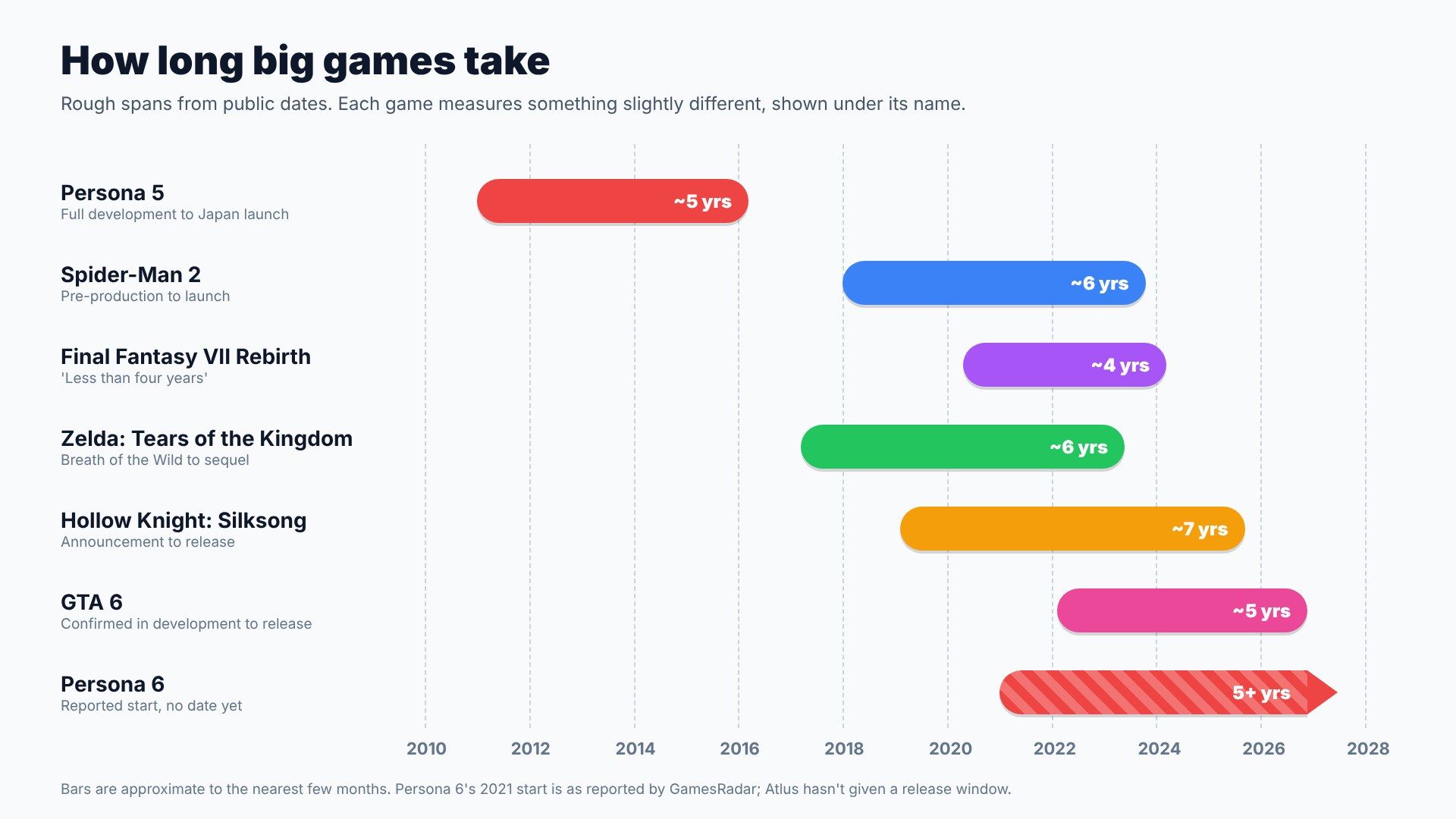 Image: Zerocade
Why it takes longer than it used to
Bigger teams
More detail needs more people, and more people need more coordination. Some sourced team sizes:
| Game | Team |
|---|---|
| Persona 5 (2016) | About 40 at the start, about 70 in full production |
| Spider-Man 2 (2023) | 264 developers at peak, plus 116 support staff |
| Baldur's Gate 3 (2023) | About 400, almost 10 times the team on Divinity: Original Sin |
Adding people doesn't make a game proportionally faster. A team of 400 spends far more time in meetings, reviews and handovers than a team of 40.
Bigger budgets
The UK's competition regulator reported in 2023 that a big AAA game now costs about $200 million to develop, and a Call of Duty about $300 million, against $50 to 150 million for the biggest games five years earlier. One unnamed publisher had spent $660 million on development plus about $550 million on marketing for a single game.
Leaked Insomniac documents from December 2023 gave rare detail. Spider-Man 2 cost around $300 million, against an original budget of about $270 million, and needed 7.2 million sales to break even. Its cutscenes alone cost over $40 million. Ratchet & Clank: Rift Apart, by comparison, cost $81 million.
Bigger budgets mean higher stakes, so publishers are less willing to ship something unfinished. That leads to delays rather than cuts.
New engines and technology
Persona 5 is a good example. Atlus's previous game, Catherine, used an outside engine, so the team built a new in-house one for Persona 5. Combined with a move from PS3 to PS4, that helped push Persona 5 from a planned 2014 release to 2016 in Japan.
Delays that stack up
GTA 6 is the extreme case. Rockstar confirmed it was in development in 2022, showed the first trailer in December 2023, then delayed it from fall 2025 to May 2026 and again to November 19, 2026, when it finally launched. GTA 5 had come out in 2013. Hollow Knight: Silksong was announced in 2019 and released on September 4, 2025, after Xbox had once listed it as coming by June 2023.
The pandemic added to it. In GDC's 2021 survey of over 3,000 developers, 44% said Covid had delayed their game.
 Image: Atlus
How studios speed it up
The fastest big studios have one thing in common: they don't start from zero.
- Reuse the world. Sega's RGG Studio keeps rebuilding the same Tokyo district, Kamurocho, and builds each game on the last. Studio director Masayoshi Yokoyama has said that approach is probably unique to them. Like a Dragon: Infinite Wealth was its 10th new game in the decade Rockstar spent making two.
- Keep the team together. Square Enix kept 80 to 90% of the Final Fantasy VII Remake team for Rebirth, which took less than four years. Director Naoki Hamaguchi has suggested the third part could take about three.
- Reuse the map, change the toys. Zelda: Tears of the Kingdom used Breath of the Wild's Hyrule. Nintendo's developers said putting new ideas into the same world was harder than starting fresh, but it still avoided rebuilding the whole map.
- Make smaller games in between. Insomniac's documents said mid-sized games take about two years less than its tentpoles. Atlus does the same with remakes like Persona 3 Reload and the upcoming Persona 4 Revival, and split its team to make Metaphor: ReFantazio.
That last point is probably what Wada means by a shorter wait for Persona 7: with Persona 6's engine and tools built, the next one doesn't need to start from scratch. On paper, at least.
What it means for players
Long development isn't always a bad sign. Some of the best-received games, like Baldur's Gate 3 and Tears of the Kingdom, took years. But it does mean announcements come earlier, delays are common, and a "coming soon" can mean two years.
What to watch next
Watch for Atlus's next Persona 6 update. Persona 4 Revival arrives on February 18, 2027, and Atlus may hold back big Persona 6 news until that launch is done, though it hasn't said so. Whether Persona 7 really arrives faster will show if Wada's promise holds.