
The short version
- Lenovo's ThinkBook 14x Gen 2 is now on sale in the UK from £1,129.99 with Intel's Core Series 3 chips, codenamed Wildcat Lake, and claims up to 27 hours of video playback.
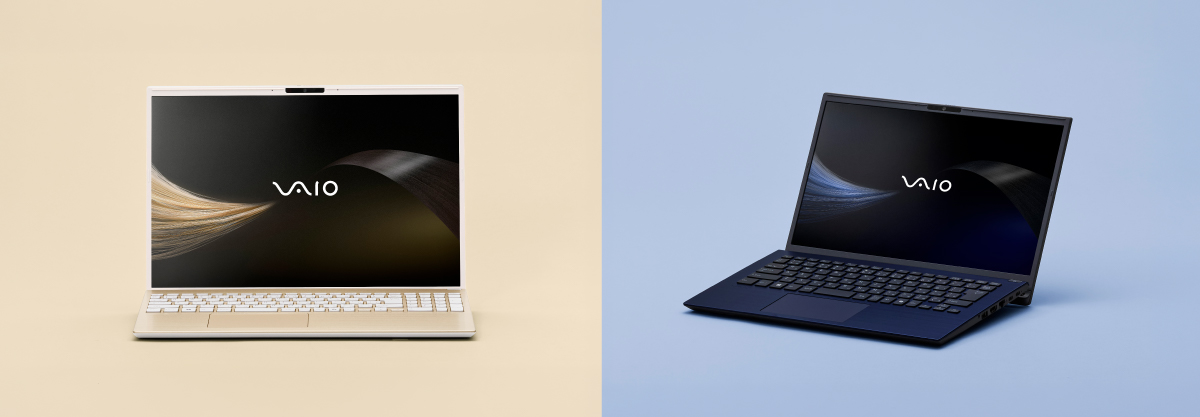
- Japan gets two more this month: the Vaio F14, out November 27, and the Dynabook M6, due in early December.
- Wildcat Lake is Intel's budget chip on its new 18A process: 6 cores (2 performance, 4 low-power), just 2 Xe3 graphics cores and a 17 TOPS NPU. Intel itself only promises "light gaming".
- In India, Wildcat Lake laptops already include Dell's XPS 13 and Dell 14S, both from ₹79,990.
What's new this week
Notebookcheck reported on November 19 that the ThinkBook 14x Gen 2, first announced at IFA in September, has gone on sale in Europe. Lenovo's UK store lists it from £1,129.99, shipping in six weeks or more. Eurozone prices run from about €1,349 to €2,249. Notebookcheck says the US gets it in January from $999.
| Lenovo ThinkBook 14x Gen 2 | |
|---|---|
| Chips | Core 5 315, Core 5 320 or Core 7 350, run at 25W |
| Memory | Up to 32GB LPDDR5X-7467 |
| Storage | Up to 2TB, with two SSD slots |
| Displays | 14-inch 2.8K OLED, 120Hz, 1,100 nits peak HDR; or 1920x1200 IPS, 120Hz, optional touch |
| Battery | 54.7Wh or 65Wh; Lenovo claims up to 27 hours of video on the larger one |
| Weight | From 990g |
| Ports | 2x USB-C 3.2, 2x USB-A, HDMI 2.1 |
| UK price | £1,129.99 (Core 5 315, 16GB, 256GB, IPS) to £1,729 (Core 7 350, 32GB, OLED) |
In Japan, Vaio opened orders for the F14 on November 17, with Core 3 304, Core 5 320 or Core 7 350 chips, a 14-inch Full HD screen, USB4 and 11.5 hours of claimed video playback, at about 1.32kg. Dynabook's M6, announced on November 18, pairs a Core 5 320 with 16GB of RAM, a 14-inch 1920x1200 screen and Gigabit Ethernet, at around 1.2kg; Japanese retailers expect it to cost in the mid-¥280,000 range.

Image: Dynabook
What Wildcat Lake is
Intel launched Core Series 3 on April 16, three months after its bigger Core Ultra Series 3 (Panther Lake) chips. Note the naming: no "Ultra" means the budget line. Our Intel codenames guide untangles where it fits.
The chip is a cut-down Panther Lake. Its CPU and graphics are on Intel's 18A process, the same one whose yield Intel's CEO said this week has reached 70%. Every model has the same basic layout:
| Chip | Cores | Top boost | Xe3 graphics cores | NPU |
|---|---|---|---|---|
| Core 7 350 | 2P + 4LPE | 4.8GHz | 2, at 2.6GHz | 17 TOPS |
| Core 5 320 | 2P + 4LPE | 4.6GHz | 2, at 2.5GHz | 16 TOPS |
| Core 5 315 | 2P + 4LPE | 4.4GHz | 2, at 2.3GHz | 15 TOPS |
| Core 3 304 | 1P + 4LPE | 4.3GHz | 1, at 2.3GHz | 15 TOPS |
All run at 15W base and up to 35W, with 6MB of cache and no hyper-threading. Business versions, the Core 7 360 and Core 5 330, add Intel's vPro management features. Memory runs in single channel, either LPDDR5X-7467 or DDR5-6400.
At launch, Intel's Josh Newman pitched it as value computing "at a time when prices are rising". Intel claims up to 2.1 times the performance of the older Core 7 150U and up to 64% lower power playing 4K YouTube.
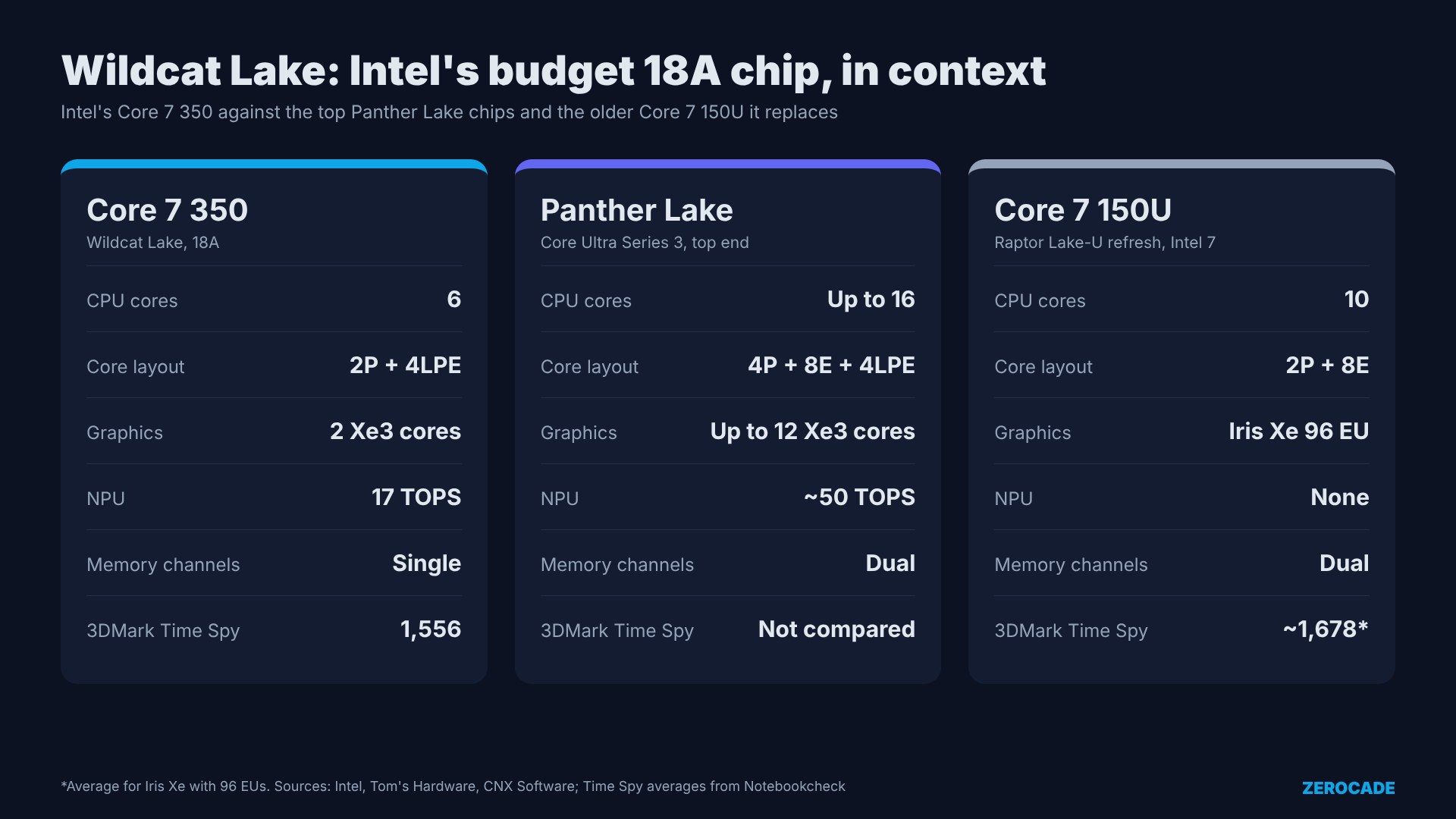
Image: Zerocade
Against Panther Lake and older chips
Panther Lake goes up to 16 cores, 12 Xe3 graphics cores, dual-channel memory and NPUs of about 50 TOPS, enough for Microsoft's Copilot+ PC label. Wildcat Lake's 17 TOPS falls short of Copilot+. In Notebookcheck's Geekbench 6 results, a Core Ultra 5 325 was about 36% faster than a Core 5 320 in multi-core, though single-core speed was about the same.
Against the Core 7 150U, an older 10-core Intel 7 chip, Notebookcheck found the Core 7 350 roughly tied in Cinebench 2024 multi-core (467 versus 470). On paper, the gain is efficiency and battery life rather than speed.
Can it game?
Not much. Notebookcheck's average 3DMark Time Spy score for Wildcat Lake's two-core Xe3 graphics is 1,556, slightly behind Intel's older Iris Xe with 96 execution units (1,678) and similar to AMD's Radeon 740M. Notebookcheck calls it "not suitable for demanding 3D games". Intel's own pitch only mentions "streaming and light gaming".
That makes it fine for older and lighter games, emulators and cloud gaming, but not for new releases. If gaming matters, a Panther Lake laptop with more Xe3 cores, or one with a dedicated graphics card, is a better fit. Single-channel memory also holds integrated graphics back, since they share system memory bandwidth.
Image: Intel
In India
The ThinkBook 14x Gen 2 hasn't launched in India; Lenovo India still sells the previous ThinkBook 14x with Core Ultra 200V chips from ₹1,08,990. But Wildcat Lake is already here in other laptops:
- Dell XPS 13 (2026) with a Core 5 320, from ₹79,990, launched in July.
- Dell 14S with Core 5 or Core 7 chips, from ₹79,990, launched on November 3, with a claimed 21 hours of Netflix playback.
- Lenovo IdeaPad Slim 3 15IWC11 with a Core 5 320, 16GB and 512GB, listed at about ₹81,990, according to Smartprix.
For comparison, Asus launched a Snapdragon X-powered Vivobook 14 with 16GB and 512GB at ₹65,990 last year. On paper, Wildcat Lake laptops in India start around ₹80,000, so they compete on battery life and build rather than raw speed.
What to watch
Watch for Lenovo's ThinkBook 14x Gen 2 reaching India, the US launch in January, and the first game benchmarks for Wildcat Lake's Xe3 graphics.