

The short version
- An NPU (neural processing unit) is a small part of the processor built only for AI work, at very low power.
- TOPS means trillions of operations per second. It's the NPU's top speed on paper, usually measured with simple 8-bit maths.
- Windows needs an NPU of more than 40 TOPS for its "Copilot+ PC" AI features. In 2026, the fastest laptop NPUs reach 85 TOPS (Snapdragon X2 Elite) and 60 TOPS (AMD Ryzen AI 400).
- For gaming, the NPU barely matters today. The graphics chip still does the heavy lifting, including AI upscaling like DLSS and FSR 4.
What an NPU actually does
Laptop chips now have three kinds of brains on one piece of silicon. The CPU runs Windows and your apps. The GPU draws graphics. The NPU does one job: the maths behind AI features, which is mostly multiplying huge grids of numbers together.
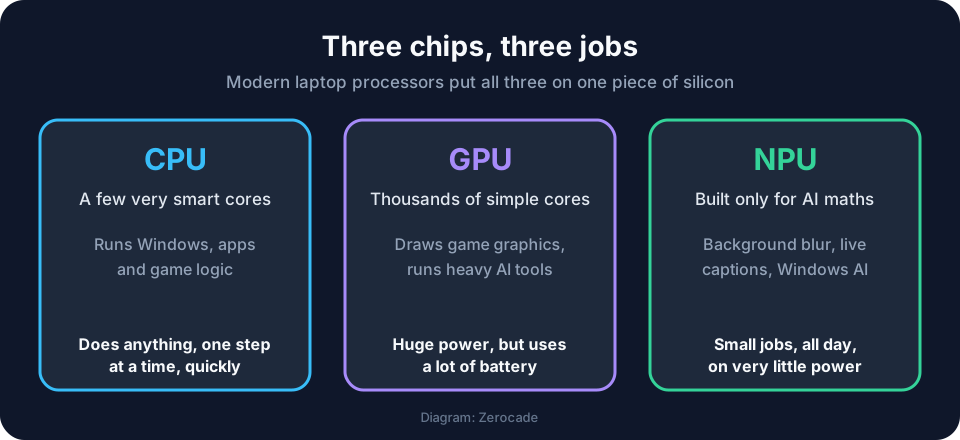 Image: Zerocade
That's why it exists. Background blur on a video call, live captions, noise removal on your microphone or Windows' AI search could all run on the GPU, but they'd drain the battery and spin up the fans. The NPU handles them quietly in the background, using a fraction of the power.
Phones got there first. Apple added a Neural Engine to the iPhone in 2017, and Qualcomm and MediaTek phone chips have had AI blocks for years. Laptops caught up in 2024, when Microsoft launched Copilot+ PCs.
What TOPS measures
TOPS counts how many simple maths operations the chip can do in a second, in trillions. It's a peak figure, the best case, not what you'll see in every app. It's a cousin of the TFLOPS number used for consoles, but it usually counts simpler, lower-precision maths, typically INT8: whole numbers stored in 8 bits.
Here's where 2026's laptop chips sit, by their makers' own figures:
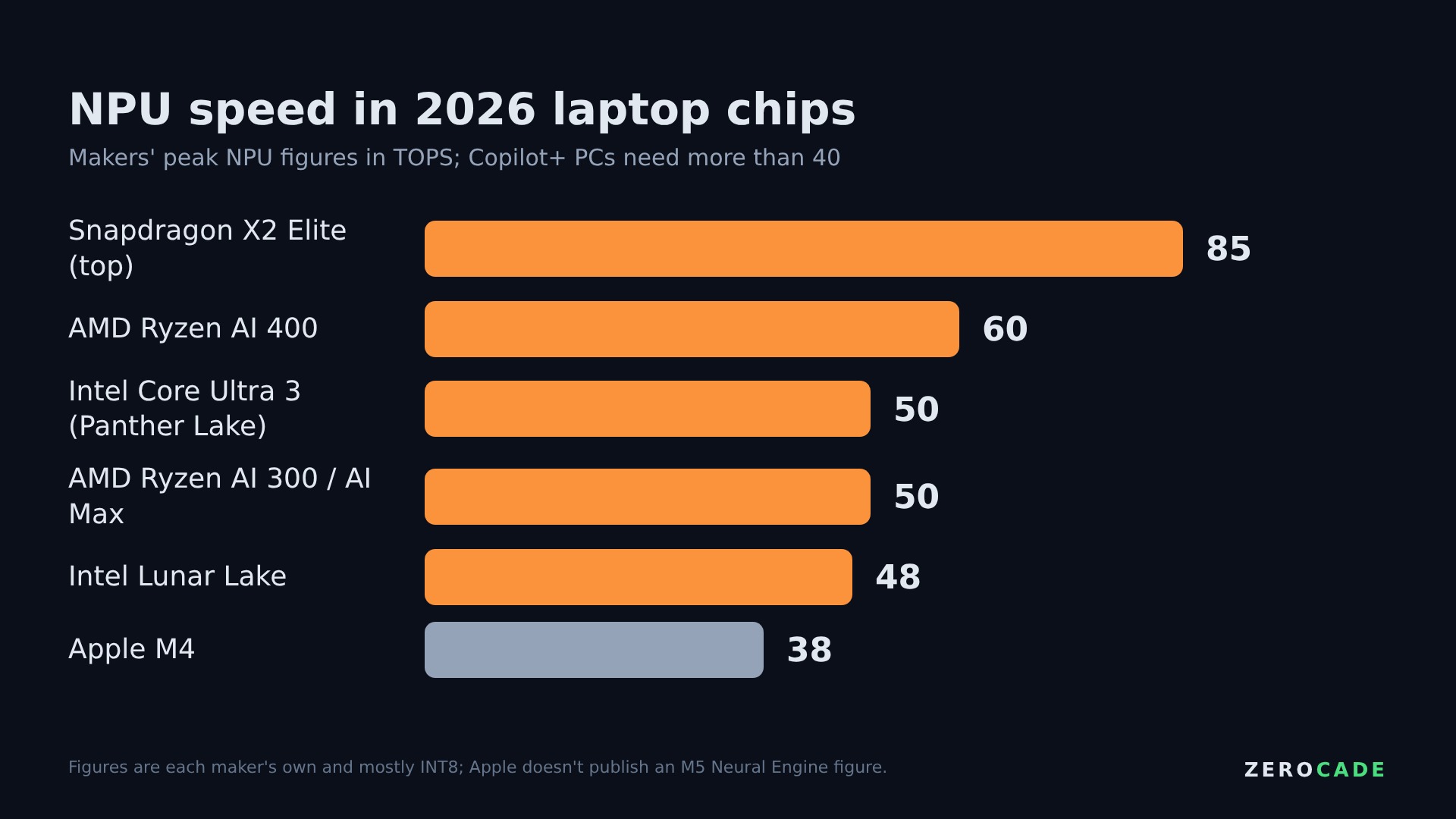 Image: Zerocade
Qualcomm's top Snapdragon X2 Elite models reach 85 TOPS, with the rest of the range at 80. AMD's Ryzen AI 400 laptop chips, codenamed Gorgon Point, reach 60. Intel's Core Ultra series 3 (Panther Lake) tops out at 50, as do AMD's Ryzen AI 300 and Ryzen AI Max chips. Apple quotes 38 TOPS for the M4's Neural Engine and doesn't publish a figure for the M5. Instead, Apple has added a neural accelerator to each of the M5's graphics cores.
Why the biggest number can mislead
Brands often quote a total TOPS that adds the CPU, GPU and NPU together. AMD says the Ryzen AI Max+ 395 reaches up to 126 TOPS in total, but its NPU alone is 50. Intel's Lunar Lake GPU is rated at 59 TOPS, more than its NPU.
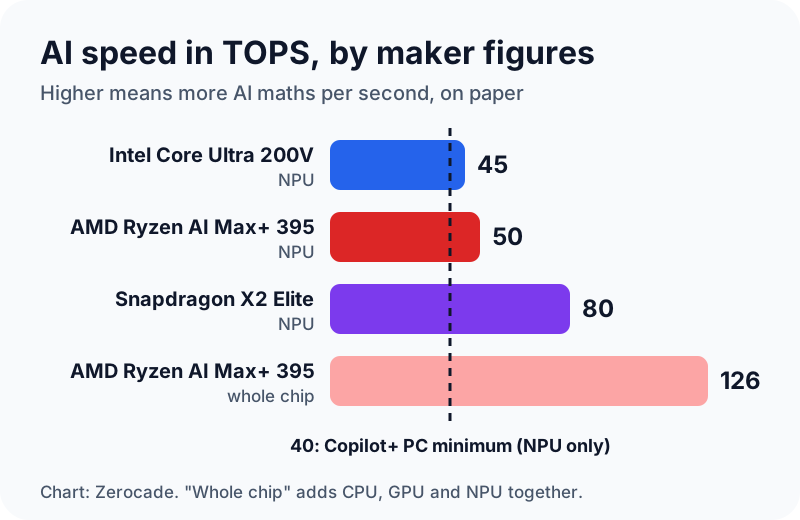 Image: Zerocade
Precision matters too. Nvidia quotes its new RTX Spark chip at up to 1 petaflop, or 1,000 TOPS, but that's measured at FP4, an even simpler kind of maths than the INT8 most NPU figures use. Halve the bits and you can roughly double the headline number. You can't line those figures up directly.
Graphics cards dwarf NPUs on raw numbers. Nvidia's RTX 3090 from 2020 was already rated at 284 INT8 TOPS. The difference is power: a graphics card might draw 300W or more, while an NPU sips a few watts.
The Copilot+ PC line
Microsoft's bar for its Copilot+ AI features is an NPU that can do more than 40 TOPS, plus 16GB of RAM and 256GB of storage. Chips that qualify include AMD Ryzen AI 300 and 400, Intel Core Ultra 200V and series 3, and Snapdragon X and X2. With AMD and Intel both shipping 50-plus TOPS NPUs across their 2026 ranges, an NPU is becoming standard rather than a premium extra.
What it means for gamers
Very little, for now. DLSS, FSR 4 and frame generation run on the graphics chip, not the NPU, because they need far more throughput and must finish within a few milliseconds every frame. Our unified memory explainer covers how the GPU side of these chips handles games.
Where an NPU can help is the stuff around gaming: background noise removal on voice chat, camera effects for streamers, and AI features in Windows that would otherwise steal GPU time.
What to check: on a spec sheet, look for the NPU figure on its own, not the total. If you mainly game, the GPU listing still tells you more.