

The short version
- TFLOPS means trillions of floating-point calculations per second. It measures a GPU's raw maths speed.
- It's simple multiplication: compute units × 64 shaders × 2 × clock speed.
- It's a decent rough guide, but memory bandwidth, the CPU, upscaling and developer work matter just as much.
- Newer AMD chips can count some work twice ("dual-issue"), so treat leaked figures carefully.
What the number measures
A FLOP is one floating-point operation, the kind of decimal maths a GPU does millions of times per frame to light, shade and place every pixel. Tera means trillion. So the PS5's 10.28 TFLOPS works out to roughly 10 trillion of those calculations every second.
That's why spec sheets love it. One tidy number, easy to compare. Microsoft led its Xbox Series X reveal with "12 TFLOPS" for exactly that reason.
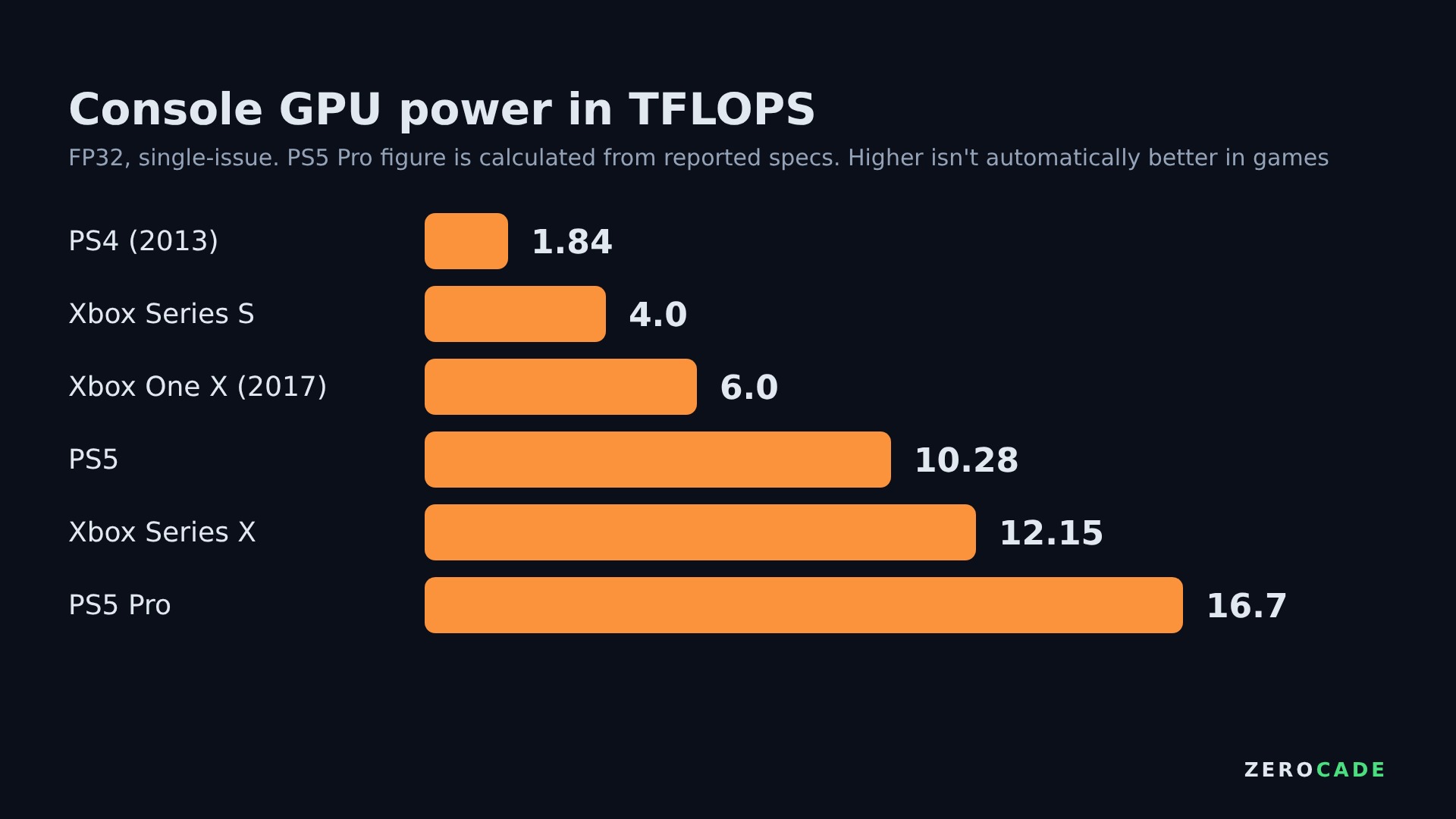 Image: Zerocade
How it's worked out
There's no magic in it. For AMD console GPUs the formula is:
- Compute units (CUs), the GPU's main building blocks
- × 64 shaders per CU
- × 2 operations per shader per clock (a "fused multiply-add" counts as two)
- × clock speed in GHz
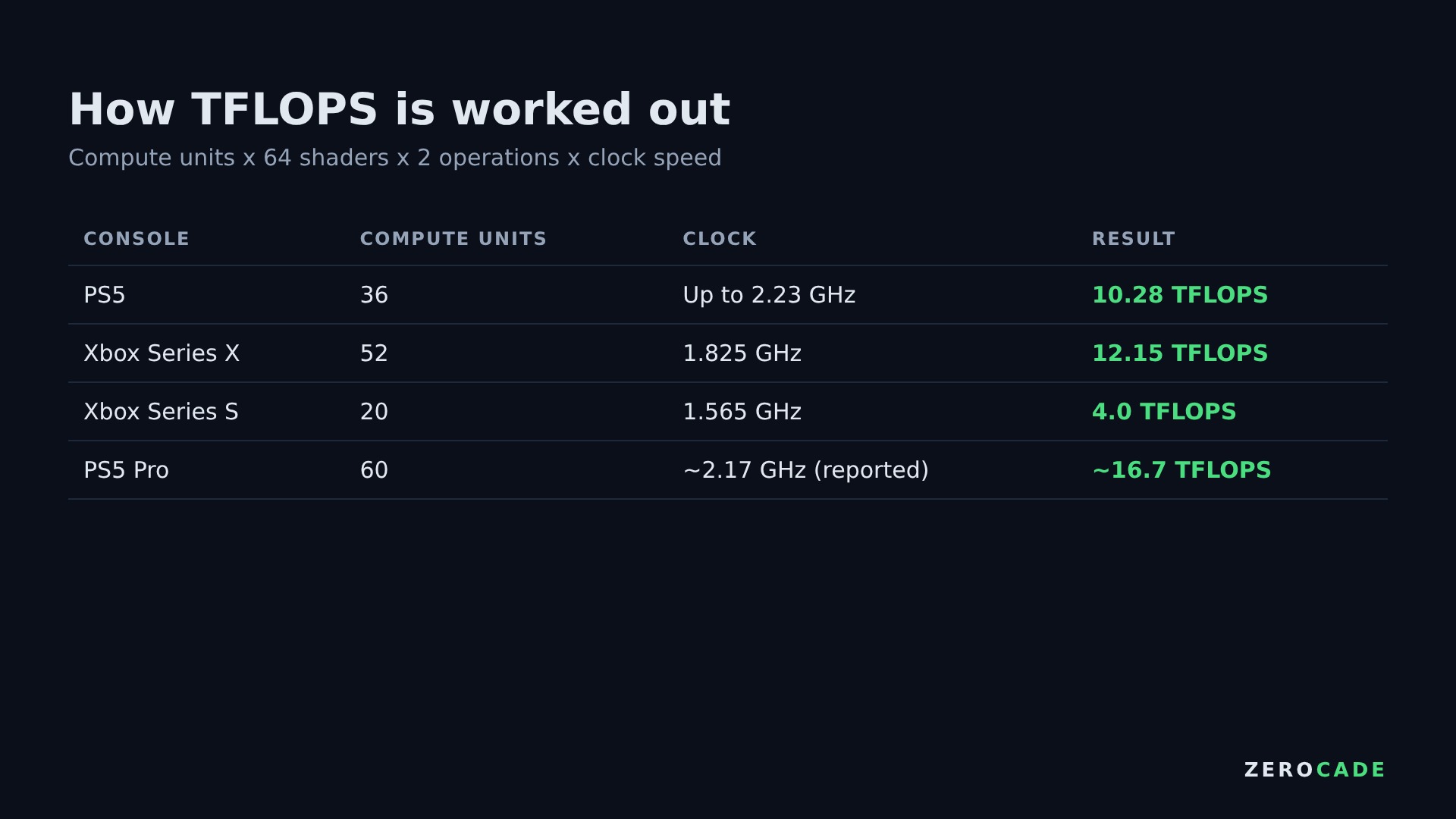 Image: Zerocade
Plug in the PS5 (36 CUs at up to 2.23 GHz) and you get 10.28 TFLOPS. The Xbox Series X (52 CUs at a fixed 1.825 GHz) lands at about 12.15. The Series S is around 4.
Notice the two strategies. Sony went with fewer CUs at a higher, variable clock. Microsoft went wide with more CUs at a lower, fixed clock. Both are valid ways to get to a similar place.
 Image: Microsoft / Xbox
Why bigger isn't automatically better
The Series X has roughly 18% more TFLOPS than the PS5. Yet in most games released on both, the two consoles end up very close. Other parts of the machine decide a lot:
- Memory bandwidth. A fast GPU waiting on data is just a fast GPU waiting. This is the number to check next to TFLOPS.
- The CPU, which runs game logic, physics and AI. All current consoles use similar 8-core AMD Zen 2 chips, so this is often the real limit at 60fps and above.
- Storage and I/O, which decide how quickly worlds load and stream in.
- Upscaling. AI tools like Sony's PSSR (see our PSSR explainer) let a console render fewer pixels and still look sharp.
- Optimisation. How well developers target each machine. The lead platform for a game often runs best.
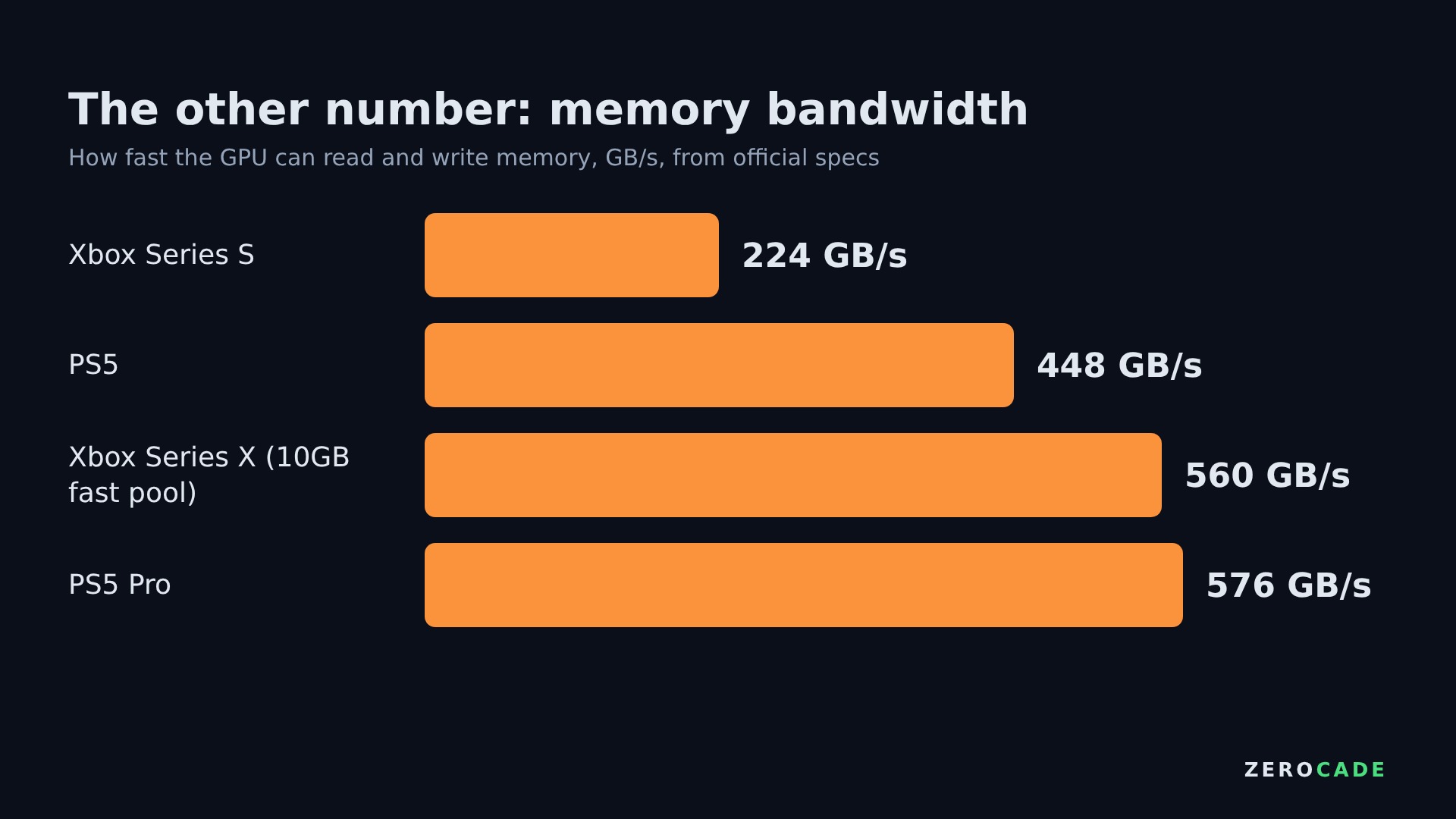 Image: Zerocade
The Series X's figure comes with a catch too: only 10GB of its 16GB runs at 560GB/s; the other 6GB runs at 336GB/s. Spec sheets rarely tell the full story.
Comparing across generations is even trickier
The PS4 had 1.84 TFLOPS, and the Xbox One X had 6. On paper the One X has about 58% of a PS5's TFLOPS, but in practice the PS5 is far more capable, because its newer RDNA 2 architecture does more useful work per FLOP and supports features like hardware ray tracing that older chips simply don't have.
So TFLOPS only works as a comparison between chips of the same architecture. Across generations or brands, it's a very rough guide at best.
The leak-reading trap
Newer AMD designs can dual-issue, running two FP32 operations at once in some cases. That can double the headline TFLOPS without doubling real game performance. It's why the PS5 Pro's GPU is quoted as about 16.7 TFLOPS by some and around 33.5 by others. It's also why the rumoured 56 TFLOPS for Xbox's Project Helix gets quoted elsewhere as 112. Same chip, different counting.
So when you see a leak, check two things. Is the figure single or dual-issue? And is anyone comparing like with like? The rumoured 40 TFLOPS PS6 versus 56 TFLOPS Helix gap, covered in our Project Helix post, is still unconfirmed, and it won't tell you much until bandwidth and real games show up.