
The short version
- Nvidia says Jensen Huang has resigned as President, CEO and board member, effective immediately. He co-founded the company in 1993.
- Colette Kress, Nvidia's CFO since 2013, is interim CEO while the board searches for a permanent one. Harvey Jones becomes the board's first-ever Chair.
- Nvidia gave no reason. The resignation comes four days after the board opened an independent investigation into Huang.
- The shares fell about 11-12% at the open on November 12 before closing down 4.34%. Earnings are still due on November 17.
What Nvidia announced
Nvidia put out a short statement on November 12, before the US market opened. That was around 7:30 PM in India. It said Huang "has resigned as President, Chief Executive Officer, and a member of the Board, effective immediately", and thanked him for his "immeasurable contributions to the company and the industry."
A filing with the US Securities and Exchange Commission confirmed the board accepted the resignation on November 11. Here's what the two documents say, and what they leave out:
- Interim CEO: Colette Kress, who stays on as CFO, until a permanent successor is named.
- New Chair: Harvey Jones, a director since 1993.
- CEO search: the board will consider internal and external candidates. There's no timeline.
- Business as usual: Jones said the board has "full confidence in Colette and the leadership team" and expects the product roadmap to continue "without interruption".
- Not mentioned: any reason for the resignation, any role for Huang after this, or any severance terms.
Kress said in the statement that Nvidia's "strength has always come from its people."
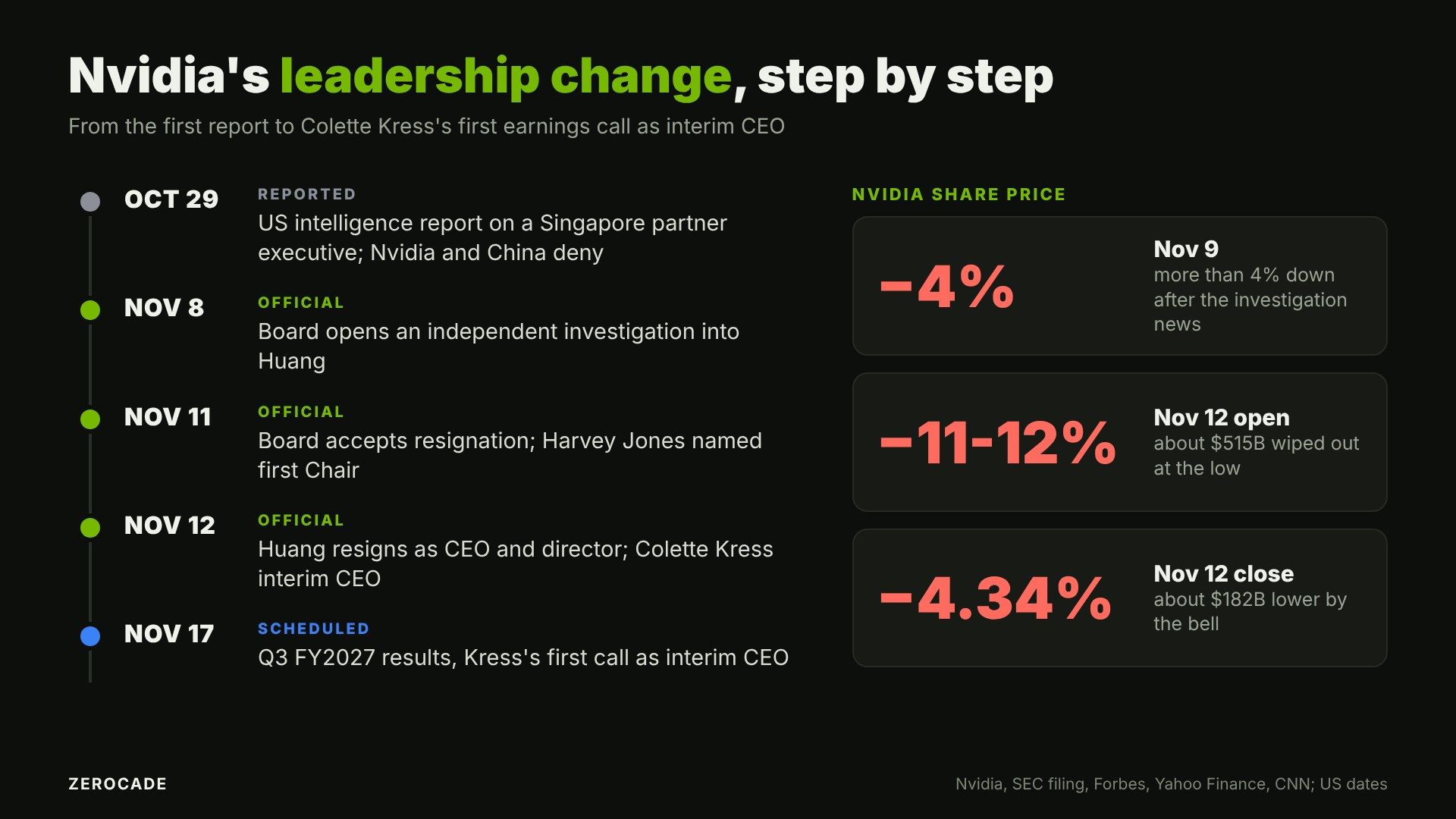
Image: Zerocade
How it got here
This moved fast. We covered the board's investigation into Huang on November 10. Here's the sequence, with what's official separated from what's reported:
- October 29 (reported): The New York Times reported that US intelligence officials believed an executive at a Singapore-based Nvidia partner, said to be close to Huang, was passing information to Beijing. Nvidia replied that Huang "talks with thousands of customer executives every year". China called the claims "groundless".
- November 8 (official): Nvidia's board opened an independent investigation, run by independent directors with outside lawyers. It said it had "no reason to believe" that national security or Nvidia secrets were compromised. Huang told staff he supported the probe and admitted to an affair.
- November 11-12 (reported): The Wall Street Journal reported Nvidia was preparing to remove him, and the board met on November 11.
- November 12 (official): Huang resigns.
Reports also say the FBI and members of Congress are looking into the matter, and that shareholders have filed a class action. Nvidia hasn't commented on either.
How the shares reacted
Nvidia's stock fell about 11-12% when trading opened on November 12. Yahoo Finance put the value wiped out at the low at around $515 billion, and Nvidia briefly dropped below Microsoft and under a $4 trillion market value for the first time since 2025.
It recovered a lot of that during the day and closed down 4.34%, still roughly $182 billion lower. That came on top of a fall of more than 4% when the investigation was announced, and a slide of over 23% across the past month, per Tom's Hardware.
Who's running Nvidia now
Colette Kress has been Nvidia's finance chief since September 2013. Before that she spent three years as a senior finance executive at Cisco, 13 years at Microsoft, including four as CFO of its Server and Tools division, and started out at Texas Instruments. She's the voice on every Nvidia earnings call, so investors already know her well.
Harvey Jones is Nvidia's first board Chair. Huang never had one above him. Jones has been on Nvidia's board since 1993, ran chip-design software company Synopsys for years, and co-founded Daisy Systems and Tensilica.
Huang co-founded Nvidia in 1993 and ran it for 33 years, turning a graphics card company into the world's main supplier of AI chips. Al Jazeera reports he owns about 3.6% of the company. He was also the public face of Nvidia's push into India, announcing an AI tie-up with Mukesh Ambani on stage in Mumbai in 2024. Nvidia has offices in six Indian cities and in April signed a 10-year lease for about 7.6 lakh sq ft in Bengaluru, worth around ₹1,230 crore. It hasn't said anything about India in this transition.
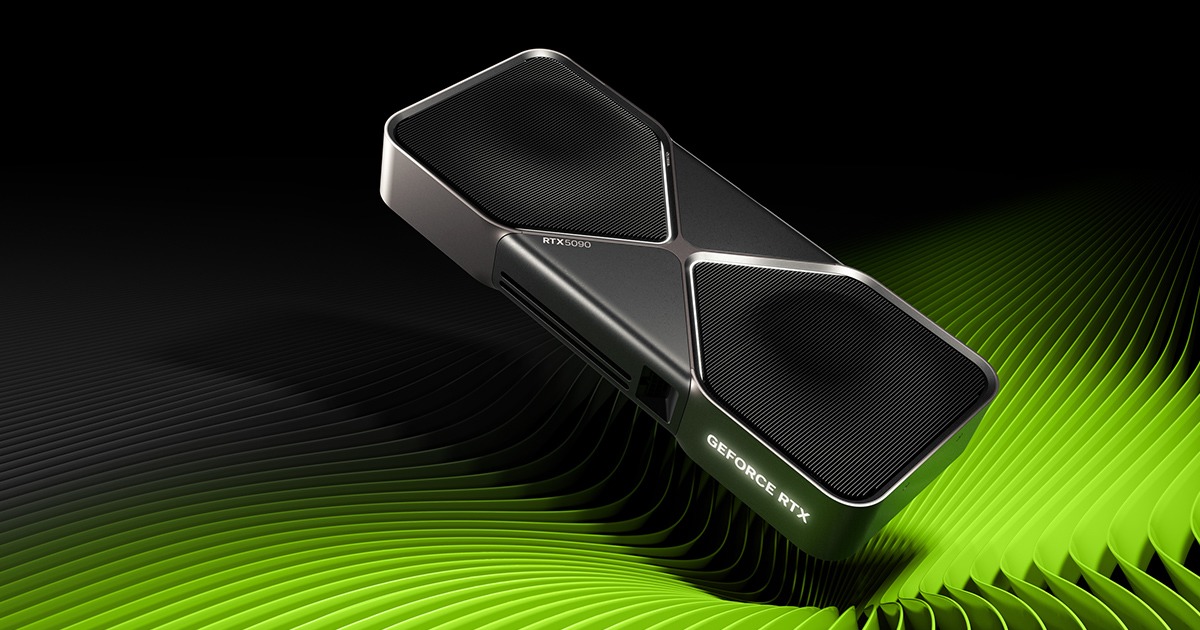
Image: Nvidia
What it means for GeForce
Nothing changes for your graphics card today. Drivers, DLSS updates and the cards on shelves don't depend on who the CEO is, and Nvidia says its roadmap carries on "without interruption". It didn't mention GeForce specifically.
The bigger questions were already there before this week:
- RTX 50 Super: The Information reported in February that the design was finished but production was pushed back because of the memory shortage.
- RTX 60: reportedly slipping to 2028. We explained why GPU generations are slowing.
On paper, an interim CEO who comes from finance is unlikely to make big product bets before a permanent leader arrives. Gaming is now a small slice of Nvidia's revenue next to data centres, so any big strategy changes are likely to start on the AI side.
What to watch
Nvidia reports its July-September results on Tuesday, November 17, with the call early on Wednesday, November 18 in India. It'll be Kress's first call as interim CEO, so listen for anything on the CEO search, GeForce supply and RTX 50 Super. GTC in mid-March 2027 is the next big stage, and the first without Huang's keynote.