
The short version
- Nvidia has launched a new GeForce generation about every two years since 2016. The RTX 50 series arrived in January 2025.
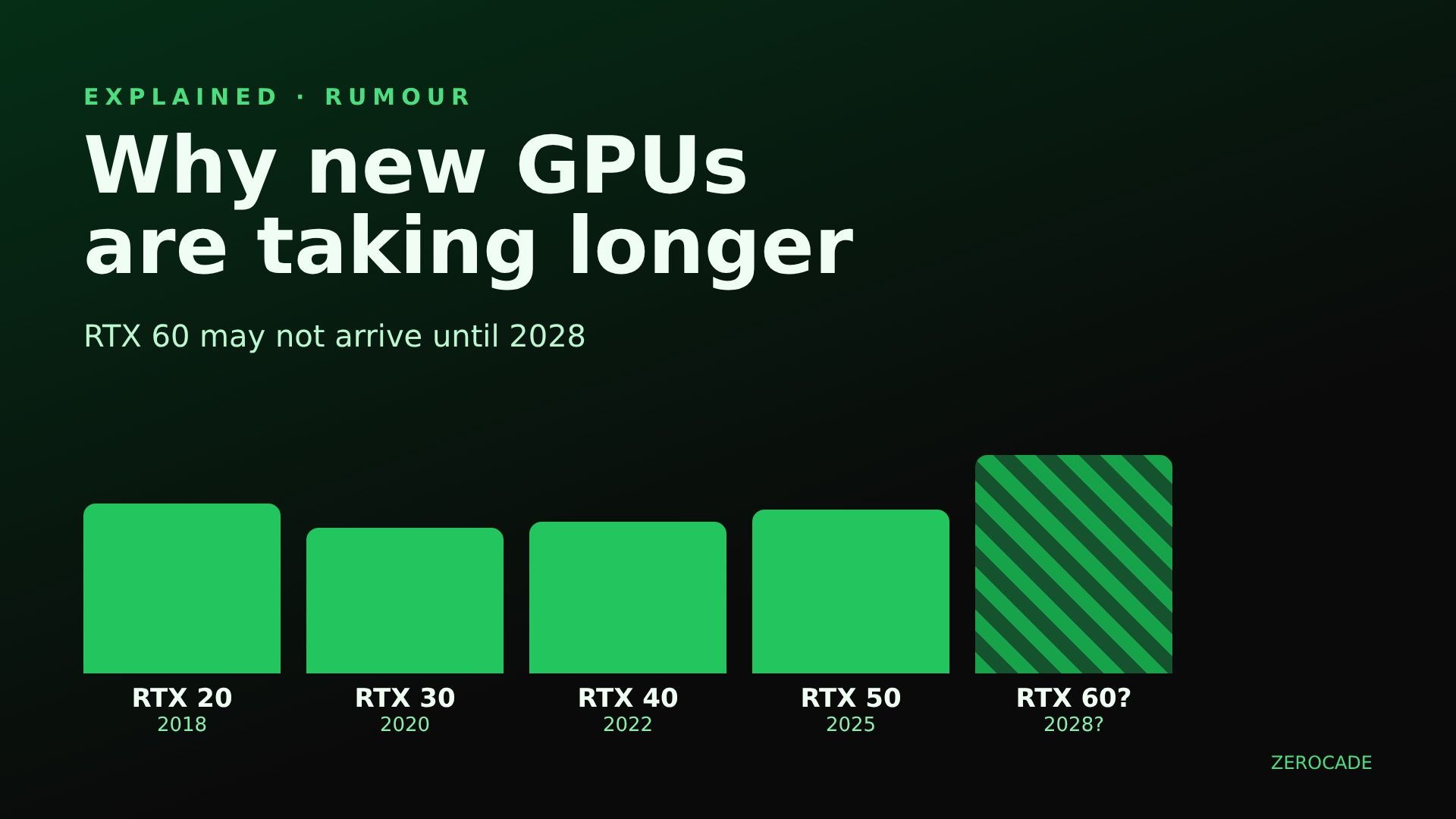
- Leaker Kopite7Kimi says the next generation, believed to be the Rubin-based RTX 60, has slipped to 2028. That's a rumour; Nvidia hasn't announced any date.
- Market analyst TrendForce says the reasons are bigger than one delay: AI chips now bring in most of Nvidia's money, memory is expensive, and each new generation brings smaller gains.
- For buyers, a longer cycle means today's cards stay current longer, but prices are unlikely to fall soon.
How a GPU generation normally works
A graphics card "generation" is a family of cards built on the same new chip design, which Nvidia calls an architecture. Blackwell powers the RTX 50 series. Ada Lovelace powered the RTX 40.
A new generation usually brings three things at once: a new architecture, a newer manufacturing process from TSMC or Samsung, and a new kind of memory or faster memory. Nvidia has also used each generation to launch a headline feature, like ray tracing with the RTX 20 and DLSS 3 frame generation with the RTX 40.
Between generations, Nvidia often releases a refresh. These "Super" cards use the same chips with more cores enabled or more memory. The RTX 40 Super cards in January 2024 are the most recent example.
That rhythm has been steady for a long time:
| Generation | First desktop cards | Gap from previous |
|---|---|---|
| GTX 10 (Pascal) | May 2016 | |
| RTX 20 (Turing) | September 2018 | 28 months |
| RTX 30 (Ampere) | September 2020 | 24 months |
| RTX 40 (Ada Lovelace) | October 2022 | 25 months |
| RTX 50 (Blackwell) | January 2025 | 27 months |
| RTX 60 (Rubin, rumoured) | 2028? | About 36 months, if early 2028 |
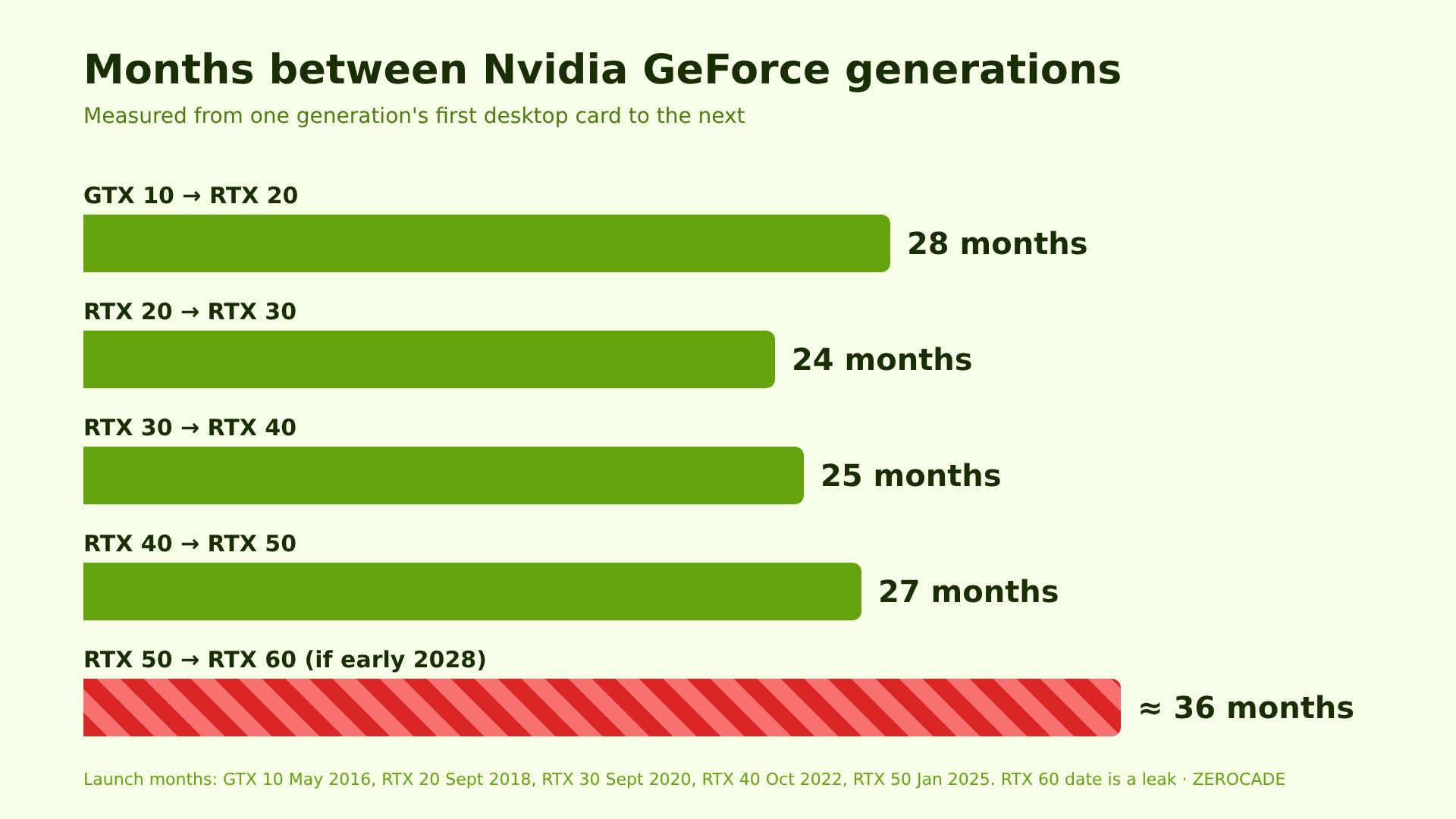
Image: Zerocade
What the leaks say
In September, Kopite7Kimi, one of the more reliable Nvidia leakers, changed his forecast for the next consumer GPU family, which he calls GR20x, from the second half of 2027 to 2028. Another leaker reportedly said most of AMD's next-generation RDNA 5 cards could also land in 2028, with perhaps one model arriving in 2027.
Earlier in the year, a report from The Information said Nvidia would not release an upgraded RTX 50 this year and that the RTX 60 had already been pushed back from late 2027. The long-rumoured RTX 50 Super cards still haven't appeared.
None of this is confirmed. Nvidia's official Rubin plans cover data centre chips, not GeForce cards, and the company hasn't commented on gaming dates. Treat 2028 as a credible rumour, not a schedule.
Why the cycle is stretching
TrendForce pulled the reasons together in an analysis on October 29. There are four main ones.
1. AI is where the money is. In Nvidia's latest reported quarter, data centre revenue was $89 billion out of $96.2 billion in total, about 92.5%. Gaming cards are a small slice of the business now. Every wafer TSMC makes for Nvidia can become an AI chip that sells for far more than a GeForce card, so gaming chips get less priority.
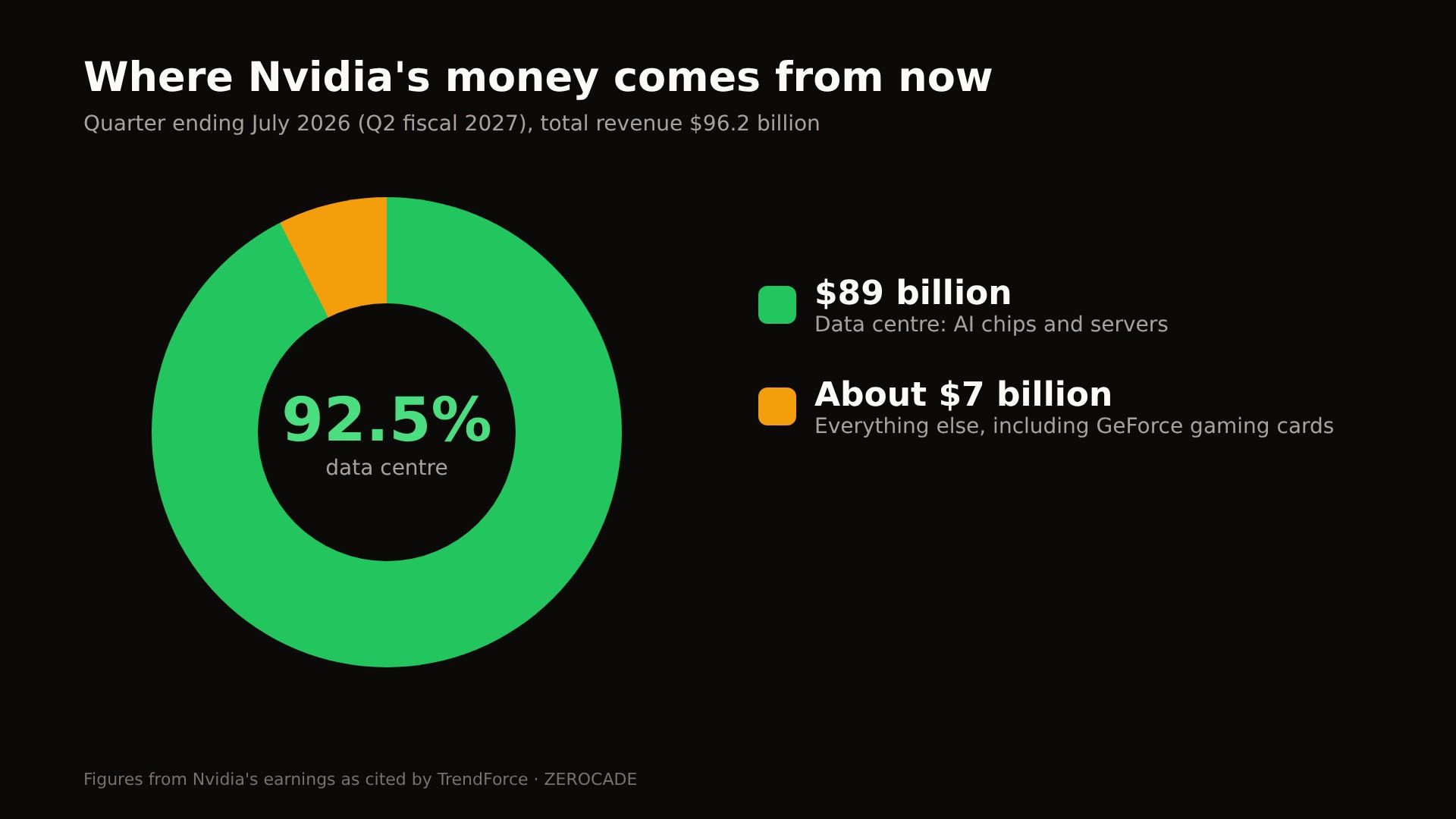
Image: Zerocade
2. Memory is scarce and expensive. AI servers are soaking up memory production, and the RTX 50 Super was reportedly held back by the cost of GDDR7. Our explainer on HBM covers why AI memory is squeezing the memory in gaming cards.
3. New chips cost more to make. Each new manufacturing process is more expensive per wafer than the last. Our process node explainer explains why "smaller" chips no longer get cheaper.
4. The gains are shrinking. TrendForce points to TechSpot's testing, which found the RTX 5080 only about 4% faster than the RTX 4080 Super at 1440p and 11% faster at 4K, without frame generation. If a new generation doesn't deliver a big jump, there's less pressure to rush it out. More of the improvement now comes from software, like DLSS and frame generation, which can arrive without new hardware.
TrendForce also notes pressure from below: integrated graphics in chips like Intel's Panther Lake and AMD's Strix Halo are getting good enough to cut into entry-level graphics cards.
What it means for you
On paper, a longer cycle has an upside. A card you buy now stays the newest generation for longer, and game developers will target RTX 50 and RX 9000 cards as the high end for years.
The downside is price. With no new generation pushing older cards down, and memory costs rising, prices aren't likely to fall soon. The RTX 5080 has already climbed to nearly $2,000 in the US, and Indian prices have been rising too.
If you're shopping, the practical advice is to buy on today's prices and needs rather than wait for the RTX 60. Waiting could mean more than two years. Keep an eye on Nvidia's January CES keynote, where Super refreshes have been announced before, for the first sign of whether the current generation is getting a mid-cycle refresh.