


The short version
- Alinea Analytics estimates Slay the Spire 2 has sold about 7.9 million copies on Steam since its Early Access launch in March, worth about $157.6 million. Developer Mega Crit has only confirmed 3 million, from its first week.
- Most PC estimates start with Steam reviews: multiply the review count by a number, usually somewhere between 20 and 80.
- Analysts then mix in player counts, public Steam profiles, bestseller ranks and any data publishers share privately.
- The best tools claim to land within about 15-30% for most games. For any single game, an estimate can still be badly wrong.
The Slay the Spire 2 numbers
Alinea's Rhys Elliott shared the figures on November 17. They're all Steam-only estimates, not numbers from Mega Crit:
| Figure | Alinea estimate |
|---|---|
| Copies sold | About 7.9 million |
| Revenue | About $157.6 million |
| Share of copies from China | 32.2% |
| Daily players last weekend | 1.1 million |
| Players with 100+ hours | 1.9 million |
The game launched in Early Access on March 5, 2026, on Steam only. It normally costs $24.99, or ₹1,100 in India, and is currently 20% off at ₹880 until November 26.
The only official figure is Mega Crit's own: 3 million copies and more than 25 million runs in the first week. Alinea had it at 4.6 million after two weeks, and Sensor Tower's VG Insights at 7 million in June. Dividing Alinea's revenue by its copy count gives about $20 a copy, which fits with regional prices and sales.
Image: Mega Crit
Step 1: count the reviews
Steam shows how many reviews every game has. Developers noticed years ago that sales tend to be a fairly steady multiple of that number.
Indie developer Jake Birkett wrote about it in 2014. The multiplier became known as the Boxleiter number, after developer Mike Boxleiter, who'd used it before. In Birkett's 2018 update, based on more than 50 indie games, the average was 82 sales per review, but the range ran from about 30 to 150, with outliers at 18 and 226.
GameDiscoverCo's Simon Carless found a median of 58 across 237 games, but only 38 for games launched in 2020. Steam started prompting players to review in October 2019, so newer games collect more reviews per sale. VG Insights suggested about 30 for 2021 releases.
The multiplier also shifts with genre, price, discounts and whether keys are sold elsewhere. One game, Clone Drone, sat at 67 sales per review for 2017-19 but 14 in 2020. Birkett himself warns against making business decisions from it.
Step 2: sample Steam profiles
The second method is to look at what people own. SteamSpy, launched in 2015, polled 100,000-150,000 public Steam profiles a day and scaled the results up. Developers said it was within about 10% for games that had sold more than a few thousand copies.
That ended in April 2018, when Valve made game libraries private by default. SteamSpy switched to other methods, and its numbers got noisier. A loophole using achievement data briefly revealed exact owner counts that July, and Valve closed it within days.
Achievements are still useful. In 2023, Game World Observer took Larian's official figure of 1.3 million players finishing Baldur's Gate 3, divided by the roughly 17% of players with the ending achievement, and estimated about 7.6 million copies.
Step 3: watch the player counts
SteamDB shows how many people are playing a game right now. It takes those numbers straight from Steam's public API, updating the most popular games every five minutes.
Concurrent players aren't sales, though. Slay the Spire 2 peaked at around 527,000 to 574,000 players at once, while selling 3 million copies in its first week. Helldivers 2 peaked at about 459,000 on Steam, yet Sony confirmed 12 million sales across PS5 and PC within three months. A game people play for hours a day looks very different from one they dip into.
Image: Mega Crit
Step 4: blend everything
Modern trackers combine all of the above:
- Gamalytic mixes review multiples, player counts divided by playtime, bestseller ranks and profile sampling, calibrated against a leaked 2018 Steam dataset. It says 77% of about 120 test games landed within 30%, against 43% using reviews alone.
- VG Insights, bought by Sensor Tower in 2025, adds wishlists, weekly top-seller lists and data some publishers share with it. It claims 84% of 55 games within 15%.
- Alinea doesn't publish its method. It calls its figures estimates.
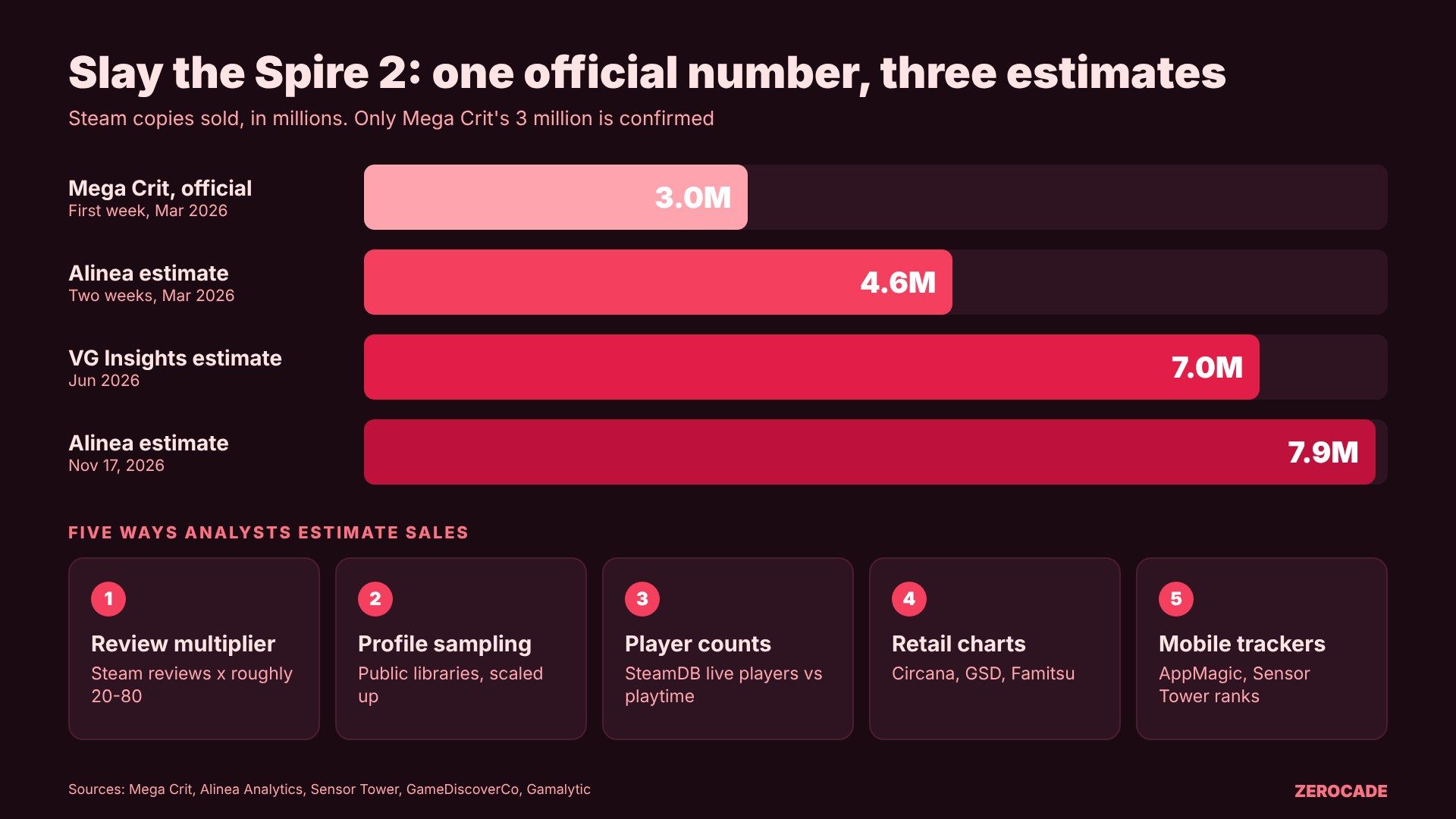
Image: Zerocade
Step 5: consoles and phones
Console sales are harder to see. Circana in the US gets physical sales from retailers and digital sales only from publishers who choose to share them; Nintendo never has, and EA and Xbox stopped in July 2026. Our sales charts guide explains the gaps. Europe's GSD charts work the same way, while Japan's Famitsu charts count physical copies only.
On phones, which matter most in India, AppMagic and Sensor Tower estimate revenue from app-store rankings, trained on data from developers who share it. AppMagic claims about 10% average error per month but counts in-app purchases only, not ad revenue. Sensor Tower was behind the GTA 6 pre-order estimate we covered this week.
How close do they get?
Sometimes close, often low:
- Black Myth: Wukong: VG Insights estimated 8.4 million on Steam in 48 hours. Game Science later said 10 million across all platforms in three days.
- Helldivers 2: TD Cowen estimated 8 million-plus in March 2024. Sony confirmed 12 million that May.
- Slay the Spire 2: estimates have climbed from 4.6 million to 7.9 million, with no official update since 3 million.
Publishers rarely fill in the gaps. Rivals would learn from the data, and it's easier to announce a flattering milestone than a full number. As former PlayStation US boss Shawn Layden put it, everyone wants competitors' data, but "not everyone wants to offer up their own."
On paper, treat any estimate as a range rather than a fact, especially for a single game. Our Helldivers 2 and Stellar Blade estimates post is another example of the same tools at work.
What to watch
Watch for Mega Crit to share a new official number, perhaps at Slay the Spire 2's 1.0 launch, which would show how close Alinea's 7.9 million really is.