

The short version
- Net bookings is the figure most Western game publishers use to show what they sold in a quarter. It counts the full sale when it happens.
- Revenue, under official accounting rules, can only count money once it's been earned. For games with online services, part of the price gets spread over months.
- That's why Take-Two reported $1.60 billion in bookings but $1.50 billion in revenue for July to September.
- Nintendo and Capcom report copies sold instead, and Sony mostly reports sales and profit for its whole PlayStation business. So their numbers can't be compared one-to-one.
Why this came up now
Take-Two reported results on November 9, nine days before GTA 6 launches. Every headline quoted "net bookings" and "recurrent consumer spending", and the numbers didn't line up with revenue. Once GTA 6 launches, you'll see a flood of sales figures from different sources, so it helps to know what each one actually measures.
Bookings vs revenue, step by step
Imagine you buy a $70 game on December 1, and it includes online play.
- The publisher books the whole $70 that day. That's net bookings: the net amount sold, digitally or shipped to shops, in the period.
- The accountants split the price in two. Part of it pays for the game itself, which you have now. Part of it pays for online services you'll use over the coming months. Take-Two's filings call these separate obligations.
- The game part counts as revenue right away. The online part is deferred: it sits on the books as money owed in service, and is counted as revenue a little at a time. Take-Two says it spreads this over 9 to 15 months.
- Eventually the two numbers meet. Over a year, revenue catches up with bookings.
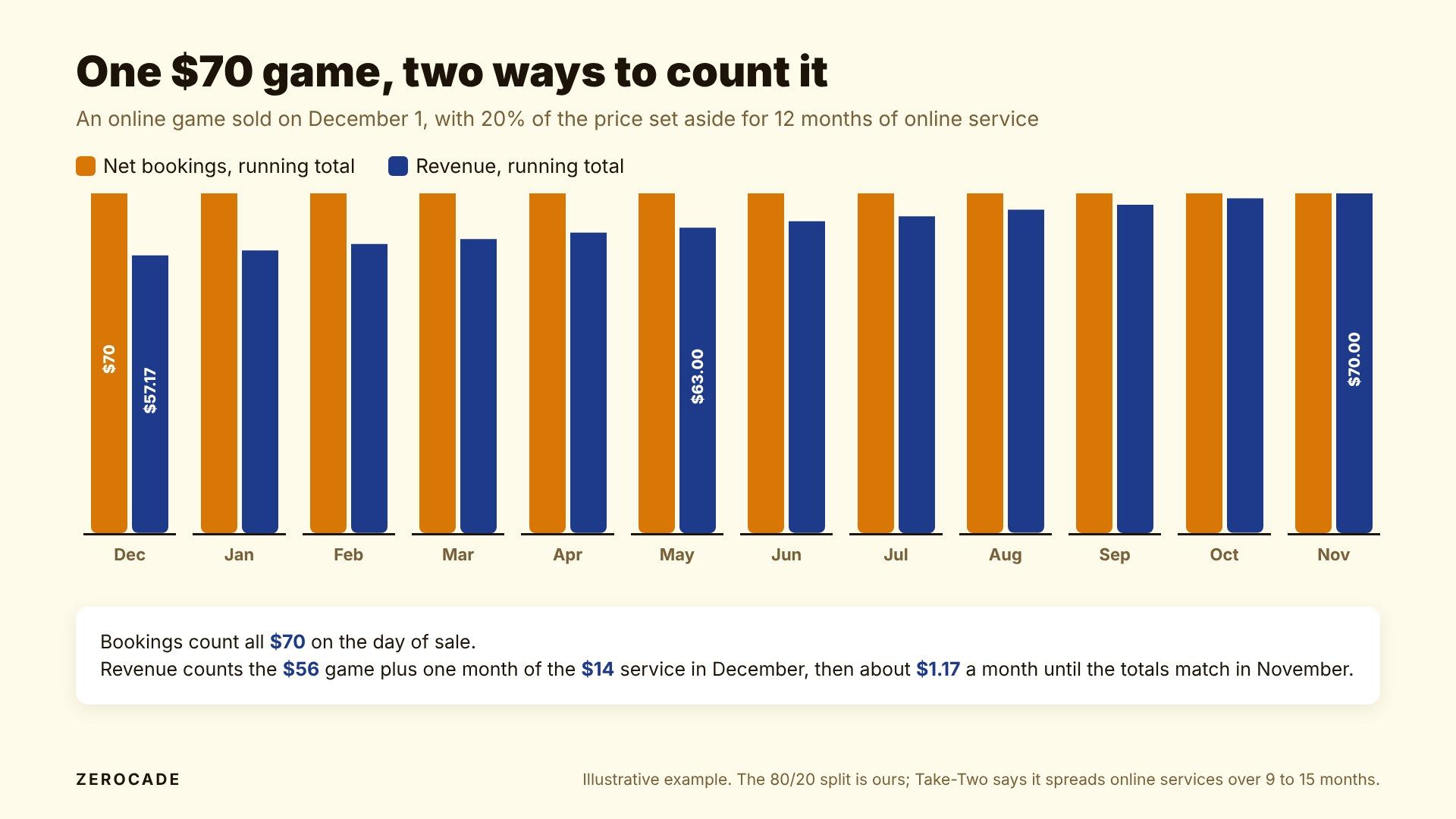
Image: Zerocade
In our example, using a made-up 80/20 split, bookings show $70 in December. Revenue shows about $57.17: the $56 game part plus one month of the $14 service. The remaining $12.83 trickles in at about $1.17 a month.
Virtual currency, like GTA Online's Shark Cards, works the same way: it's booked when you buy it and deferred as revenue. At the end of September, Take-Two had about $1.04 billion of deferred revenue waiting to be counted.
Why publishers prefer bookings
- It matches the launch. A huge game launching in November would otherwise look smaller in its launch quarter than it really was.
- It's closer to cash. Bookings track money coming in, which is what investors usually want to see.
- It's what they forecast. Take-Two's guidance, such as its $8.0-8.2 billion target for this financial year, is given in bookings.
Electronic Arts makes the maths plain: bookings equal revenue plus the change in deferred revenue. In the quarter that Battlefield 6 launched, EA reported $1,901 million in revenue plus $1,145 million of deferral, for $3,046 million in bookings.
Recurrent consumer spending
This is Take-Two's term for money from players who keep paying after buying the game: virtual currency, add-ons, in-game purchases and in-game ads. It made up 81% of Take-Two's bookings last quarter, which shows how much of the business comes from games like GTA Online and NBA 2K rather than new releases.
Ubisoft uses a similar measure called player recurring investment. EA calls it live services.

Image: Rockstar Games
Take-Two's CFO said on the latest call that add-on content sold separately counts toward recurrent spending. That's why sales of GTA 6's ₹7,499 ($99.99) Ultimate Edition feed into that line as well as the main game sale.
How each publisher reports
| Company | Main figure | What it means |
|---|---|---|
| Take-Two | Net bookings | Sold digitally or shipped to shops in the quarter |
| EA | Net bookings | Revenue plus change in deferred revenue |
| Ubisoft | Net bookings | Sales adjusted for service periods and licensing; can come in below sales |
| Sony | Segment sales and profit | Whole Game & Network Services business, plus units and monthly active users |
| Nintendo | Units sold | Copies sold to date, including digital and bundles |
| Capcom | Platinum Titles | Games over 1 million copies, including digital |
Ubisoft is a good reminder that bookings aren't always higher. In its April-June quarter, its bookings were €255.8 million against sales of €268.2 million.
Sony's latest report gives a flavour of its approach: ¥1,208.5 billion in sales for the PlayStation business last quarter, about 127 million monthly active users, and 78% of full-game sales were digital.
Shipped vs sold
One more trap: sold-in means copies shipped to shops, and sell-through means copies bought by players. Publisher bookings count physical copies when they're shipped. Nintendo and Capcom's unit figures are the company's own sales, including digital, not copies rung up at the till.
So when GTA 6 launches, a headline about copies "sold" in its first days could mean shipped, sold to players, or an outside estimate like Sensor Tower's. Check which one it is.
The catch
Bookings aren't an official accounting measure, and nobody audits them the way they audit revenue. Each company defines them a bit differently, and they make launch quarters look as strong as possible.
US regulators have pushed back in the past. In 2017, the SEC objected to Take-Two's earlier name for the metric, "Net Sales", as too easy to confuse with official figures, and Take-Two renamed it. Zynga faced similar questions in 2016.
How to read GTA 6's numbers
When Take-Two reports its October-December quarter early next year, look at net bookings for the size of the launch, recurrent consumer spending for how much Ultimate Editions and add-ons added, and deferred revenue for how much of the money is still to be counted. Treat early outside estimates as estimates, not official sales.