
The short version
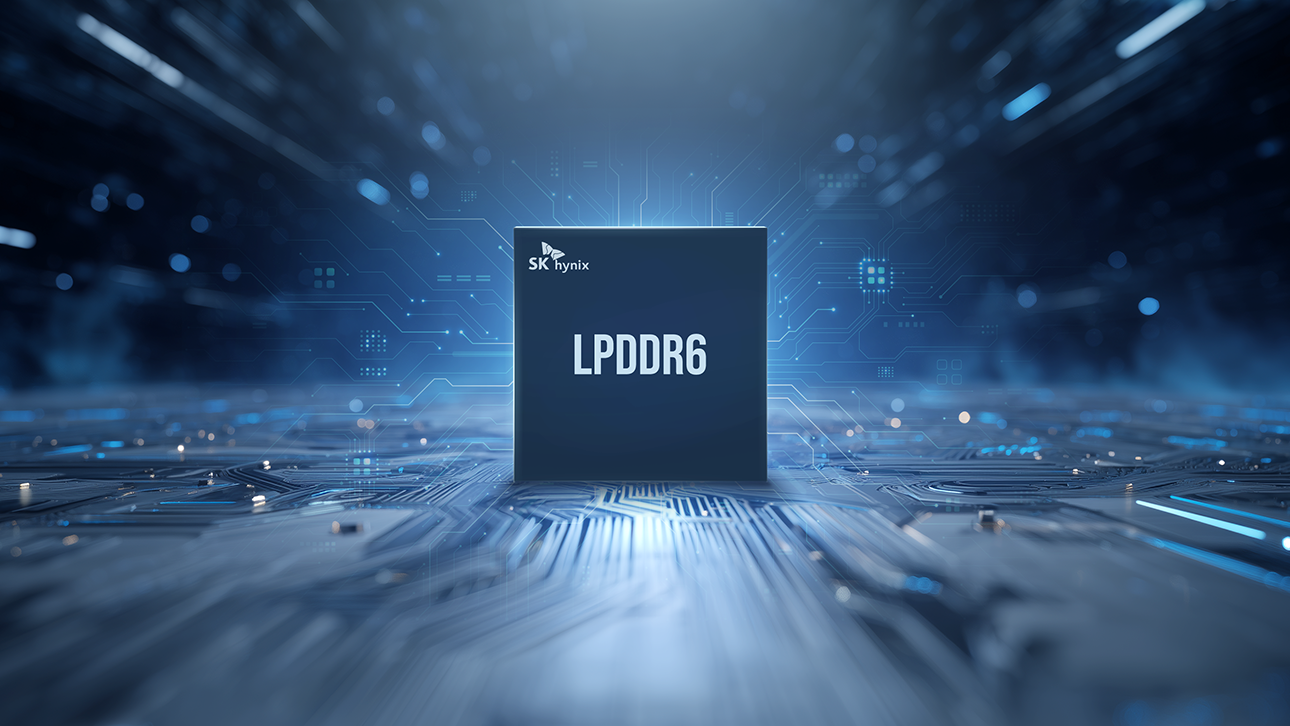
- LPDDR6 is the next generation of low-power memory used in phones, tablets and thin laptops. JEDEC published the standard in July 2025.
- It widens a phone's memory bus from 64 to 96 bits and starts at about 10.7 gigabits per second per pin, rising to 14.4. In practice, that's up to about 50% more bandwidth than LPDDR5X.
- Snapdragon 8 Elite Gen 6, its Extreme sibling and MediaTek's Dimensity 9600 Pro all support it. Samsung and SK hynix are shipping it, and Micron follows in 2027.
- A rumour says Samsung's Galaxy S27 Pro will only use LPDDR6 on the 1TB model. Memory prices have nearly doubled this year, which helps explain why.
Why this came up
On November 14, Notebookcheck reported a claim from Korean leaker Vampire King that the Galaxy S27 Pro's top 1TB version will get 16GB of LPDDR6, while other models stick with LPDDR5X. The post is unverified, and Samsung's launch isn't expected until early 2027.
Notebookcheck also suggested the regular Snapdragon 8 Elite Gen 6 can't use LPDDR6. Qualcomm's own product briefs disagree: both the Gen 6 and the Extreme Gen 6 list support for "LPDDR5x/6" at up to 24GB. So if the S27 Pro does mix memory types, it's Samsung's choice, not a chip limit.

Image: Samsung Semiconductor
Step 1: what LPDDR is
LPDDR stands for low-power double data rate memory. It does the same job as the RAM sticks in a desktop PC, holding everything the processor is working on, with two big differences:
- It's soldered on or right next to the processor rather than slotted in. Shorter wires mean it can run fast on little power.
- In a phone, the CPU, GPU and AI engine share it. There's no separate graphics memory, so a game's textures, the app and the AI model all compete for the same bandwidth.
That second point is why memory speed matters so much on phones. Our phone SoC explainer covers how those parts fit together.
Step 2: what LPDDR6 changes
| LPDDR5X | LPDDR6 | |
|---|---|---|
| Speed per pin | Up to about 10.7Gbps | 10.667Gbps at launch, up to 14.4Gbps |
| Typical phone bus | Four 16-bit channels, 64-bit | Four 24-bit channels, 96-bit |
| Peak bandwidth on Snapdragon 8 Elite Gen 6 | 84.8GB/s | 127.2GB/s |
| Measured | 114GB/s (Samsung, 16GB on Snapdragon) | |
| Power | About 20% better, per Samsung and SK hynix |
The big change is the width. JEDEC's design gives each LPDDR6 die two 12-bit sub-channels, 24 data lines in all. In a phone with four channels, that turns a 64-bit bus into a 96-bit one. Even at the same clock speed, that's 50% more data moved each tick.
The measured number is lower than the theoretical peak. Samsung validated 16GB of LPDDR6 on the Snapdragon 8 Elite Extreme Gen 6 at 114GB/s in September. ServeTheHome reports Qualcomm's controller is qualified to about 10.6Gbps for now, well short of LPDDR6's 14.4Gbps ceiling.
LPDDR6 also adds:
- Smarter power saving. It can drop its supply voltage when running slowly, so a phone sitting idle uses less.
- Reliability features, including error correction inside the chip and protection against a memory attack called row hammering.
- Flexible bursts. It can switch between 32-byte and 64-byte transfers on the fly, depending on the job.
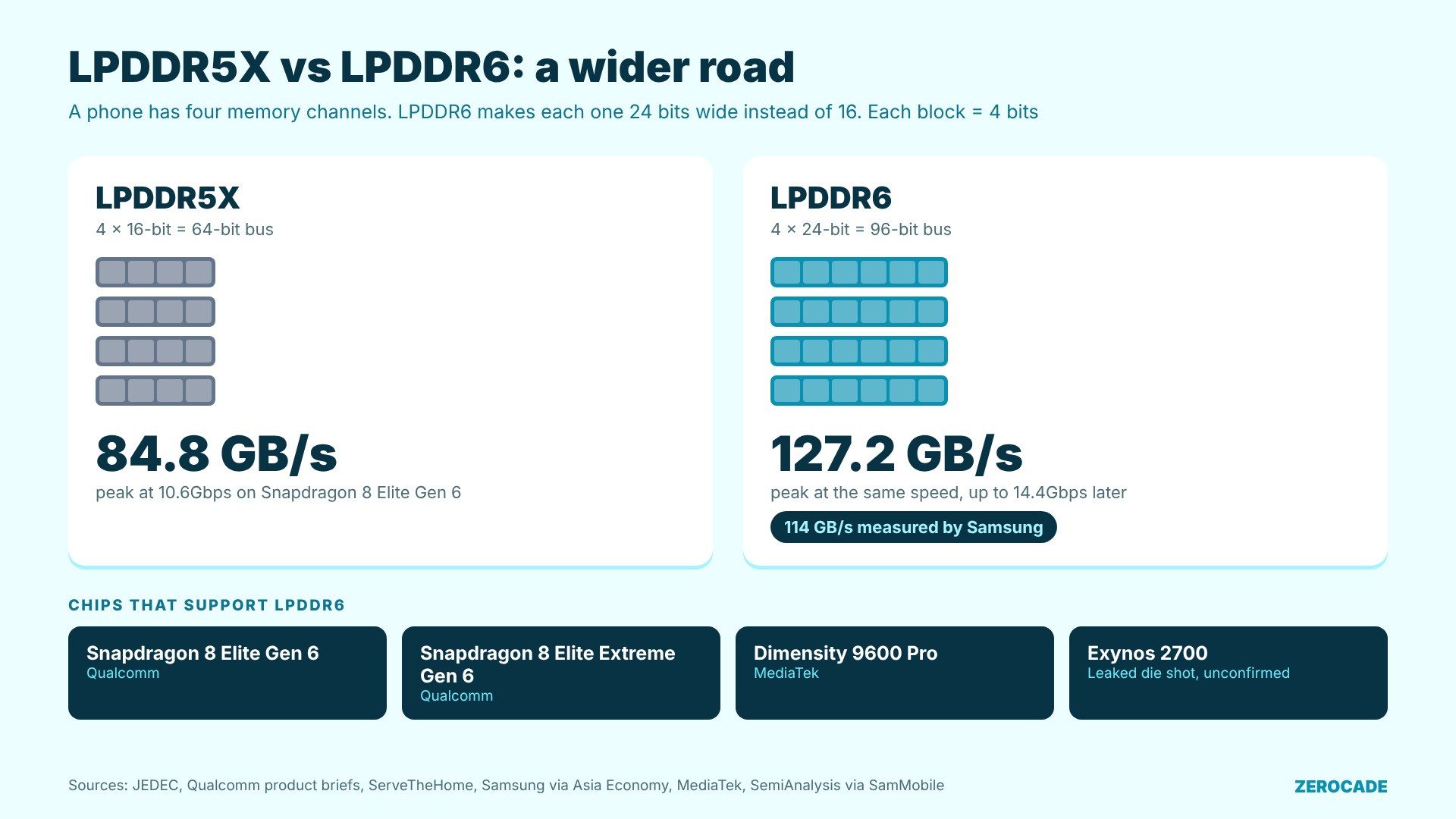
Image: Zerocade
Why it matters for gaming
Phone GPUs are often limited by how fast they can fetch data, not how fast they can calculate. High-resolution textures, frame generation and upscaling all move a lot of data. More bandwidth gives the GPU more room, especially as chips like the Snapdragon 8 Elite Extreme Gen 6 add AI upscaling and frame generation of their own. We covered those features in our Xiaomi 18 Pro report.
It matters for on-device AI too. When a phone runs a chatbot locally, how fast it writes text depends heavily on memory bandwidth, because the model's weights are read again for every word. As a rough rule, going from 85 to 114GB/s would let the same model write about a third faster. That's our estimate from the bandwidth figures, not a tested number.

Image: Samsung Semiconductor
Who makes it, and which chips use it
- Samsung showed LPDDR6 at CES 2026, where it won an Innovation Award, and validated it with Qualcomm in September.
- SK hynix announced 16Gb LPDDR6 chips on its 1c process in March, claiming 33% more speed and over 20% better efficiency than LPDDR5X, with supply from the second half of 2026.
- Micron plans volume production in the second half of 2027.
On the chip side, Qualcomm's Snapdragon 8 Elite Gen 6 and Extreme Gen 6 and MediaTek's Dimensity 9600 Pro support it, along with UFS 5.0 storage. A leaked die shot suggests Samsung's Exynos 2700 does too, but that isn't confirmed. Market researcher Omdia expects LPDDR6 to be just 3% of LPDDR shipments in 2027, rising to 39% by 2030.
Why only the 1TB model?
Price. TrendForce says regular memory contract prices rose about 93-98% in the first quarter of 2026 alone, and mobile LPDDR around 90%, as factories shifted to AI servers. It expects another 10-15% rise this quarter. A new, scarce memory type costs even more, so on paper it makes sense to save it for the most expensive model.
That cost reaches Indian buyers too. The Vivo X500 Pro, launching here on November 26 with a Dimensity 9600 Pro, is one of the first phones in India on a chip that supports LPDDR6, as we covered in our Vivo X500 report. Which memory it actually uses is something to check on the spec sheet.
What to watch
Watch for which 2027 flagships list LPDDR6 on their spec sheets, starting with the Galaxy S27 series. If you're buying a top phone in India next year, the RAM type is now worth checking alongside the chip.