


The short version
- On November 18, hours before GTA 6 unlocked, many PS5 owners couldn't sign in to PlayStation Network. Downdetector reports peaked in the thousands, and the disruption eased within about an hour. Sony hasn't explained the cause.
- Launch-night failures usually hit sign-in and licence checks, not downloads. Downloads are the same file for everyone and can be copied worldwide; sign-ins are unique to each player.
- When a service slows down, consoles retry automatically, which piles on even more load. Engineers call this a retry storm or thundering herd.
- That's why games use login queues and player caps, and why a status page can say "all fine" while you're staring at an error.
What happened on November 18
At around 18:00 GMT (11:30pm IST), PS5 owners began reporting that "Sign in to online services" was failing, even though their internet connection test passed. Some saw a message that PlayStation services were busy. The PlayStation Store, multiplayer and party chat were affected. Downdetector showed more than 1,000 reports within an hour, and Newsweek counted over 4,000 at the peak.
What Sony's status page showed depends on when you looked. Newsweek saw it confirm a major outage, warning that players "might have difficulty launching games, apps or network features", before it showed everything normal again by 3:15pm US Eastern time. Other outlets that checked at different moments saw it showing normal. Xbox Live wasn't affected.
Sony hasn't said what caused it, and nothing directly ties it to GTA 6. Some outlets pointed to the required PS5 system update Sony released on November 17, which every player had to install before midnight. That link is speculation. The timing, though, is a textbook example of what this guide explains.

Image: Rockstar Games
Step 1: downloads are easy, sign-ins are hard
A launch night asks two very different things of a platform.
The download is the same 212GB for everyone. Publishers copy it to a content delivery network (CDN): thousands of servers in cities around the world. Your console fetches it from a nearby copy. Spreading identical files around is a solved problem, and pre-loads move most of the data days early anyway. Our pre-load guide explains how the game then sits encrypted until unlock.
The sign-in and licence check is different. Each request is unique: this account, this password, this purchase, this console. It has to be checked against a single, consistent record of who owns what. You can't cache "is this person allowed to play?" in Mumbai and London separately, or a refund or a ban in one place wouldn't apply in the other. So these requests all funnel back to a smaller set of services that must agree with each other.
When millions of people try to sign in within the same hour, that funnel is what jams.
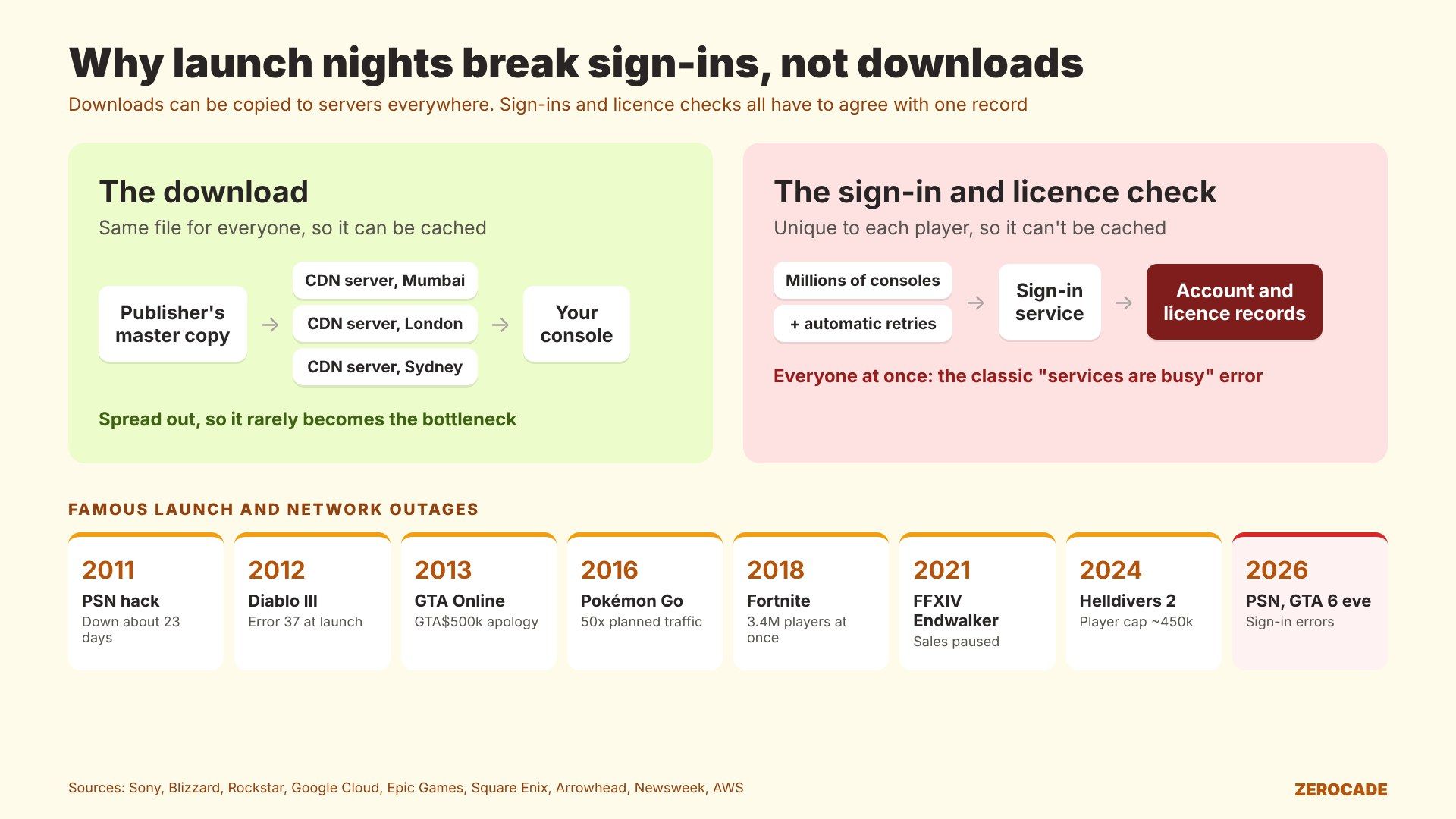
Image: Zerocade
Step 2: why retries make it worse
When a sign-in fails, your console doesn't give up. It tries again, often automatically and quickly. That's sensible for one person, but disastrous at scale.
Amazon's engineering guide on the subject puts it plainly: when failures are caused by overload, retries that add load "can make matters significantly worse". A service that was, say, 20% over capacity suddenly receives the original traffic plus a wave of retries, and falls further behind. Engineers call this a thundering herd.
The fixes are well known:
- Backoff: wait longer after each failed attempt.
- Jitter: add a random delay so millions of devices don't retry at the exact same second.
- Rate limiting: reject some requests early with a "busy" message so the rest can succeed.
That last one is likely what a "services are busy" error is. It's a deliberate refusal to protect the system, not necessarily a crash.
Epic's own postmortem of Fortnite's February 2018 outages shows the herd in action. At 3.4 million concurrent players, its account service failed and sign-ins were mostly blocked. When one chat system failed over, the rush of players reconnecting at once knocked over a friends-service load balancer. Epic also hit its cloud provider's instance limits and ran out of network addresses.
Step 3: queues and player caps
The other answer is to let people in at a controlled rate. That's what a login queue is.
- Final Fantasy XIV: Endwalker (December 2021): demand far exceeded capacity, and new servers were delayed by the chip shortage. Square Enix paused sales of the game and gave players up to 21 days of free play time.
- Helldivers 2 (February 2024): Arrowhead capped the game at about 450,000 concurrent players to keep servers stable, later raising it to 700,000.
- WoW Classic (2019): Blizzard deliberately launched with fewer servers, accepting queues rather than ending up with half-empty servers once the rush faded.
Cloudflare's Waiting Room product exists for the same reason: admitting users "as spots become available" instead of letting everyone crash the site at once.
Step 4: why status pages lag
Status pages are often updated by people, not automatically. During an incident, engineers are fixing the problem first. Sometimes the page itself depends on the broken system: during Amazon's huge S3 outage in February 2017, AWS couldn't update its own health dashboard for about two hours, because the dashboard relied on S3.
PSN has shown the same gap. During a six-hour outage in July 2026, Sony's page first said all services were up. Downdetector fills that gap, but it only counts user reports: it shows that people are having problems, not why. Vodafone UK's CTO once called it "a great detector but it's not a flawless detective".
Step 5: lessons from history
- 2011, PSN hack: an intrusion took PSN offline for about 23 days and affected around 77 million accounts. Not a launch rush, but the longest PSN outage.
- 2012, Diablo III: Error 37 locked players out on launch day. Blizzard admitted its "very aggressive" projections still fell short.
- 2013, GTA Online: server errors and lost characters at launch. Rockstar paid players GTA$500,000 in compensation.
- 2016, Pokémon Go: traffic hit 50 times Niantic's target within 15 minutes of launching in Australia and New Zealand, against a worst case of 5 times, according to Google Cloud.
GTA 6 is priced at ₹5,999 on the PlayStation and Xbox stores in India, and The Independent notes consoles need to be online at unlock so the purchase can be verified. Sony's support page for the game points to Restore Licenses and Offline Play settings if sign-in problems return.
What to watch
Watch for any explanation from Sony of the November 18 outage, and for Rockstar's plans for GTA Online, which will put far more strain on servers than the single-player launch did.