
The short version
- Metacritic and OpenCritic collect professional reviews of a game and turn them into one score out of 100.
- A Metascore is a weighted average: bigger outlets count for more, and Metacritic keeps the weights secret.
- OpenCritic's Top Critic Average is a plain average of top outlets, shown alongside the share of critics who recommend the game.
- With GTA 6 reviews reportedly landing on November 18, here's how to read both numbers.
Step 1: every review becomes a number out of 100
Critics score games in different ways. One outlet gives 8.5 out of 10, another gives four stars out of five, and another gives a letter grade. Before anything can be averaged, both sites convert every score to the same 0 to 100 scale.
The simple cases are easy. A score out of 10 is multiplied by 10, so 8.5 becomes 85, and a score out of 5 is multiplied by 20. Other scales use fixed tables. On Metacritic's four-star scale, 3.5 stars becomes 88. Letter grades run from 100 for an A down to 0 for an F, with A− at 91, B at 75 and C at 50.
That conversion is where some arguments start. A "B" in a review often reads as a solid recommendation, but it lands as a 75, right at the bottom of Metacritic's green band.
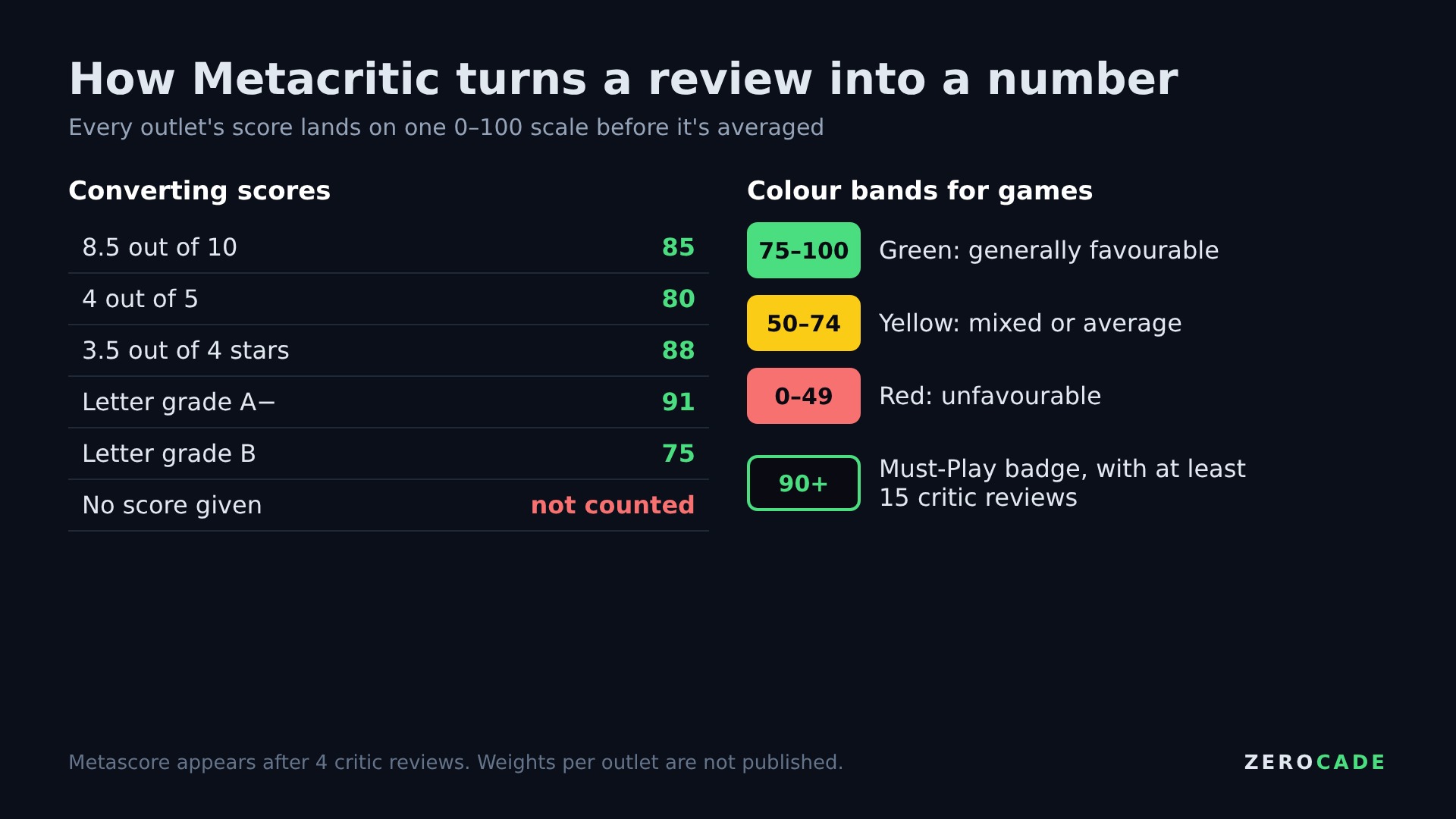
Image: Zerocade
Step 2: Metacritic weights the average
This is the bit most people don't know. A Metascore isn't the plain average of the reviews you see listed. Metacritic gives some outlets more weight than others, based on what it calls their quality and stature, and it has never published those weights.
A few more rules shape the number:
- A game needs at least four critic reviews before it gets a Metascore. Until then it shows "tbd".
- For games, unscored reviews don't count toward the Metascore at all.
- If an outlet changes its score later, Metacritic keeps the first one.
- Scores are only accepted for about a year after release. After that, the Metascore is final.
The result is shown in a colour band. For games, 75 to 100 is green, 50 to 74 is yellow and 0 to 49 is red. A game with 90 or more from at least 15 reviews earns a Must-Play badge, which Metacritic added in 2018. Steam shows the Metascore on PC store pages too, so the number follows a game around.
The user score is a different thing
Next to the Metascore sits a user score out of 10. It comes from players, not critics, and has no effect on the Metascore. Since July 2020, players have had to wait 36 hours after a game launches before they can post a user review. Metacritic added that delay to slow down review bombing, where groups flood a page with low scores.
How OpenCritic does it differently
OpenCritic launched in September 2015, partly as a reaction to Metacritic's secrecy. Valnet, the media group behind sites like Game Rant, bought it in 2024. It shows two main numbers:
- Top Critic Average: a simple average of numeric scores from outlets OpenCritic marks as "top critics", with no hidden weights. It appears once at least three top critics have scored the game.
- Critics Recommend: the share of all critics who recommend the game. For a scored review from a top outlet, that usually means the score is at or above that outlet's own median. Some unscored reviews with a clear verdict count here too.
OpenCritic then gives each game a tier based on its Top Critic Average: Mighty at 84 and above, Strong from 75 to 83, Fair from 66 to 74 and Weak at 65 and below. Unlike Metacritic, if an outlet updates its review, the new score replaces the old one.
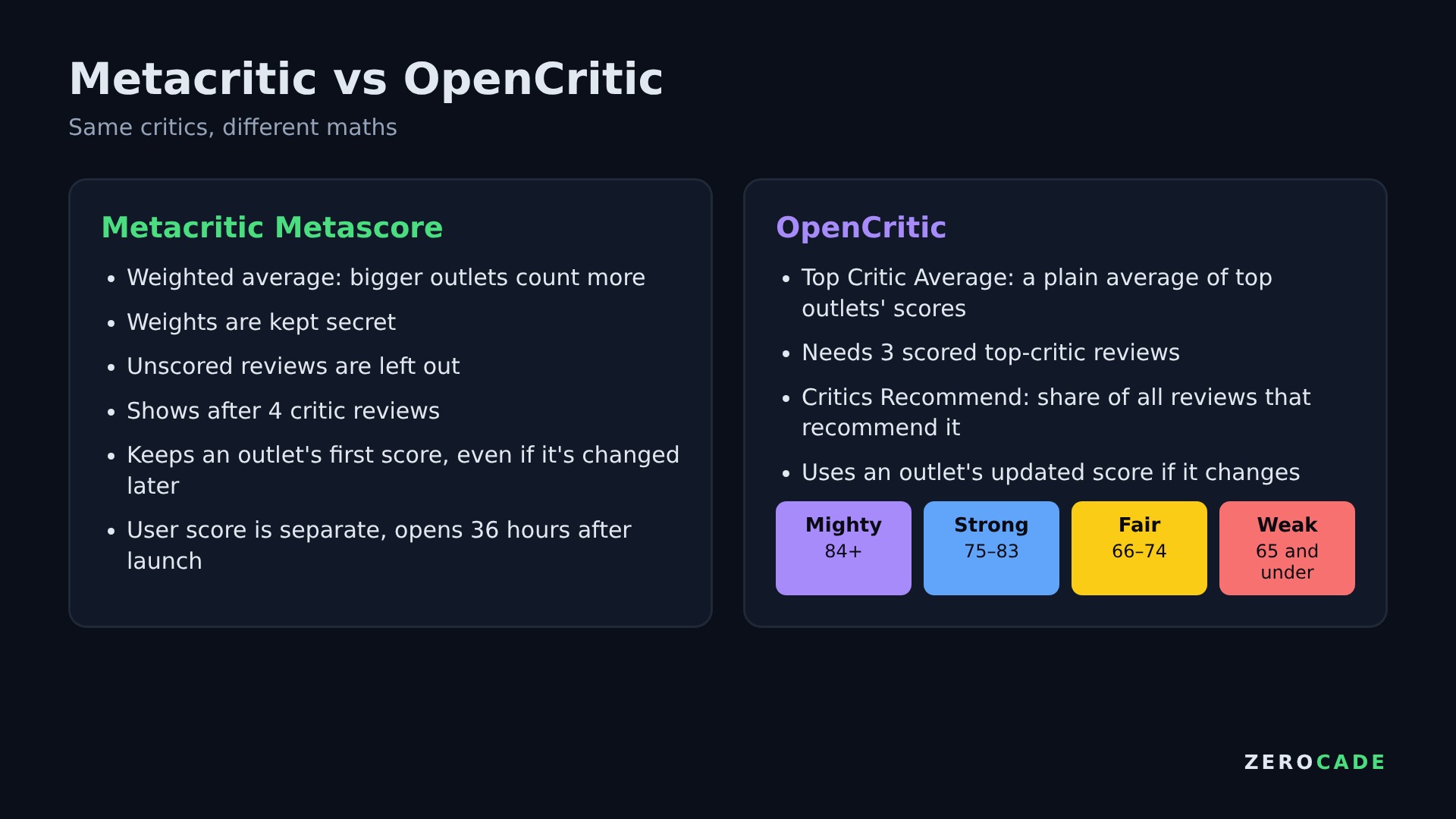
Image: Zerocade
Why one or two points can matter so much
For players, the gap between an 87 and an 89 means little. For studios it can mean real money. Some publishers have tied bonuses to Metascores. The best-known case is Fallout: New Vegas in 2010: Bethesda reportedly set a bonus target of 85 for developer Obsidian, and the game landed on 84. It went on to sell millions of copies anyway.
That's why the industry watches these numbers so closely, and why critics argue about the conversions and hidden weights. A single outlet with a heavy weight and a low score can pull a Metascore down further than you'd expect from the list of reviews.
How to read GTA 6's scores on November 18
Rockstar's recent big games set a very high bar. Grand Theft Auto V scored 97 on PS3 and Red Dead Redemption 2 scored 97 on PS4. GTA 6 will be compared with those numbers within minutes of the embargo lifting.

Image: Rockstar Games
A few tips for embargo day:
- Wait a few hours. The first number on either site is based on the reviews that went live first, and it usually moves as more arrive.
- Check both sites. If the Metascore and OpenCritic's Top Critic Average are close, the weighting isn't doing much. A big gap is worth a look.
- Look at the spread, not just the average. Ten reviews at 90 and ten split between 100 and 80 give the same average but tell very different stories.
- Read the reviews for your platform. A score doesn't tell you how the game runs on a base PS5 or Xbox Series S.
- Ignore the user score for the first 36 hours, because there won't be one.
A score is a quick summary of what critics thought. For a ₹5,999 game, the actual reviews behind it are worth ten minutes of your time.