

The short version
- Steam keeps 30% of each sale, dropping to 25% above $10 million and 20% above $50 million. Epic keeps 12%, and nothing at all on a game's first $1 million a year.
- In India, 18% GST comes out of the price first. On paper, a developer keeps about ₹593 of a ₹1,000 Steam game, before any publisher, refunds or their own taxes.
- This week, one indie game showed why developers put up with Steam's fee anyway: it earned 148 times more there than on Epic.
- Consoles generally take 30%, phones 15-30%, and itch.io lets developers choose, with a 10% default.
The argument this week
GamesRadar rounded up a debate between indie developers on November 19:
- Tiny Terraces, a $6.99 farming game from solo studio VuVuu, made $136,195 on Steam and $916 on Epic in a year, before tax.
- Skydome, the studio behind The Hive, said Epic brought in just 1.4% of its Steam revenue, and that it would "gladly pay Steam 30%" for the visibility.
- Ephemera Games said the opposite happened with Kernel Hearts, released in September at $19.99: about six in ten PC copies sold on Epic, three on Steam and one on Xbox. The reason: buying it on Epic unlocks one of its characters, Fernet, as a Fortnite outfit.
Ephemera's back-of-envelope example: 100,000 copies at $20 is $2 million. Steam's fee would be about $600,000, Epic's about $120,000. That $480,000 difference, the studio said, could fund a whole other game. It noted this ignores regional prices, refunds and taxes.

Image: Ephemera Games / Whitethorn Games
Step 1: tax comes off first
When you pay ₹1,000 for a game on Steam in India, that price includes 18% GST. Valve's tax FAQ lists India as 18%, "inclusive", and Valve pays the tax to the government itself.
So the first ₹152.54 of your ₹1,000 never reaches anyone in games. The real sale is ₹847.46, and that's the amount store fees are worked out on. Valve's agreement pays developers on "net revenues", meaning sales minus taxes, refunds and chargebacks.
Step 2: the store takes its cut
| Store | Standard cut | Details |
|---|---|---|
| Steam | 30% | 25% on a game's revenue above $10M, 20% above $50M (since 2018, including DLC). $100 fee per game, refunded after $1,000 in sales |
| Epic Games Store | 12% | 0% on the first $1M per game per year since June 2025, resetting every January. Unreal Engine's 5% royalty doesn't apply to Epic Store sales |
| Microsoft Store (PC) | 12% | Since August 2021 |
| Xbox, PlayStation, Nintendo consoles | 30% | Microsoft has confirmed its 30% in court; Sony and Nintendo don't publish theirs, but it's widely reported as 30% |
| Apple App Store | 15-30% | 15% for developers earning under $1M a year |
| Google Play | 15-30% | Changes from its Epic settlement bring 15% on a developer's first $1M a year; most markets outside the US, UK, EU, Japan and Korea get them by September 2027 |
| GOG | 30% | Widely reported; GOG doesn't publish it |
| itch.io | Developer's choice | Anything from 0% to 100%, with 10% as the default |
Epic also runs Epic First Run: launch exclusively on the Epic store and keep 100% for the first six months.
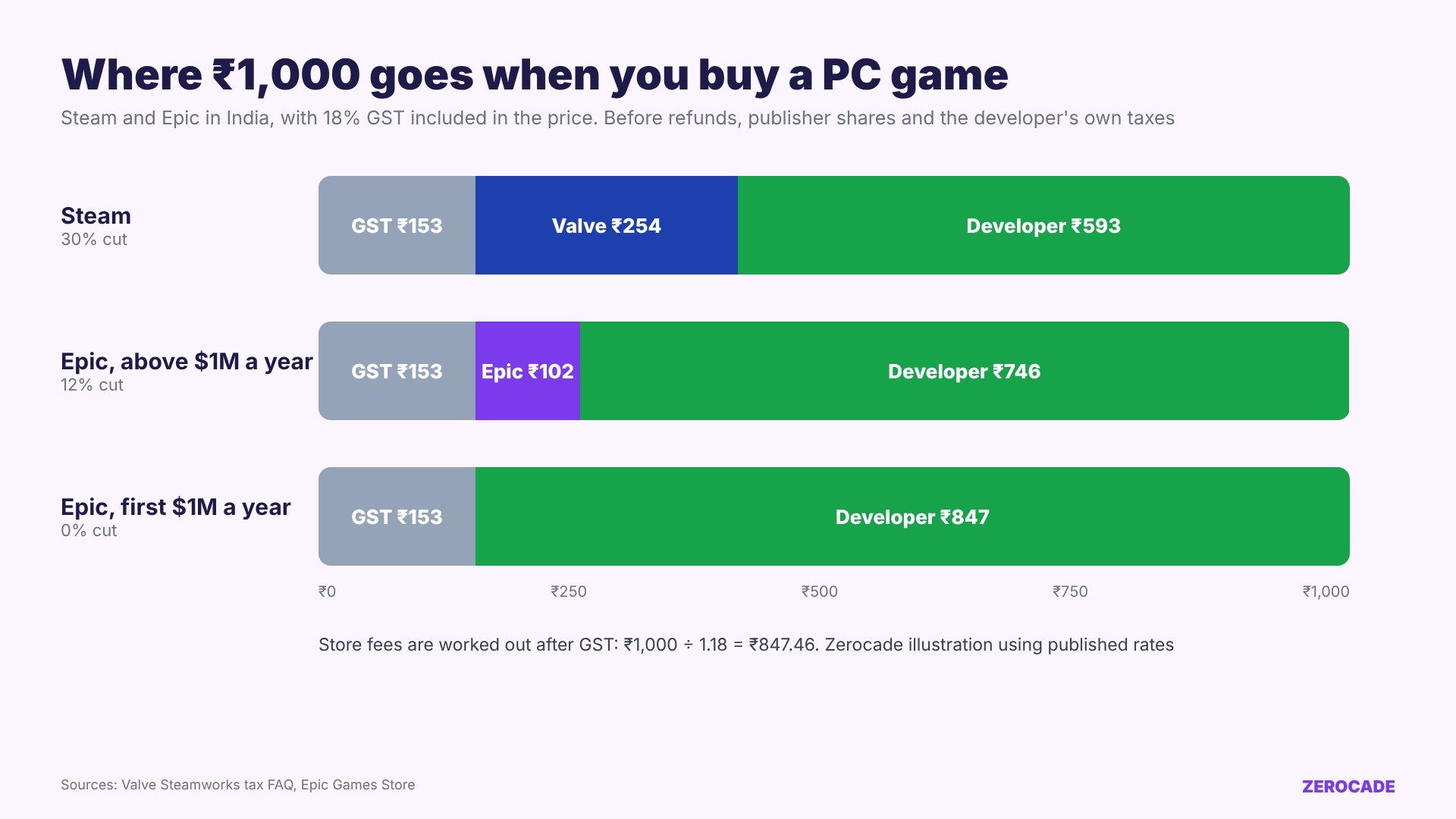
Image: Zerocade
Step 3: a ₹1,000 game, worked through
This is our illustration, using the published rates:
- On Steam: ₹1,000 minus ₹152.54 GST leaves ₹847.46. Valve's 30% is ₹254.24. The developer gets about ₹593, or 59% of the sticker price.
- On Epic, under $1M that year: about ₹847, assuming Epic also prices with GST included.
- On Epic, above $1M: 12% of ₹847.46 is ₹101.70, leaving about ₹746.
That isn't what lands in a developer's pocket, though. Refunds come out next: Steam refunds any game within 14 days of purchase if it's been played for under 2 hours. If a publisher is involved, it takes its share; Kernel Hearts, for instance, is published by Whitethorn Games. Then come the developer's own income taxes, marketing and the cost of making the game.
Step 4: why developers still pick Steam
A smaller cut of a much bigger pie usually wins. Steam hit a record 43.5 million users online at once on October 11, 2026, according to SteamDB. Wishlists, recommendations and Steam's sales events put games in front of more of those people than any other PC store can.
That's the Tiny Terraces lesson. Keeping 100% of $916 on Epic would still be far less than keeping 70% of $136,195 on Steam. Kernel Hearts shows the exception: when a store gives players a real reason to buy there, like a Fortnite outfit, the lower fee starts to matter a lot. Our guide to how analysts estimate game sales covers why Steam's numbers are also easier to track from outside.
There's an Indian side to this as well. Developers set their own Steam prices for India, and Valve added new conversion options in March 2026 to help pick regional prices. Lower Indian prices mean less money per copy for the developer, but often far more copies sold.

Image: VuVuu
The fight over fees isn't over
Store cuts are under pressure everywhere. In the US, courts have stopped Apple charging its full fee on purchases made through links out of apps, and a lower court is now setting what it can charge. Google's changes come from its settlement with Epic. In India, the Competition Commission fined Google ₹936.44 crore in 2022 and has an ongoing case against Apple over in-app commissions of up to 30%. Steam's 30% has so far stayed put.
What to watch
Watch for whether more studios share their Steam-versus-Epic numbers after this week, and for Google Play's new fees reaching India by September 2027.