
The short version
- Most chip leaks are entries in public benchmark databases like Geekbench or OpenBenchmarking. Anyone can upload to them.
- Single-core tells you how fast one core is, which drives everyday snappiness. Multi-core uses every core at once.
- Early results usually come from engineering samples on unfinished software, so the final chip can be faster or slower.
- Scores from different benchmark versions can't be compared directly, and a single listing can be faked.
Where leaks come from
When a phone maker or chip company tests unreleased hardware, the benchmark app often uploads the result to a public database. Geekbench's browser, for example, lists every result that wasn't run offline, with the device name, chip, clock speeds and memory.
Leakers comb those databases for unfamiliar model names, codenames or motherboard IDs, then post the screenshots. That's how this year's Exynos 2700 leak and the AMD Zen 6 handheld chip surfaced.
Other leaks come from internal test slides, supply-chain sources or retail listings. Those are harder to check, because there's no public database entry to look up.
What the numbers mean
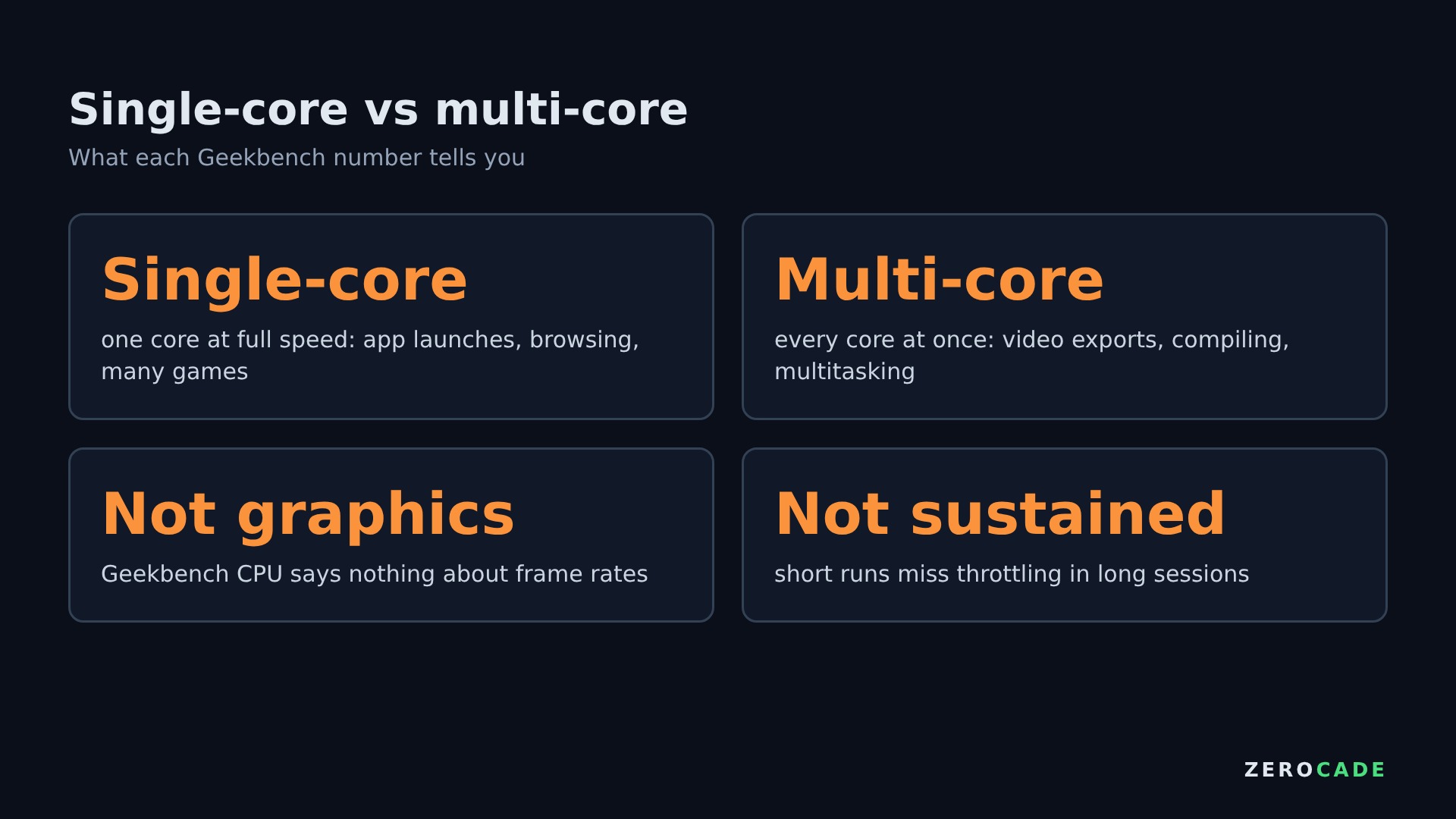 Image: Zerocade
Single-core runs a workload on one CPU core. It matters most for opening apps, browsing and many games, which still lean on one or two fast cores.
Multi-core runs work on every core at once. It's better for video exports, compiling code and heavy multitasking. A chip with lots of small cores can post a big multi-core score while feeling no faster day to day.
Geekbench's CPU test isn't a graphics test. A high CPU score says nothing about gaming frame rates, which depend far more on the GPU. And a Geekbench run lasts only a minute or two, so it misses what happens over a 30-minute gaming session. That's why a phone chip can top Geekbench and still throttle once it heats up. Sustained tests like 3DMark's stress tests tell you more about that.
Why early scores mislead
Engineering samples are pre-production chips. They often run at lower clock speeds with early drivers and firmware. The AMD handheld chip we covered ran at just 2.4GHz, which is almost certainly below its final speed. The reverse also happens: reference devices built by chip makers often run at higher power limits than the phones you can buy, so their scores flatter the final product.
Versions matter. Geekbench 7 scores lower than Geekbench 6 on the same chip. The Snapdragon 8 Elite Extreme Gen 6 shows the gap well: about 4,257 single-core on Geekbench 6 against 3,582 on Geekbench 7, per Beebom's figures. A "36% faster" claim that mixes the two means very little.
Fakes happen. Uploads can be edited, and a model name can be typed in by hand. Geekbench's maker, Primate Labs, can flag or remove suspicious results, but not every one gets caught. One listing on its own is a hint, not proof.
A quick checklist
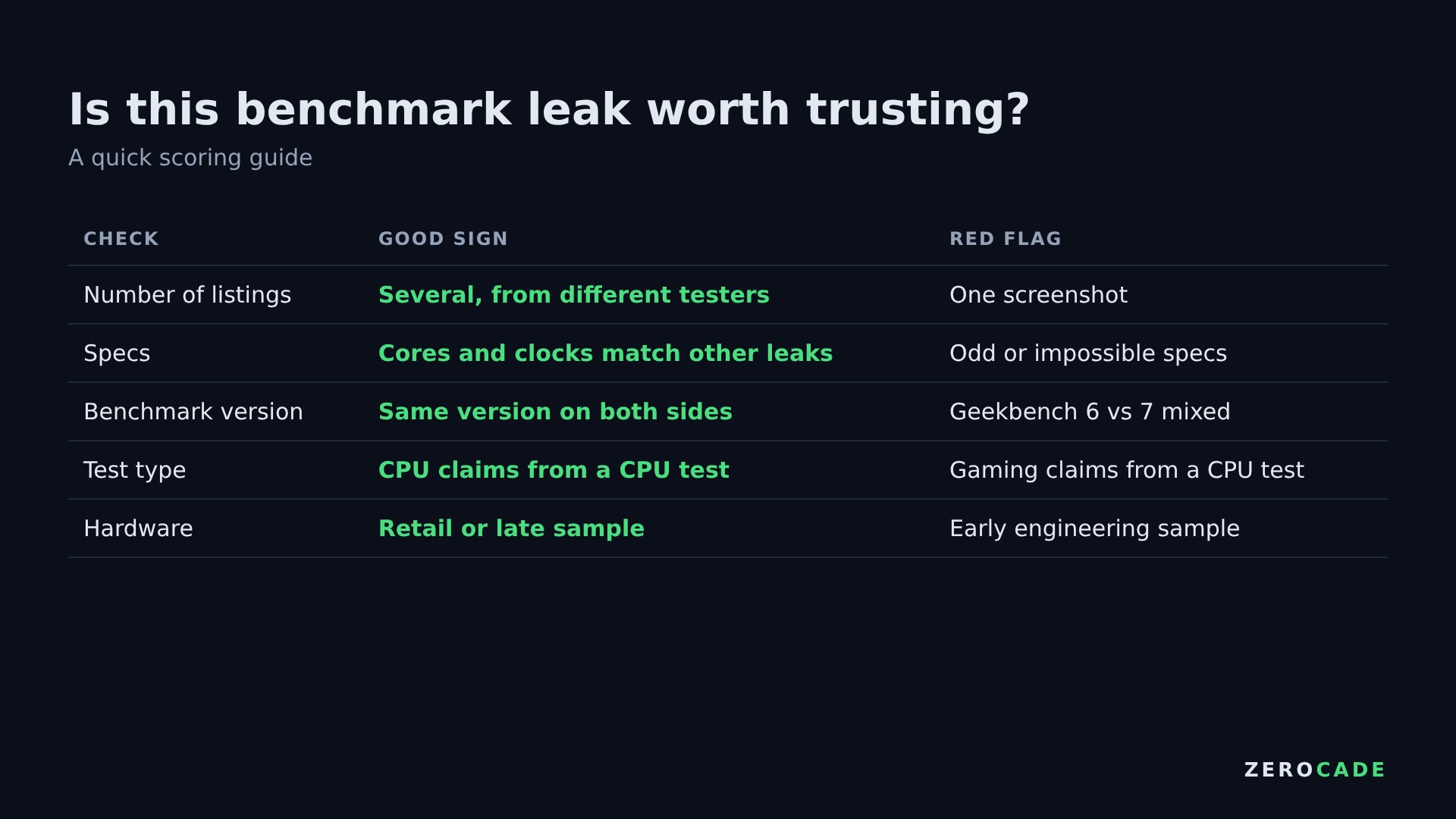 Image: Zerocade
Before you trust a leak, ask:
- Is there more than one listing, from more than one source?
- Do the core count and clocks match other reports?
- Are the comparisons using the same benchmark version?
- Is it a CPU test being used to make claims about gaming?
- Is it an early sample, or something close to retail?
If the answers to the first two are yes and the next two are no, it's worth taking seriously. Otherwise, wait for launch-day testing from outlets that run the chip themselves.
Who to trust
Leakers build records over time. Some, such as KeplerL2 on AMD graphics or Digital Chat Station on Chinese phones, are right often enough that their posts get covered widely. Others post everything and get remembered for the hits. On paper, a leaker's track record on that specific kind of hardware is the best guide you have. Whatever the source, treat any number before launch as a rough direction, not a result.