
The short version
- Phone batteries store charge by moving lithium into a material called the anode. For decades that's been graphite. Silicon-carbon batteries mix silicon into it.
- Silicon can hold roughly ten times as much lithium as graphite by weight, so the same size cell stores more. In practice, that's about a 10-20% gain in energy density.
- The catch is that silicon swells as it charges, up to 300% in its pure form. Wrapping it in a carbon structure keeps that down to about 10-20%.
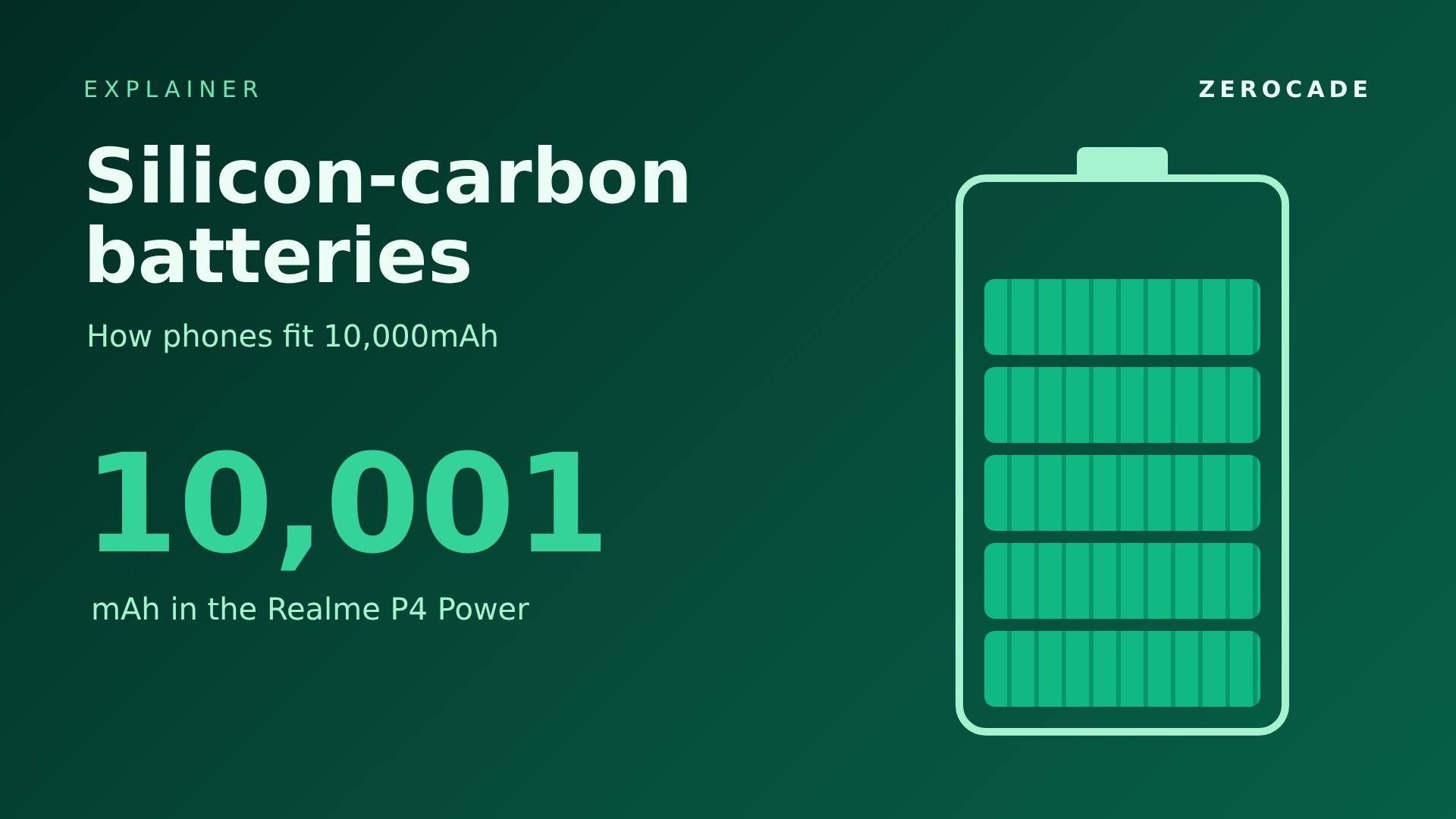
- That's how phones like the OnePlus Turbo 6 (9,000mAh) and the Realme P4 Power (10,001mAh, sold in India) fit such big batteries. Apple, Google and Samsung have held back.
How a phone battery works
Every lithium-ion battery has the same basic parts: two electrodes, a liquid electrolyte between them, and a thin separator that stops them touching.
- Charging: the charger pushes lithium ions out of the cathode (usually a metal oxide), through the electrolyte, and into the anode, where they're stored.
- Using the phone: the ions flow back to the cathode, and the electrons they leave behind travel through the phone's circuits to power it.
- Capacity depends largely on how many lithium ions the anode can hold.
That third point is where silicon comes in. Graphite stores lithium by letting ions slip between its layers of carbon atoms. It's stable and cheap, but it's close to its limit: about 372 mAh per gram in theory.
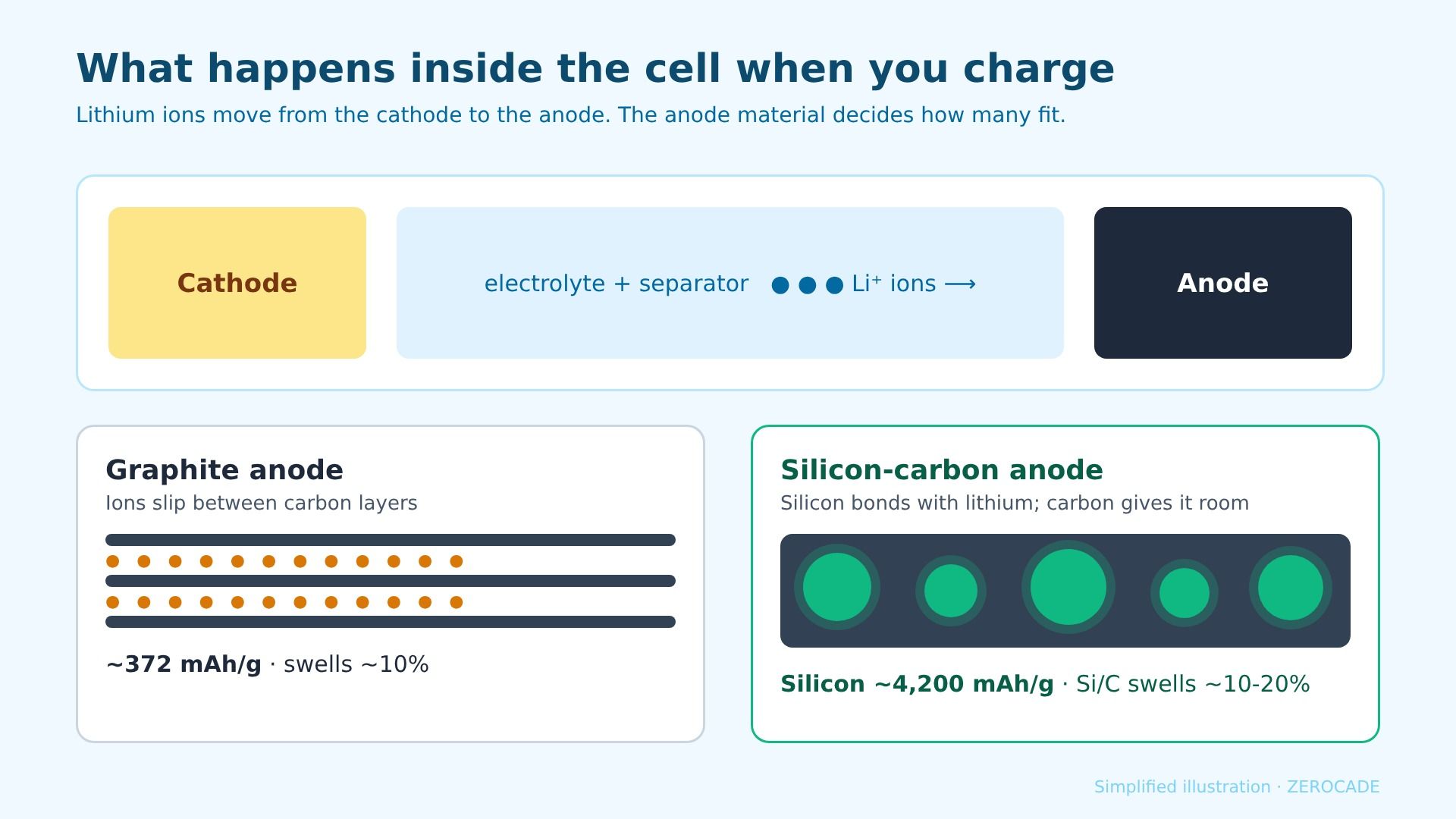
Image: Zerocade
Why silicon holds so much more
Silicon doesn't just let lithium slot between layers. It bonds with it chemically, and each silicon atom can take on several lithium atoms. That gives silicon a theoretical capacity of around 4,200 mAh per gram, roughly ten times graphite's.
So why not build anodes from pure silicon? Because all that lithium has to go somewhere. Pure silicon swells by up to 300% when fully charged, compared with about 10% for graphite. Do that hundreds of times and the material cracks, the protective layer on its surface breaks and re-forms, and the battery loses capacity fast. Silicon also conducts electricity less well, which adds heat.
What the carbon does
A silicon-carbon anode spreads small silicon particles through a carbon framework. The carbon does three jobs:
- It gives the silicon room to expand without breaking the anode apart.
- It holds the structure together over many charge cycles.
- It carries current, making up for silicon's poor conductivity.
According to Android Authority, a well-designed Si/C cell can limit swelling to about 10-20%, depending on how much silicon is in it. More silicon means more capacity but more swelling, so every brand picks its own balance. Most don't say what percentage they use.
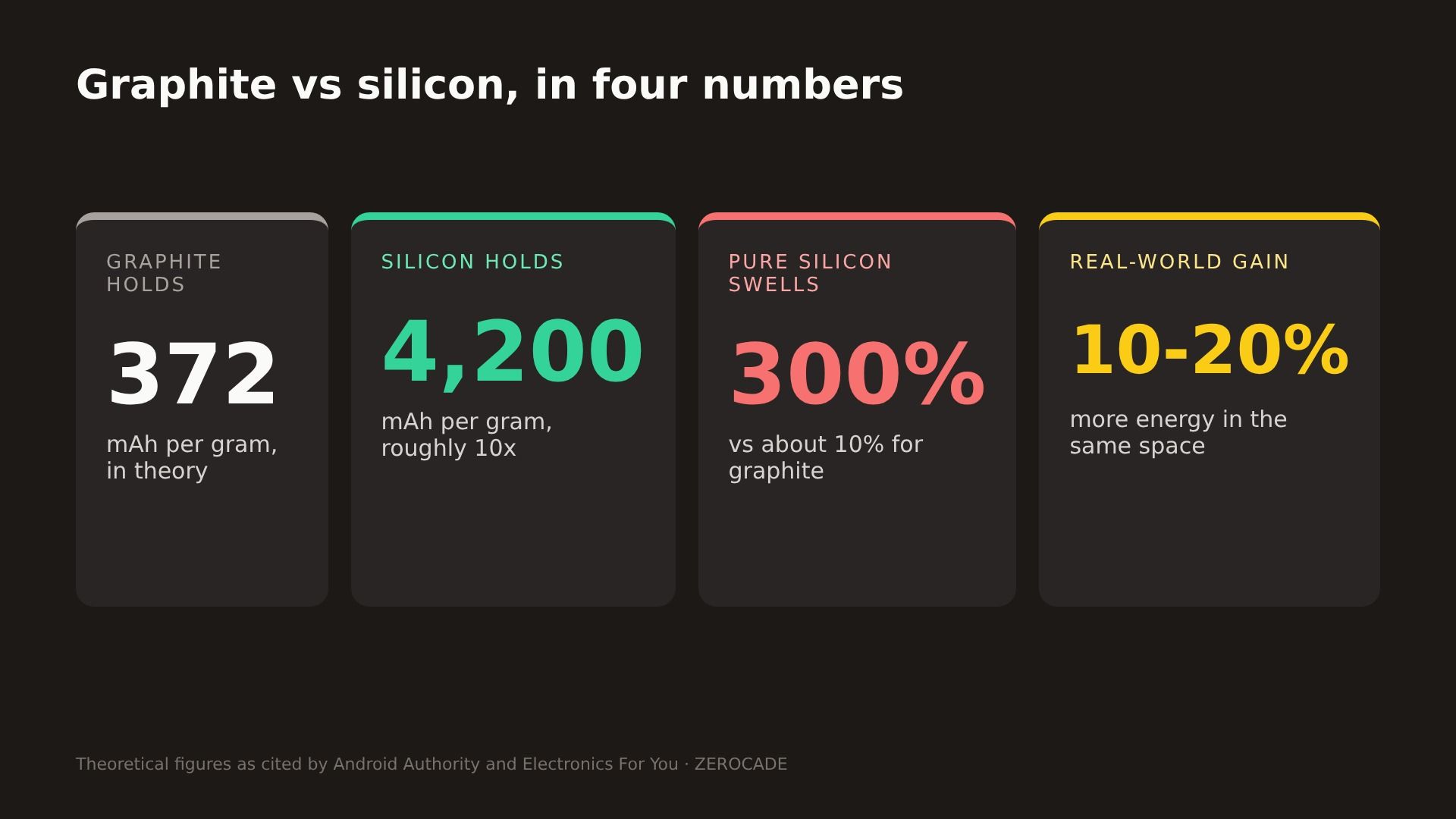
Image: Zerocade
What it means for real phones
Chinese brands started adopting silicon-carbon in flagships a few years ago, and the jump has been visible model to model:
| Phone | Battery | Note |
|---|---|---|
| OnePlus 12 | 5,400mAh | Graphite |
| OnePlus 13 | 6,000mAh | Silicon-carbon, up from 5,400mAh |
| OnePlus Turbo 6 | 9,000mAh | 8.5mm thick, 217g |
| Realme P4 Power | 10,001mAh | Sold in India, 219g, 80W charging |
The trend is showing up in sales too. Phones with batteries of 6,000mAh or more made up 10% of global smartphone sales in January 2025 and 29% in January 2026, according to 91mobiles data cited by Electronics For You. Our China performance phones comparison shows how this year's gaming phones all lean on huge batteries.
For gaming, a bigger battery doesn't just mean longer sessions. It also means the phone can sustain higher brightness and refresh rates without dying halfway through an evening. Heat is still the limit on performance, though, as our thermal throttling guide explains.
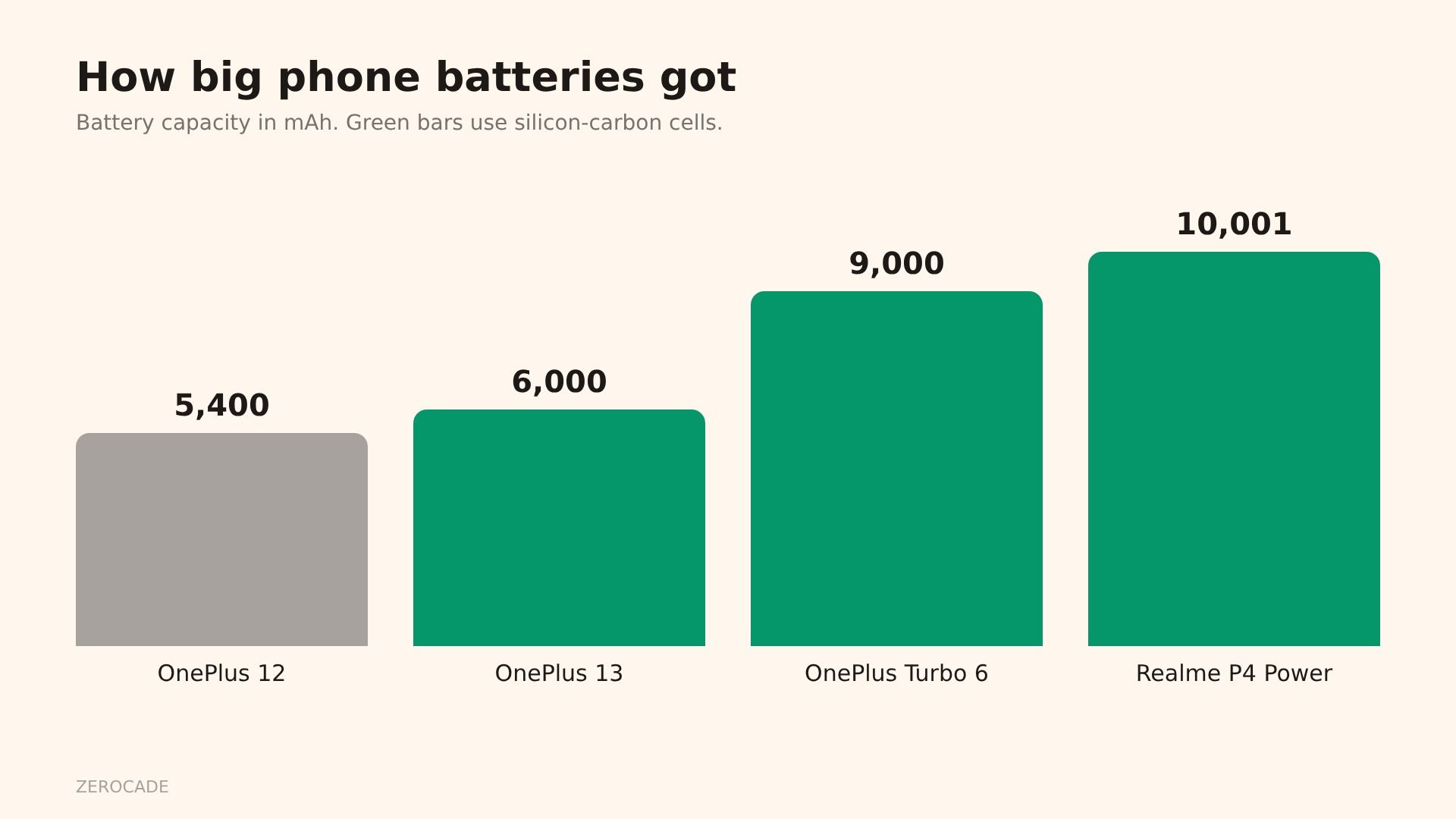
Image: Zerocade
The catch
- Lifespan. Android Authority notes that Si/C cells may not last as long as the most durable graphite cells, especially with very fast charging. Lower-silicon designs can match graphite. Realme claims its 10,001mAh cell keeps 80% capacity after 1,650 full cycles and offers an eight-year battery-health guarantee, but that's the maker's claim.
- Cost. The cells are more expensive and trickier to make.
- Limited long-term data. Electronics For You points out that real-world ageing data, especially at high temperatures, is thin, and many durability figures come from manufacturers.
Why Apple, Google and Samsung haven't switched
As of the iPhone 17 and Pixel 10, neither Apple nor Google uses silicon-carbon cells, and Samsung has been similarly conservative with battery sizes. BGR suggests the bigger brands are wary of swelling and stability, and that Apple in particular doesn't need the extra capacity because its phones already get good battery life from efficient chips. None of the three has explained its reasons publicly.
mAh isn't the whole story
One last thing to watch: mAh measures charge, not energy. Energy is charge multiplied by voltage, so a 10,000mAh battery at a typical 3.85V holds about 38.5 watt-hours. Two phones with the same mAh can still last different amounts of time depending on the chip, the screen and the software. Check battery-life tests from reviewers rather than comparing mAh numbers alone.