

The short version
- Cache is a small pool of very fast memory built into the processor. It holds the data the CPU needs next, so it doesn't have to wait on your RAM.
- 3D V-Cache is AMD's trick of stacking an extra slice of cache onto the processor, instead of beside it. It triples an 8-core Ryzen's L3 from 32MB to 96MB.
- Games reuse lots of data many times per frame, so more cache often means higher and steadier frame rates, especially with a fast graphics card.
- The newest, the Ryzen 7 9850X3D, launched at $499 in January and sells for about ₹53,000 in India. The relaunched 5800X3D is the budget route.
Cache, in one paragraph
Your RAM is fast, but compared to the CPU it's far away. Every trip out to it costs time the processor spends doing nothing. Cache sits right next to the cores and answers much faster. There are levels: tiny L1 and L2 caches inside each core, and a bigger L3 shared by all the cores. The more of a game's working data fits in L3, the fewer slow trips to RAM.
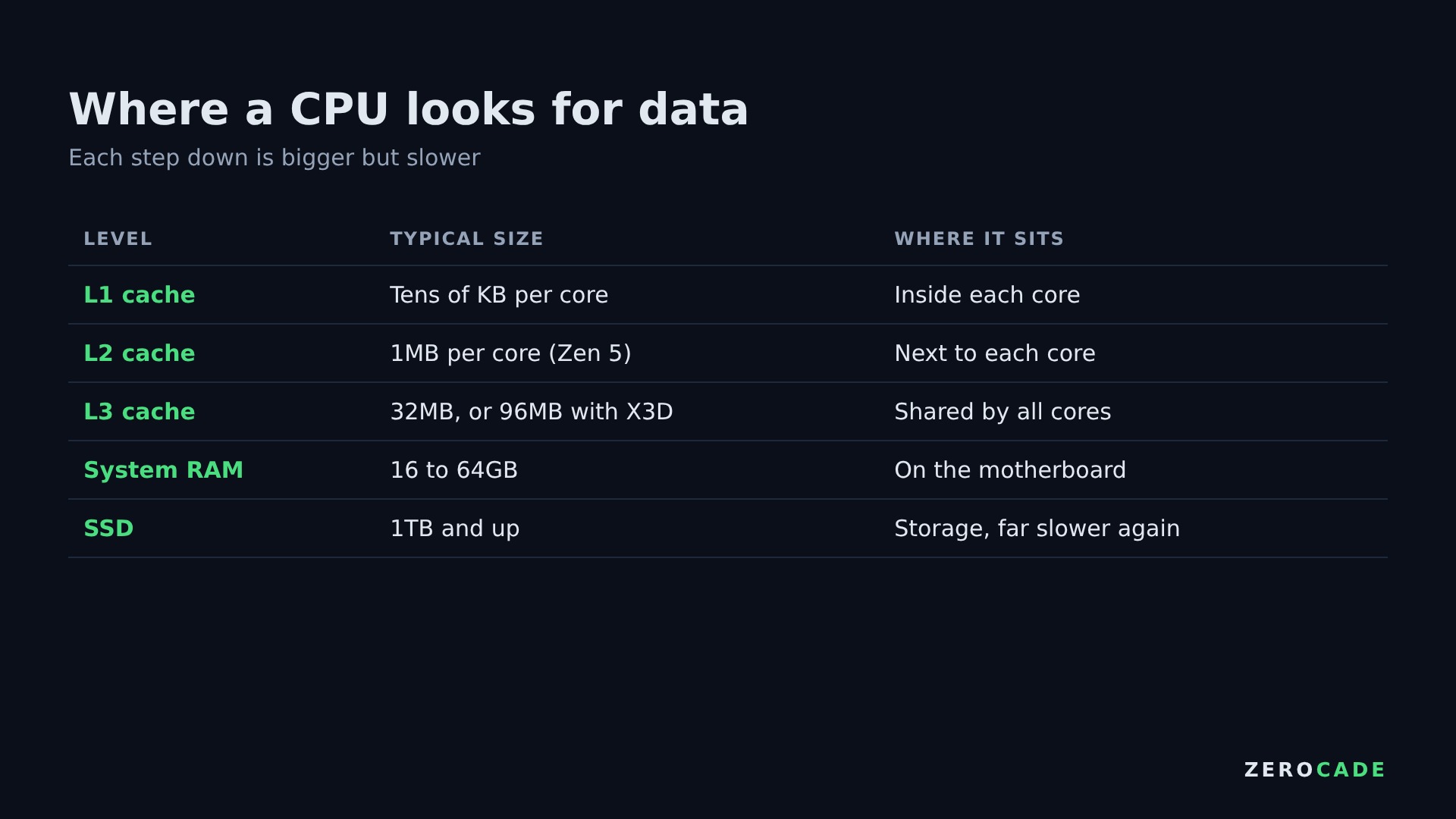 Image: Zerocade
What AMD stacked
A normal Ryzen 7 5800X has 32MB of L3. For the 5800X3D in 2022, AMD bonded a second chip with another 64MB directly onto the processor die, making 96MB in the same small package. That vertical stacking is the "3D" part. TSMC handles the stacking, using a technique that joins the two layers copper to copper without the usual solder bumps.
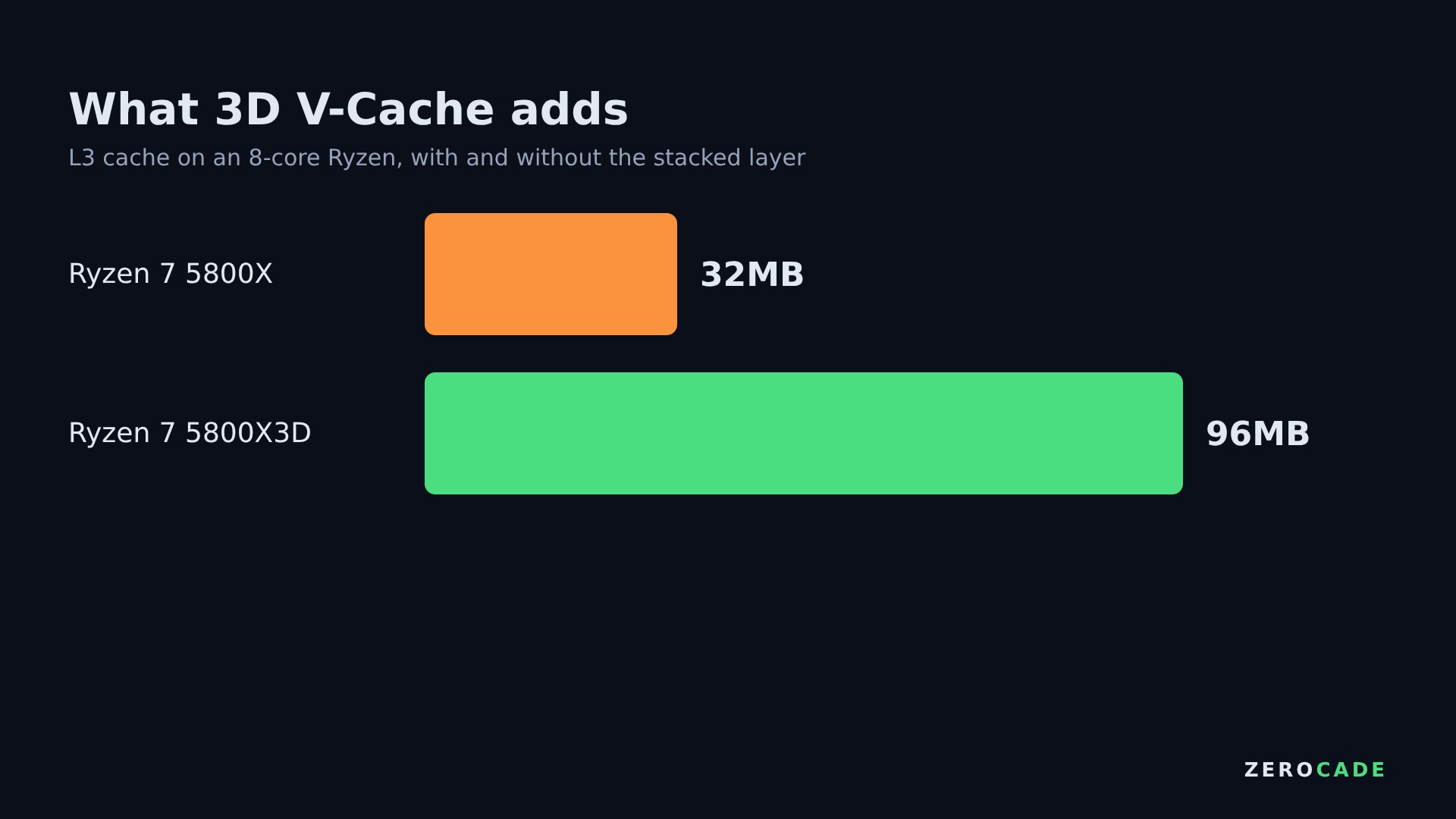 Image: Zerocade
The original method used for the 5800X3D has since been replaced, which is why reviving the chip in 2026 needed fresh engineering work.
Why games benefit so much
Games keep jumping between the same bits of data: the positions of characters, physics objects, AI routines and the world around you. That access pattern is hard to predict and doesn't fit in a small cache, so a normal CPU waits on RAM a lot. With triple the L3, much more of it stays close.
The gains show up most when the CPU is the bottleneck. That means high-refresh gaming at 1080p, competitive shooters at 200fps and up, and busy simulation or strategy games. In AMD's own testing against Intel's Core Ultra 9 285K at 1080p, the 9850X3D's lead ranged from about 5% in Call of Duty: Black Ops 7 to about 60% in Baldur's Gate 3, a game known for heavy CPU load in its busiest areas. Those are AMD's figures, so treat them as a best case.
At 4K, the graphics card usually limits you, so a big cache matters less. AMD's testing also found that memory speed barely matters with X3D: DDR5-4800 and DDR5-6000 differed by under 1% across 30-plus games, because the cache does the work fast RAM would otherwise do.
The X3D family
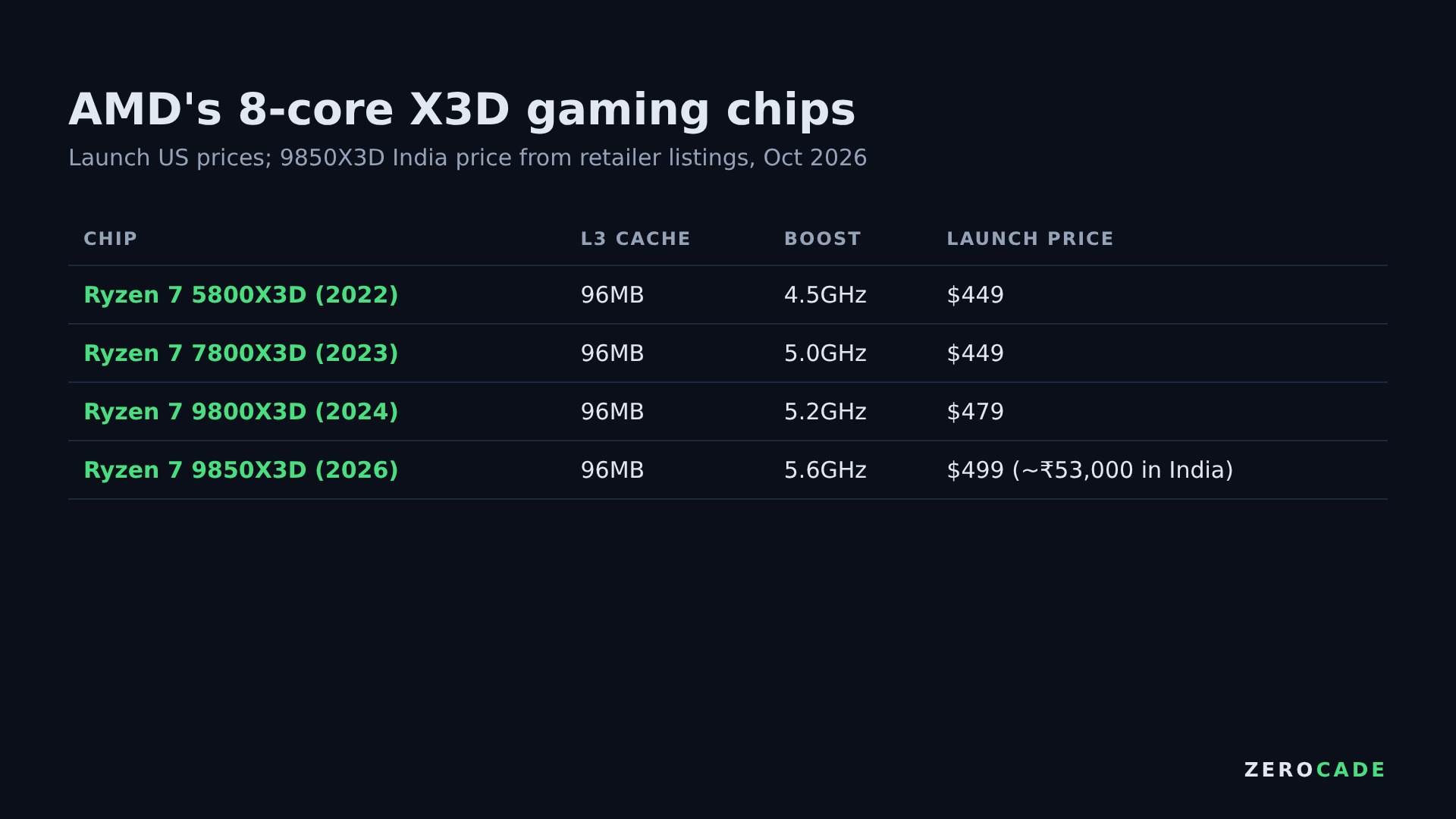 Image: Zerocade
All four 8-core gaming chips share the same 96MB of L3. What changes is the core design and the clock speed. The 9850X3D is essentially a faster-binned 9800X3D, boosting to 5.6GHz instead of 5.2GHz at a 120W TDP. AMD's own chart puts it about 3% ahead of the 9800X3D, and independent reviews reported a similar 3 to 6%. Our chip binning guide explains how AMD picks the faster chips.
In India, getpc's retailer tracking shows the 9850X3D at around ₹52,200 to ₹53,000 through October at shops like EZPZ Solutions and Computech, with Amazon listing it higher at about ₹58,000. The 9800X3D is usually the better value if you can find it a few thousand rupees cheaper, given how close they perform.
AMD also sells 12- and 16-core X3D chips, like the Ryzen 9 9950X3D. Those only put the extra cache on one of their two core groups, which suits people who game and also do heavy work like video editing.
The trade-offs
- Heat and clocks. In the first two X3D generations, the cache layer sat on top of the cores and trapped heat, so clock speeds were lower and overclocking was locked.
- Not for everything. Video editing and code compiling care more about core count and clock speed than cache, so a regular Ryzen 9 or Core Ultra can win there for less.
- Price. X3D chips cost more than their non-X3D twins.
For the Ryzen 9000X3D chips, AMD flipped the design and moved the cache layer underneath the cores. That lets heat out more easily, allows higher clocks and finally unlocked overclocking.
What to look for
If gaming is the main job for your next PC, an X3D chip belongs on the shortlist, on paper at least. The 9800X3D and 9850X3D need an AM5 board and DDR5. The 5800X3D still works on older AM4 boards with DDR4, which saves a lot with RAM prices where they are. Our DDR4 vs DDR5 guide helps decide which platform makes sense right now.