

The short version
- Mesh shading changes how a GPU handles a game's geometry, the triangles that make up every model.
- It splits models into small groups called meshlets and lets the GPU drop hidden ones before it spends time drawing them.
- It's supported on Nvidia RTX cards (and GTX 16), AMD RDNA 2 and newer, Xbox Series X|S, and recent Apple chips like the new iPad mini's A20 Pro.
- Games that rely on it, like Alan Wake 2, can run poorly or not at all on older GPUs.
How GPUs used to handle geometry
Every 3D object in a game is built from triangles, and each triangle has corners called vertices. A character might have tens of thousands of triangles; a whole city scene, many millions.
For years, GPUs pushed those vertices through a fixed line of steps. A vertex shader positioned each vertex. Optional tessellation and geometry shader stages could add detail. Then the GPU turned the triangles into pixels, tested which were hidden, and coloured the rest.
That pipeline was designed when scenes had far fewer triangles. Its main weakness is that most of the "is this even visible?" decisions happen late, after the GPU has already done a lot of work on geometry that ends up behind a wall or off screen.
What mesh shaders change
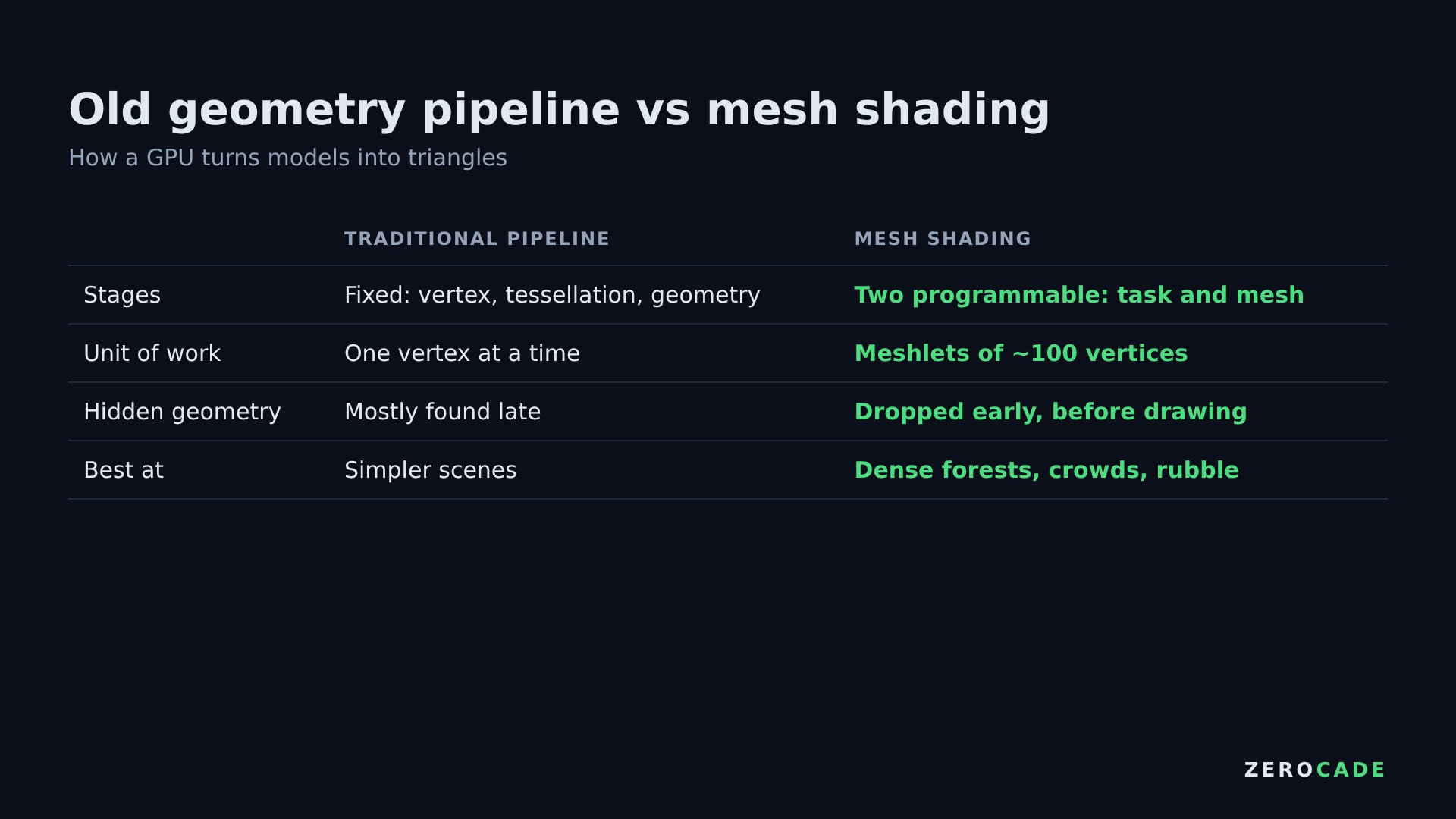 Image: Zerocade
Mesh shading replaces most of those fixed stages with two programmable ones:
- A task shader (Microsoft calls it an amplification shader) looks at groups of geometry and decides which are worth processing at all, and at what level of detail.
- A mesh shader then builds the actual triangles for each meshlet, usually a chunk of around a hundred vertices and a similar number of triangles.
The big win is culling: throwing work away early. If a meshlet is behind a wall, outside the camera's view or facing away, the GPU can skip it before it costs anything. That helps most in dense scenes like forests, crowds and rubble, where most of the geometry is hidden at any moment.
It also gives developers more control. Because both stages are programmable, a game can choose its own level-of-detail rules, generate geometry procedurally, or stream in detail as the camera gets closer, all on the GPU. Unreal Engine 5's Nanite system, which handles huge triangle counts, uses a similar cluster-based approach.
Who supports it
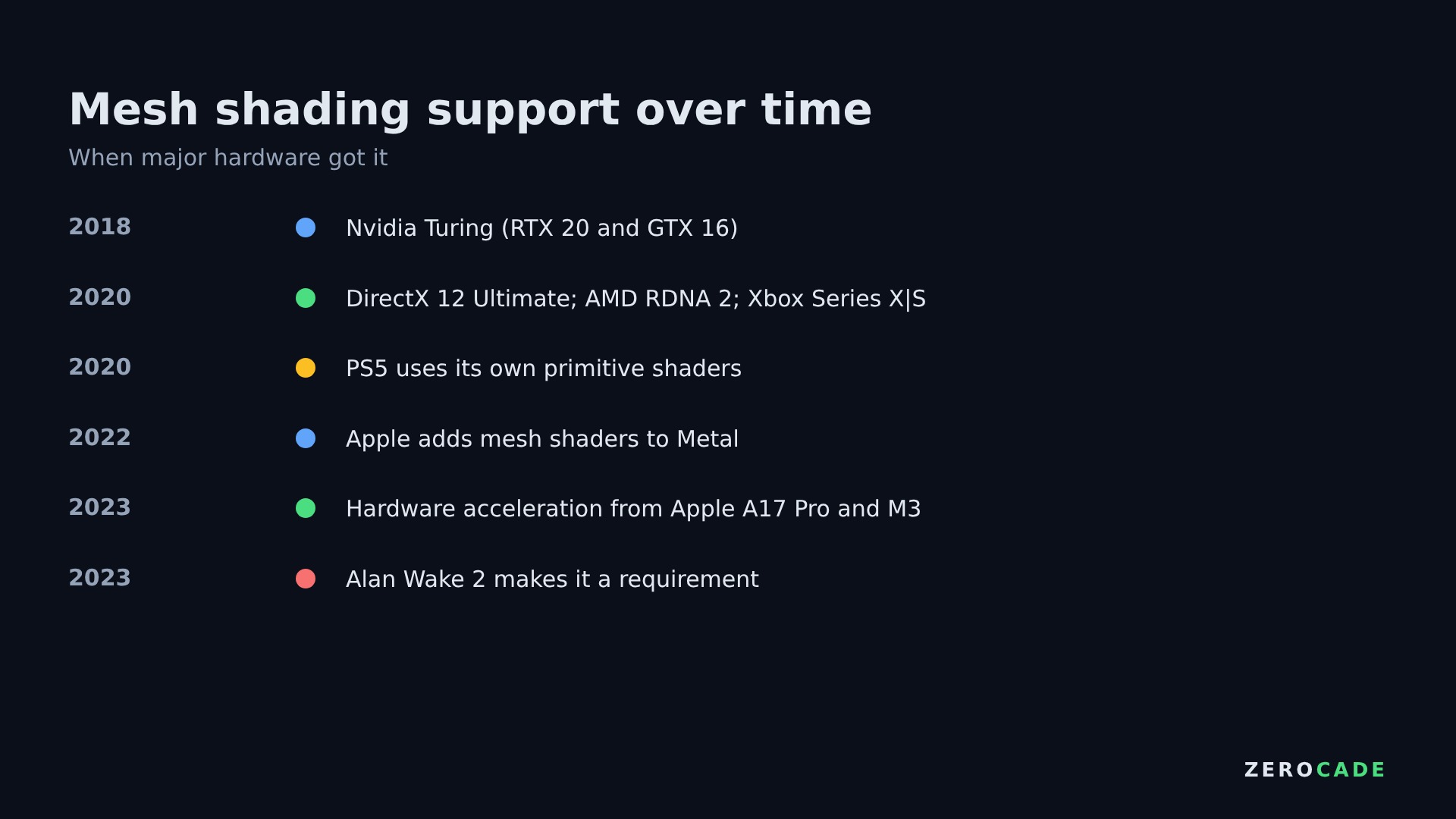 Image: Zerocade
Nvidia brought mesh shaders to its Turing cards in 2018, covering the RTX 20 and GTX 16 series. Microsoft made them part of DirectX 12 Ultimate in 2020, alongside ray tracing. AMD's RDNA 2 GPUs and the Xbox Series X|S support them.
The PS5 uses its own similar feature, called primitive shaders, which does much of the same job in a different form. That's one reason cross-platform games can use the technique on both consoles.
Apple added mesh shaders to its Metal graphics API in 2022 and hardware acceleration from the A17 Pro and M3 chips onward. The new A20 Pro iPad mini lists it too. On phones, recent Snapdragon and Dimensity chips support it through Vulkan, though few mobile games use it yet.
Why players should care
Mesh shading is one reason newer games can show far more detail without a matching drop in frame rate. The catch is that games built around it can leave older cards behind.
Alan Wake 2 listed mesh shader support as a requirement at launch in 2023. Owners of GTX 10-series and RX 5000-series cards, which lack it, found the game ran very badly or refused to start until a later patch improved things. More engines now assume mesh shaders by default, so expect more games to follow.
What to check before you buy
If you're shopping for a GPU, a handheld or a gaming tablet, check for DirectX 12 Ultimate or mesh shader support in the spec sheet:
- Nvidia: any RTX card, plus GTX 16 series.
- AMD: RX 6000 and newer, and handhelds with RDNA 2 or later graphics, including the Steam Deck and ROG Ally family.
- Intel: Arc graphics cards and recent Core Ultra integrated graphics.
In India, older GTX 10-series and RX 5000-series cards still turn up cheaply second-hand. On paper they're fine for older games, but they'll struggle with more and more new releases. Our TFLOPS explainer covers why raw power figures don't tell the whole story either.