
The short version
- Kotaku reported on October 22, 2026 that Gears of War: E-Day cost Xbox over $500 million (about ₹4,400 crore) to make, before marketing. Bloomberg's Jason Schreier called the number "real" on October 30. Microsoft hasn't confirmed it.
- Most of a game's budget is people: hundreds of developers paid for four to six years. Cutscenes, motion capture, outsourcing and tools add the rest.
- Real figures from leaks and court documents: Spider-Man 2 about $300 million, The Last of Us Part II about $220 million, Horizon Forbidden West about $212 million.
- Marketing usually comes on top, which is why big games need millions of full-price sales just to break even.
Where the $500 million figure comes from
The E-Day number started with a single anonymous source "familiar with Xbox's business", quoted by Kotaku. Insider Gaming's Tom Henderson had said in June that the cost was over $400 million. The Game Business editor Chris Dring said what he'd heard matched the $500 million figure, and Schreier, discussing BioWare's closure on October 30, called it a real number.
Windows Central's Jez Corden pushed back on how it's counted. His sources say the figure covers The Coalition's whole budget across E-Day and earlier work, including assets that will be reused in a sequel. So treat $500 million as reported, not official, and probably a studio-wide total.
 Image: Xbox Game Studios
Most of the money is salaries
A big-budget game is built by a small town of people. Insomniac's leaked files from December 2023 showed 264 developers working directly on Spider-Man 2 at its peak, plus 116 more in management, IT and support. A big team is only part of it. Most AAA games now take four to six years, and the costs add up every month.
Here's a simple way to see it. Each developer costs the studio far more than their salary. Taxes, health cover, office space, computers, software licences and equipment all add on top. Multiply that full cost by a few hundred people, then by 60 or 70 months, and you're in the hundreds of millions before anything else.
That's also why delays are so expensive. Every extra month keeps the whole team on the payroll.
Cutscenes, capture and content
The rest of the budget goes into making the game look and play like a modern blockbuster:
- Cinematics: Spider-Man 2's 314 minutes of cutscenes alone cost over $40 million, according to the leak. Insomniac's own notes said they "sprawled out" past early estimates.
- Performance capture: actors, capture stages, facial scanning and animation clean-up for every scene.
- Art and world-building: huge, detailed cities and characters at today's quality bar.
- Outsourcing: external studios build art, test the game and port it. Credits on big games often list dozens of partner studios.
- Audio, music and licences: orchestral scores, voice casts in several languages, licensed songs and car or weapon brands.
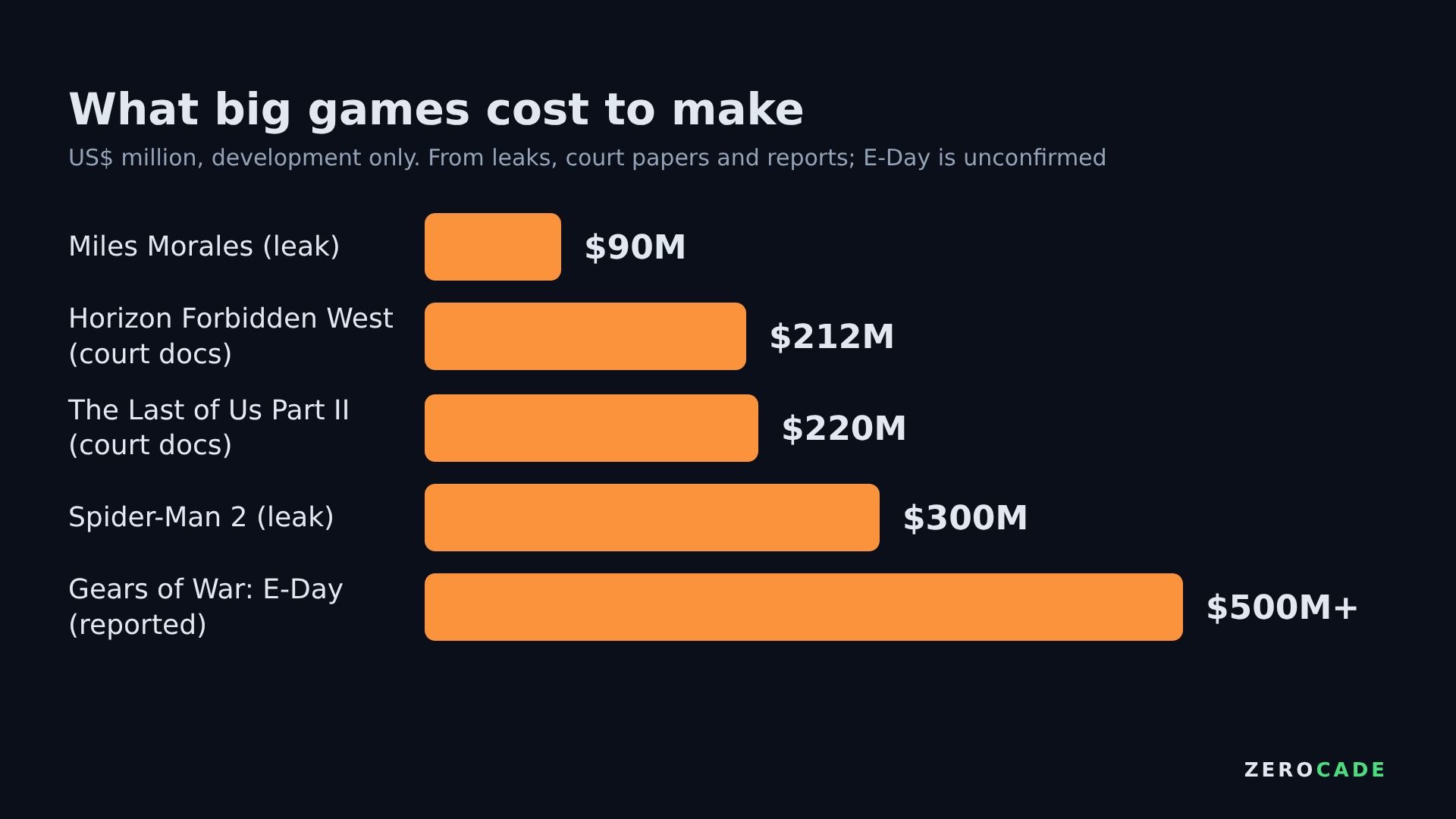 Image: Zerocade
Real budgets, from leaks and court documents
Publishers almost never share budgets, so most real numbers come out by accident. Insomniac's hack showed Spider-Man 2 cost around $300 million, about $30 million over its $270 million budget and nearly three times the 2018 game. It needed 7.2 million full-price sales to break even. The shorter Miles Morales cost just $90 million, and Sony's internal slides set a goal of keeping future tentpole games at $350 million or less.
The FTC v. Microsoft case in 2023 made public Sony's figures for The Last of Us Part II (about $220 million) and Horizon Forbidden West (about $212 million). Activision Blizzard's numbers for big Call of Duty games were higher still once marketing was included.
Why it matters to players
On paper, $500 million needs a lot of sales. Alinea Analytics estimated E-Day sold about 230,000 copies in its first week, worth around $37 million, though Game Pass makes that hard to judge. Our E-Day launch coverage has the details.
 Image: Xbox Game Studios
When budgets climb this high, publishers take fewer risks. Sequels and remakes feel safer than new ideas, prices creep up, and a single flop can close a studio. EA's reported decision to drop the next Mass Effect and focus on Star Wars Battlefront 3, which we covered in our BioWare closure report, is the same pressure. That's also why so many games now arrive with season passes and in-game stores.
Next time a game gets delayed or cancelled, look at its team size and how long it's been in development. The money usually explains the decision.