
The short version
- Reuters reports that private equity firm Silver Lake and Saudi Arabia's Public Investment Fund (PIF) have held talks to buy Unity, the company behind one of the world's most used game engines.
- The group reportedly discussed a valuation of about $25 billion (roughly ₹2.4 lakh crore). Unity is working with an investment bank to weigh its options.
- No deal is agreed. Unity declined to comment, and Silver Lake and PIF didn't respond to Reuters.
- PIF and Silver Lake were part of the consortium that took EA private in a $55 billion deal, which Reuters says closed in August.
What Reuters reported
The report came out on November 5, from Reuters journalists Milana Vinn and Akash Sriram, citing people familiar with the matter. According to them, Silver Lake and PIF approached Unity in recent weeks. Unity has since been working with an investment bank to evaluate the approach.
The talks are early. Reuters says no deal is certain, and the plan and terms could still change. The roughly $25 billion valuation was discussed before Unity's latest results, which lifted its market value to about $21.5 billion (about ₹2 lakh crore).
There's an awkward detail. Silver Lake already owns about 8% of Unity, from an investment of up to $400 million in 2017, and Silver Lake's Egon Durban sits on Unity's board. Reuters notes that would normally mean he steps back from any board discussion of a sale.
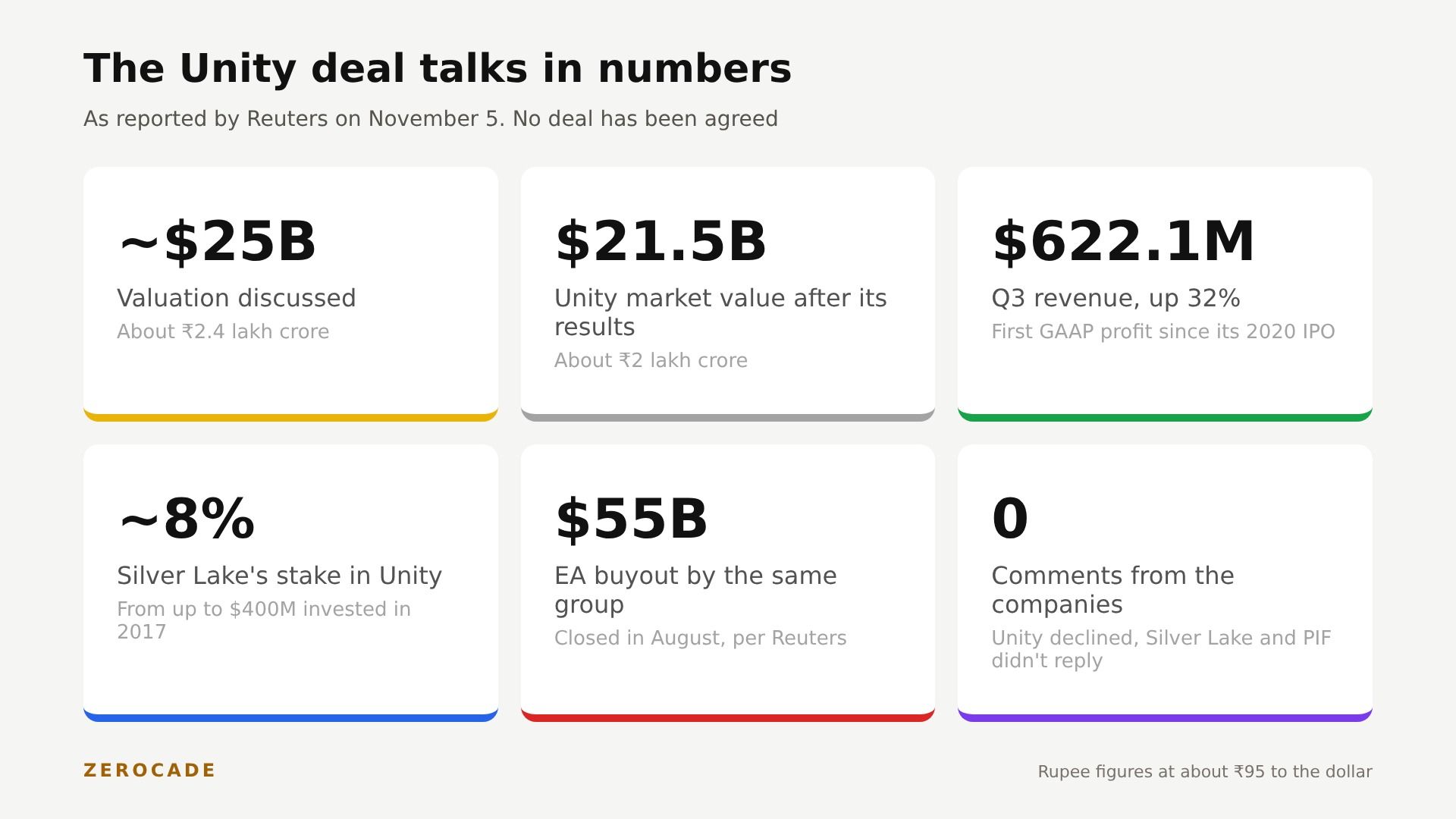
Image: Zerocade
Unity's stock rose after the news. Reuters said its shares were up about 4% in after-hours trading. Investing.com reported a bigger jump of 6.6% to $52.04 by the evening, after the shares had already climbed nearly 15% during the day on Unity's earnings. The two figures don't match exactly, and both are early after-hours numbers.
Why now: Unity's best quarter in years
The approach came just as Unity's business turned a corner. On the same day, Unity reported third-quarter revenue of $622.1 million, up 32%, beating Wall Street's estimates. It also made its first profit under standard accounting rules (GAAP) since going public in September 2020.
Most of that growth came from Vector, Unity's AI-powered advertising platform. That matters for the deal. Unity doesn't just make an engine. A big part of its money comes from helping mobile games show ads and find players.
It's a big change from a few years ago. In September 2023, Unity announced a Runtime Fee that would have charged developers per game install. The backlash was huge, and Unity later scrapped the fee in September 2024. Many studios still remember it.
The same investors, again
PIF and Silver Lake have been busy in gaming. Reuters notes they've partnered on major gaming deals before.
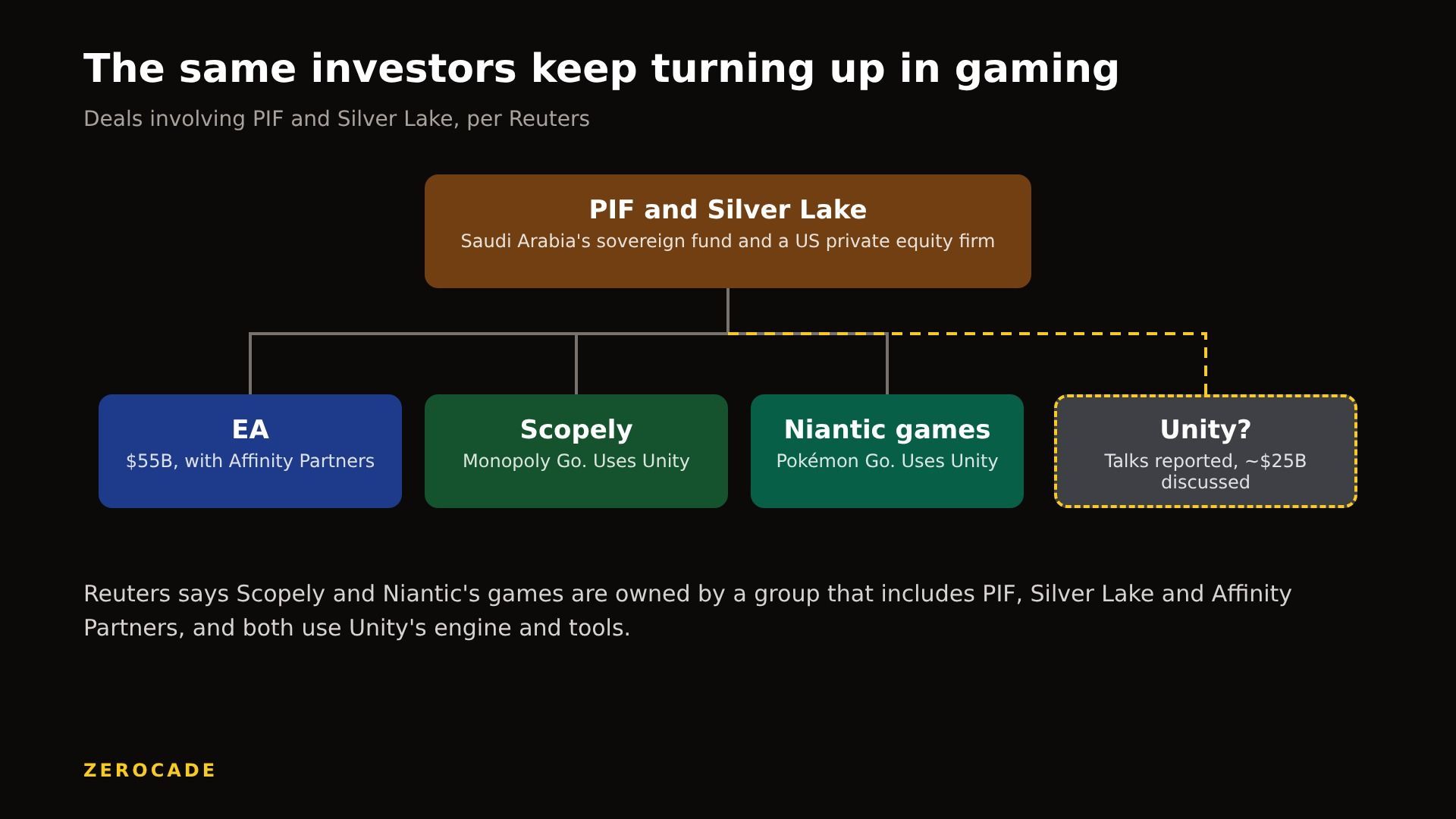
Image: Zerocade
- EA: taken private for $55 billion (about ₹5.2 lakh crore), with Affinity Partners. Reuters calls it one of the largest leveraged buyouts ever.
- Scopely, maker of Monopoly Go, and the group that now runs Niantic's games, including Pokémon Go, are owned by a group that includes PIF, Silver Lake and Affinity Partners. Both use Unity's engine and tools.
That last point is why this deal would be more than a financial bet. The same owners would control a big mobile publisher, a famous AR game studio and the engine those games are built on. We covered a similar wave of consolidation in our post on EA closing BioWare and cancelling Mass Effect.
What it could mean for games
Unity is used by a huge number of studios, especially on mobile and in indie games. A change of owner doesn't change the engine overnight, but it could change pricing, priorities and how much Unity pushes its ad business.

Image: Niantic / The Pokémon Company
On paper, there are two ways to read it. Private owners could invest in Unity without worrying about quarterly results. But leveraged buyouts usually load the company with debt, and paying that down often means cost cuts. PC Gamer notes that EA was hit with mass layoffs and billions in debt after its buyout.
For now, it's only talks. Watch for an official statement from Unity, a formal offer, or a rival bidder. Developers will also be watching for any hint of pricing changes. After the Runtime Fee, that's the first thing many will check.