
The short version
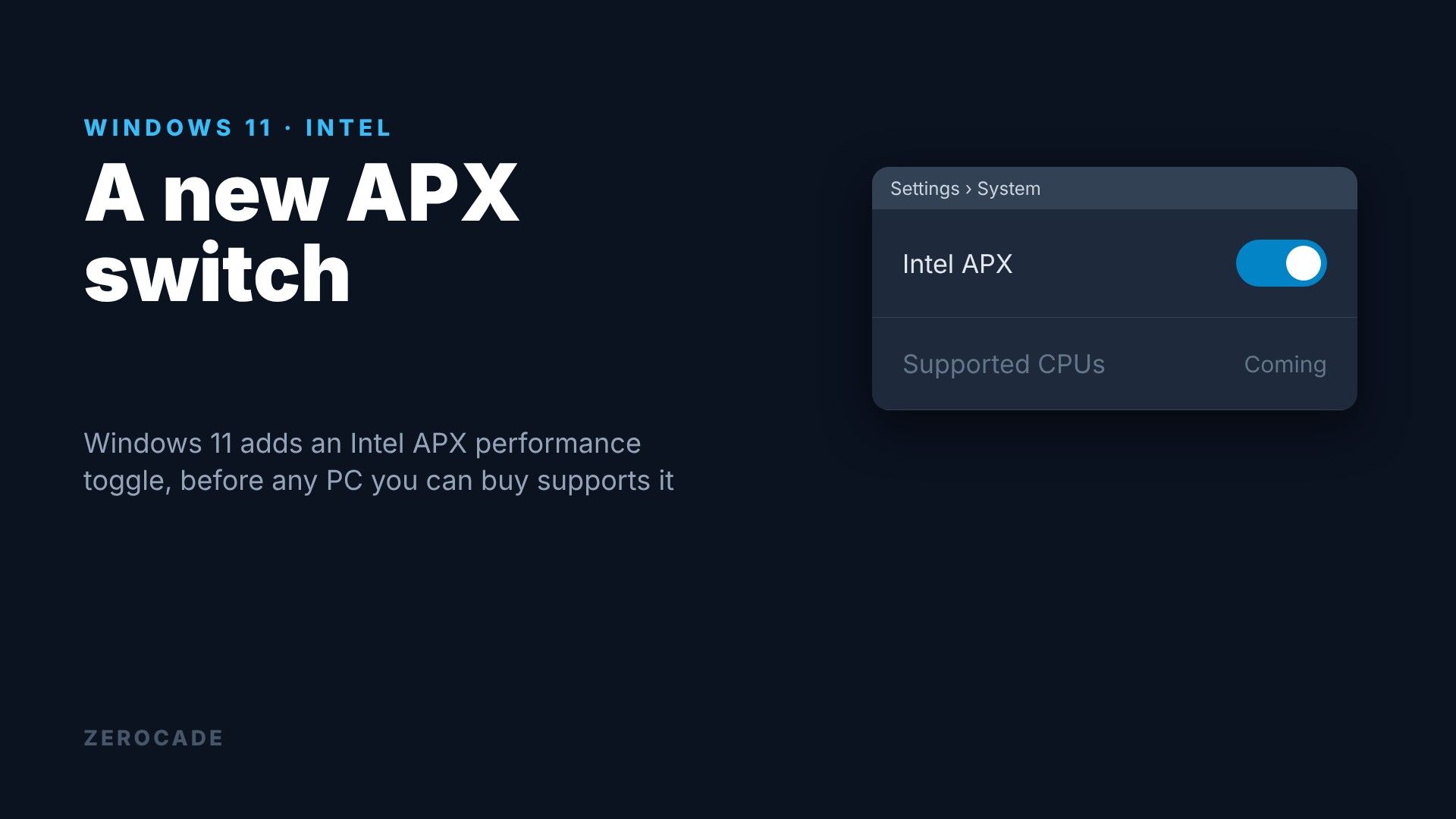
- Windows 11 Insider Build 29695, out on October 23 in the Experimental (Future Platforms) channel, adds a toggle for Intel APX (Advanced Performance Extensions), which Microsoft says gives "better performance".
- APX doubles a CPU's general-purpose registers from 16 to 32, but apps have to be recompiled to use it.
- No current consumer chip supports it. Intel's Nova Lake, reportedly due in early 2027, is expected to be first, and there's no India pricing for it yet.
- AMD Ryzen support isn't confirmed.
Where the toggle is
According to German site Deskmodder, the setting sits under Settings > System > Advanced, labelled as an extension for improved performance (APX), and is aimed at developers. Not every Insider sees it yet. Some testers couldn't find it, which suggests Microsoft is rolling it out gradually, as it often does with Insider features.
The Future Platforms channel is Microsoft's testing ground for features tied to hardware that isn't out yet, which tells you a lot about where APX stands.
What APX actually changes
Registers are the tiny, fastest slots of storage inside a CPU core. When a program runs out of them, it has to shuffle values out to memory and back, which costs time. Today's 64-bit x86 chips have 16 general-purpose registers, a number that hasn't changed since AMD introduced 64-bit x86 in 2003.
APX doubles that to 32, adds new instructions that can push or pull two values at once, and adds "conditional" loads and stores that help the processor avoid some branches it would otherwise have to guess.
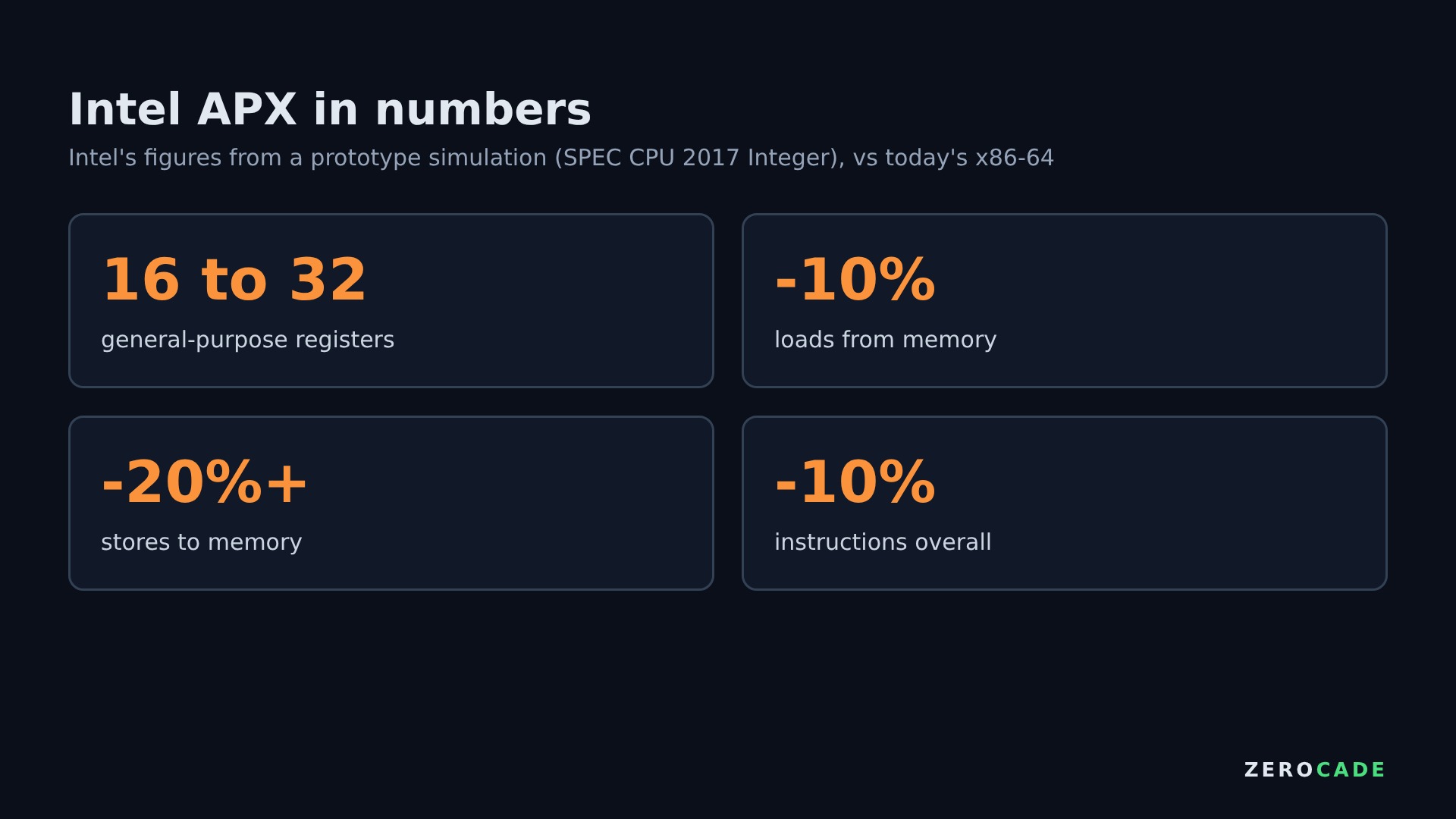 Image: Zerocade
Intel first described APX in 2023. Its own prototype simulation, run on the standard SPEC CPU 2017 integer tests, found that code built for APX needs about 10% fewer loads, over 20% fewer stores and 10% fewer instructions than the same code built for today's baseline.
That isn't the same as a 10-20% speed-up. Fewer memory trips and instructions help, but the real gain will depend on the app and how well the compiler uses the extra registers. Our x86 vs Arm explainer covers what an instruction set is, if you want the background. Arm chips, for comparison, have had 31 general-purpose registers since their 64-bit design arrived.
 Image: Intel Corporation
Why your PC can't use it
APX needs new hardware inside the CPU, and a Windows update can't add that.
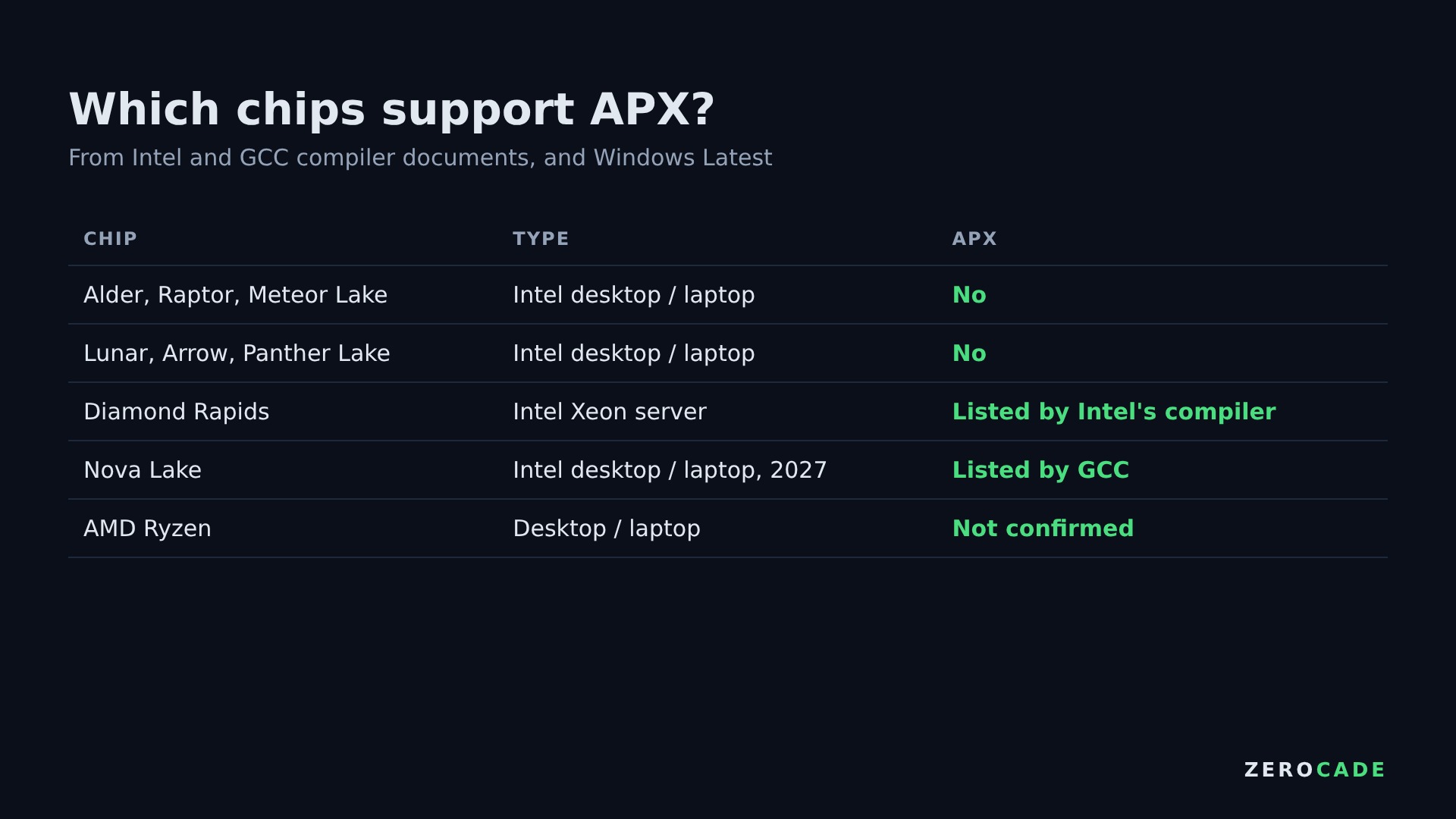 Image: Zerocade
According to Windows Latest, Alder Lake, Raptor Lake, Meteor Lake, Lunar Lake, Arrow Lake and Panther Lake chips all lack it. Intel's compiler documents list it for the Diamond Rapids Xeon server chips, and the GCC compiler lists it for Nova Lake. Deskmodder's write-up mentions Intel and AMD CPUs, but AMD hasn't confirmed APX support for any Ryzen chip.
So the toggle is groundwork. Windows is getting ready before the chips arrive, the same way game engines and compilers need time to adopt a new feature.
What it means for games
On paper, APX could help CPU-heavy games, since game code shuffles a lot of data through registers: physics, AI, and the code that prepares each frame for the graphics card. Simulation-heavy games and big open worlds would be the most likely winners.
But a game only benefits once it's rebuilt with APX support, and studios won't do that until enough players own APX chips, because the same game still has to run on everything else. Expect it to show up first in Windows itself, browsers, compilers and benchmarks, and in games much later.
What to watch
Intel confirming APX on Nova Lake when it launches the chips, and AMD saying whether future Ryzen chips will support it. Nova Lake itself is still unannounced; our Core Ultra 4000 naming leak has the latest on what it might be called.