


The short version
- IPC means instructions per clock: how much work a CPU core gets done in each tick of its clock.
- Roughly, a core's speed is IPC × clock speed. Multiply by cores for work that spreads across them.
- Chip makers quote IPC gains as an average over a chosen set of tests, usually at a fixed clock. Games often see much less.
- Zen 5 was sold on a 16% IPC gain and came out about 3% faster in games. The biggest gaming jump of that generation came from cache, not IPC.
Why this matters right now
AMD's new Zen 6 server chips came with a claim of about 27% higher IPC over Zen 5. That's a big number, and it will get repeated a lot before Zen 6 Ryzen desktop chips arrive. So it's worth knowing what it measures, and what it doesn't.
What IPC actually is
A CPU runs on a clock. At 5GHz, that clock ticks five billion times a second. In each tick, a core can start, finish or move along a number of instructions: add two numbers, load a value from memory, compare, jump.
IPC is the average number of instructions a core completes per tick. A core with higher IPC does more in the same tick, so at the same clock speed it's faster.
The rough formula looks like this:
- Single-core speed ≈ IPC × clock speed. A chip with 10% more IPC at the same clock is about 10% faster on one thread.
- Multi-core speed ≈ IPC × clock × cores, but only for work that splits cleanly, like video encoding or rendering.
- Games sit in between. They lean hard on one or two main threads and spread the rest across a handful of cores. Our Hyper-Threading and SMT explainer covers why more threads don't always help.
How a core gets more done per tick
IPC isn't one feature. It comes from lots of design choices working together:
- Wider cores. More units that can decode and run instructions at the same time.
- Better branch prediction. The core guesses which way an "if" will go and starts work early. A wrong guess wastes ticks.
- Bigger buffers. More instructions in flight, so the core can work around ones that are stuck waiting.
- Faster, bigger caches. If data is close by, the core doesn't sit idle waiting on RAM.
That last one matters most for games, and it's where the trouble with IPC claims begins.
Image: AMD
How chip makers measure IPC
There's no single official IPC test. Each company picks a set of programs, runs the old and new chip at the same fixed clock, and averages the difference.
AMD's history shows how this works:
| Generation | AMD's IPC claim | How AMD measured it |
|---|---|---|
| Zen 2 | +15% | Average of AMD's chosen tests |
| Zen 3 | +19% | 25 workloads at 4GHz |
| Zen 4 | +13% | 22 workloads at 4GHz |
| Zen 5 | +16% | Average of AMD's chosen tests |
| Zen 6c | ~+27% | Server and AI tests, per briefing reports |
Look at Zen 4's breakdown and you can see why an average hides a lot. Across AMD's 22 tests, the gains ranged widely, and in CPU-Z, one of the tests on its own list, the gain was about 1%. An average of 13% can contain tests at 1% and tests at 30% or more.
Intel does the same thing. For Arrow Lake, it claimed about 9% higher IPC for its Lion Cove performance cores.
Where the claims and the games split apart
This is the part that matters if you're buying a gaming CPU.
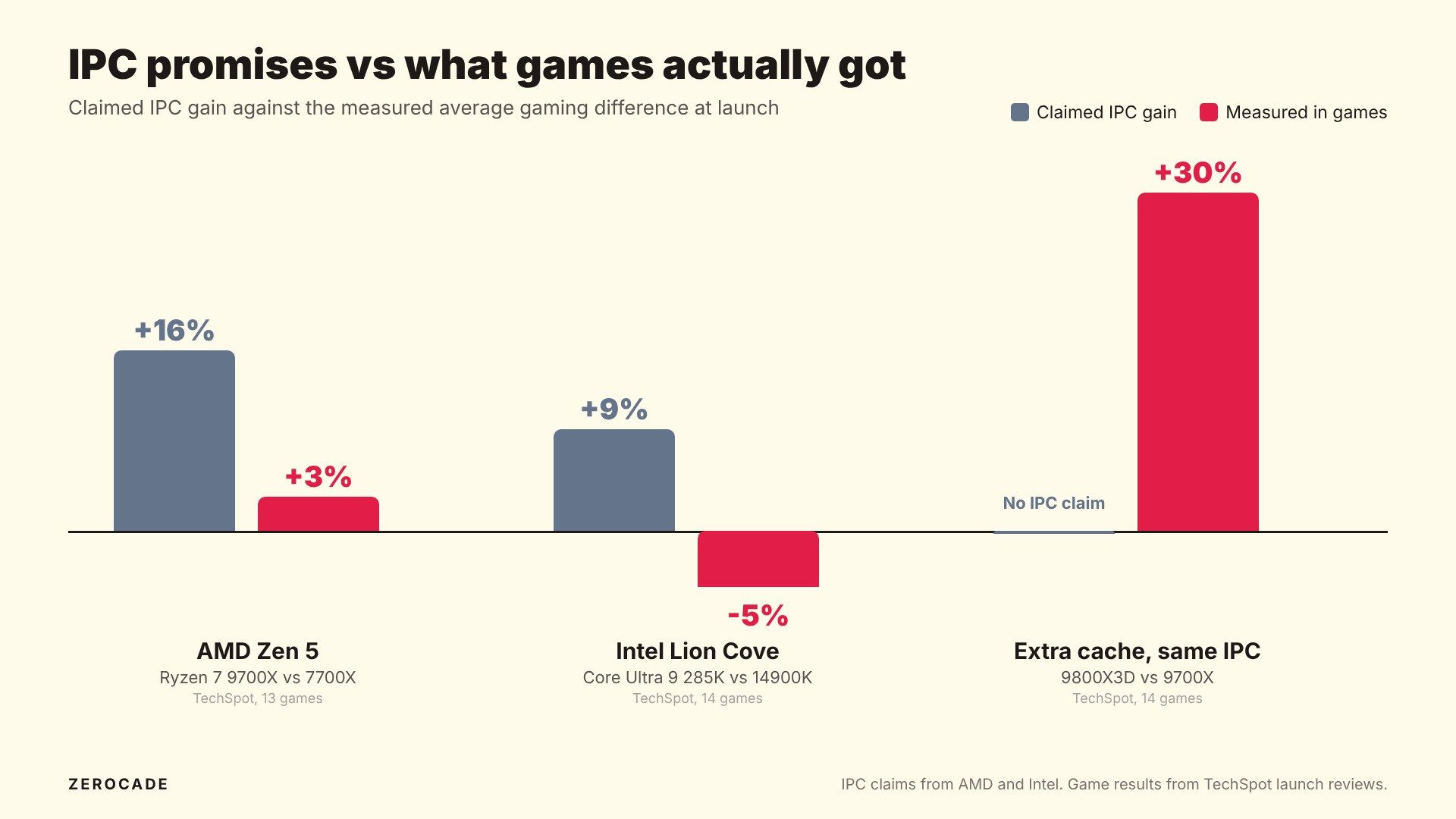
Image: Zerocade
- Zen 5: AMD claimed 16%. In TechSpot's 13-game launch testing, the Ryzen 7 9700X was about 3% faster than the Ryzen 7 7700X.
- Arrow Lake: Intel claimed 9% for Lion Cove. In TechSpot's 14-game testing, the Core Ultra 9 285K was about 5% slower than the older Core i9-14900K.
- Ryzen 7 9800X3D: same Zen 5 cores as the 9700X, so no new IPC claim at all. It was about 30% faster than the 9700X in TechSpot's games, and about 11% ahead of the 7800X3D.
Why the gap? Games are unusually hungry for memory. A game core spends a big share of its time waiting for data about the game world: objects, physics, AI. A wider core can't do more work if it's sitting idle waiting on RAM.
The 9800X3D shows this clearly. It adds a stack of extra cache, so more of that data sits right next to the cores. ComputerBase locked both chips at the same 4.8GHz clock and found the 9800X3D 43% faster than the 9700X in games. Same cores, same clock, much more effective work per tick in games. Our 3D V-Cache explainer goes deeper on why.
Arrow Lake's dip has its own causes. Intel moved its memory controller onto a separate tile, which added delay on every trip to RAM, and it dropped Hyper-Threading. A higher IPC figure in Intel's tests didn't survive the extra wait for memory in games.

Image: AMD
Why not just raise the clock?
If speed is IPC × clock, why bother with IPC at all? Because clock speed hits walls.
Intel learned this the hard way with the Pentium 4. Its NetBurst design used very long pipelines, stretching from 20 stages to 31, so each stage did less work and the chip could clock higher. The plan was 10GHz. In practice, NetBurst chips topped out at 3.8GHz, ran hot, and lost lots of work every time a branch guess was wrong. Intel replaced them with the Core architecture in July 2006, which ran at lower clocks but did far more per tick.
Today's desktop chips already boost to between 5 and 6GHz. Every extra 100MHz costs a lot more power and heat. That's why most of each new generation's gain now comes from IPC and cache rather than raw clock speed.
When a game is limited by the GPU instead
There's one more catch. IPC only matters when the CPU is the thing holding a game back.
At 4K with high settings, most games wait on the graphics card, not the CPU. A faster processor then changes very little. CPU reviews test at 1080p with the fastest GPU they can get for exactly this reason: to remove the graphics card from the picture. Our guide to CPU-bound vs GPU-bound games explains how to tell which one you're hitting.
How to read an IPC claim
When the next one lands, run through this:
- What tests is it averaged over? Server and AI tests, like those behind the Zen 6c figure, tell you little about games.
- At what clock? A fixed-clock IPC gain can shrink or grow once real boost clocks are involved.
- Does the cache change too? For games, a bigger or closer cache can matter more than a wider core.
- What do 1080p game reviews show? That's the only number that answers the gaming question.
If you're buying now, the gaming results already tell the story on paper: the Ryzen 7 9800X3D, about ₹48,360 at PrimeABGB as of November 11, leads on cache, not on an IPC claim.
What to watch
When Zen 6 Ryzen chips are announced, ignore the IPC slide for a moment and look for two things: how much L3 cache each chiplet gets, and the first independent 1080p game benchmarks. Those will tell you far more about gaming performance than any average across someone else's test list.