

The short version
- In an interview on the Cheeky Pint YouTube channel with Stripe co-founder John Collison, OpenAI CEO Sam Altman said that, from a global allocation point of view, it's "quite terrible" for everyone to keep the world's limited DRAM in their own computers.
- His reasoning: home PC memory sits busy only about 5% of the time, so under a shortage it does more work in cloud data centres. He didn't give any data for the 5% figure.
- The comment landed badly with PC builders. A 32GB DDR5 kit that cost $100 to $200 a year ago now starts around $440 to $530 in the US (about ₹42,000 to ₹50,000 converted), and much of that rise comes from AI data centres buying up memory.
- Memory makers say the shortage runs into 2028 or later, so prices aren't coming down soon.
What Altman actually said
The remark came up while Altman and Collison were discussing local AI, meaning open-source models you run on your own PC instead of in ChatGPT's cloud. Tom's Hardware first reported it on October 30, and Slashdot puts it at about the 29-minute mark of the video.
Paraphrasing his argument:
- Memory in a home computer spends most of its life idle. He put that at roughly 95% of the time.
- Memory is in short supply right now, so it should go where it's used the most.
- A data centre runs its memory flat out for thousands of users, so "you want maximum utilization in the cloud".
- He acknowledged that most people's instinct is the opposite.
Wccftech also reports that he talked about memory makers being wary of building lots of new factories after past boom-and-bust cycles. That fits what the companies themselves say.
It's an opinion about how the world's memory should be shared. It isn't an OpenAI product plan, and nobody is coming for your RAM sticks. But it comes from the CEO of one of the biggest memory buyers on the planet, which is why it struck a nerve.
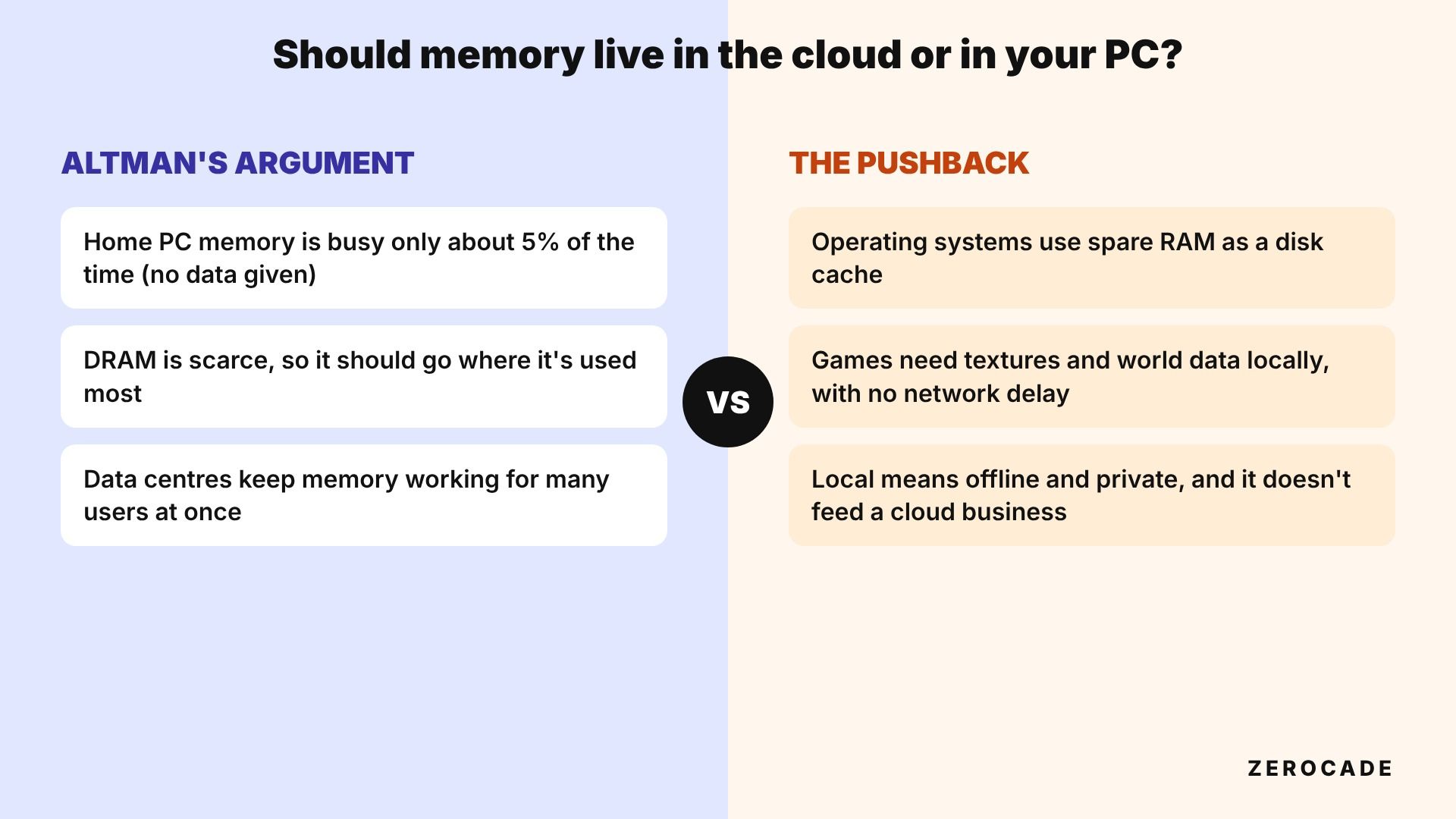
Image: Zerocade
Why PC gamers pushed back
"Idle" RAM isn't really idle. Windows, macOS and Linux all use spare memory as a disk cache, keeping recently used files ready so games and apps load faster. A slice of memory that looks free is often doing work.
Games can't wait for the cloud. A game needs its textures, geometry and world state in local memory, and it needs them right now. The VRAM on your graphics card and the system RAM next to it are what keep frame times smooth. Streaming that over the internet adds delay that no data centre can remove. Notebookcheck made the same point, noting that the argument skips over gaming, everyday apps and multitasking.
Local means private and offline. Wccftech pointed out that running things on your own machine works without a connection and keeps your data at home. Notebookcheck added that the view happens to fit OpenAI's business, which sells access to models running in its own data centres.
What RAM costs right now
The comment arrived in a terrible week for memory prices:
- Japan: an Akihabara price survey (via AKIBA PC Hotline) for October 17-24 found a Corsair 128GB DDR5-6000 kit at ¥514,800 (about $3,200). That's up 62% from September 12 and about 761% from ¥59,800 a year earlier.
- US, extreme case: a Patriot Viper Xtreme 5 32GB DDR5-7600 kit that sold for $109.99 in August 2024 is listed at $1,523.47 on Amazon. Wccftech notes that's an asking price, not what people are paying.
- US, realistic case: cheaper 32GB DDR5-6000 kits from Lexar, TeamGroup and G.Skill sit between about $440 and $530. That's roughly ₹42,000 to ₹50,000 converted. We couldn't confirm a current India listing for the same kits, and Indian prices also carry GST and import costs.
- Next quarter: TrendForce expects regular DRAM contract prices to rise another 10-15% in Q4 2026.
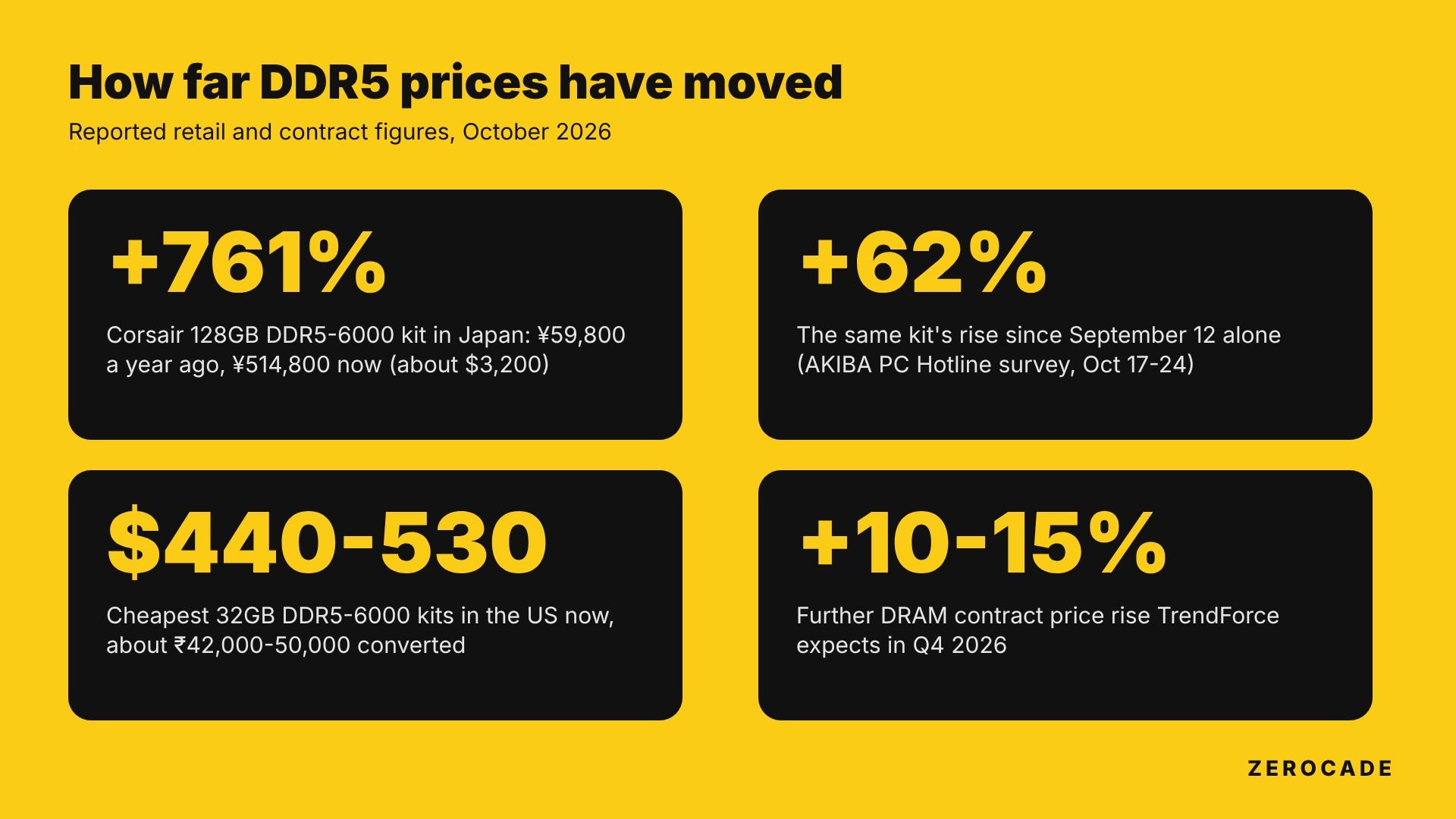
Image: Zerocade
Why the shortage won't end soon
The memory makers' own words back up the gloomy view. Samsung said on its Q3 earnings call that its 2027 HBM supply, the stacked memory used in AI chips, is already sold out. It expects tight conditions into 2028, and long-term contracts with ten major customers cover 60-70% of its capacity. SK hynix goes further and expects demand to outrun supply until 2030. We covered both in our Samsung and SK hynix stories.
AI data centres are where that memory goes. Every wafer turned into HBM for a server is one that doesn't become DDR5 for your PC or GDDR for a graphics card. It's also why console makers are nervous: the reported PS6 price worries come down to the same chips.
What to do if you're building a PC
If you already have 16GB or 32GB of DDR4, our DDR4 vs DDR5 guide explains why staying on an older platform makes more sense this year than it has in a long time. If you need new RAM, compare kit prices across a few Indian retailers before you buy, and don't count on prices falling before 2027.