
The short version
- On October 28, 2026, Microsoft previewed two new DirectX Raytracing (DXR) features: Clustered Geometry and Partitioned TLAS. It calls this the most significant DXR update since 2018.
- Both features make it cheaper to build and update the data that ray tracing searches through. That's one of the biggest hidden costs of ray tracing in big, detailed worlds.
- In Microsoft's own test on a Radeon RX 9070, Clustered Geometry took one scene from 1.2 fps to 79 fps. That's a best-case developer sample, not a game.
- It works on all Nvidia RTX cards, AMD's RX 9000 series and Intel's Arc B-Series, with no new hardware needed. It's a developer preview for now, so it'll take a while to reach games.
How ray tracing works in a game
Most of what you see in a game is drawn by rasterisation: the GPU takes every triangle in the scene and paints it onto the screen. It's fast, but it only knows what's in front of the camera. Reflections, accurate shadows and light bouncing around a room have to be faked.
Ray tracing works the other way round. For each pixel, the GPU fires a ray into the scene and asks what it hits. From that point it can fire more rays: one towards a light to see if the spot is in shadow, one bouncing off a shiny floor to find what it reflects. That's why ray-traced reflections show things that are off-screen, and why ray-traced shadows soften naturally with distance.
The catch is the search. A modern scene can have hundreds of millions of triangles, and testing every ray against every triangle would be impossibly slow. So games build a lookup structure first.
BLAS and TLAS: the map rays search through
That structure is called a bounding volume hierarchy, or BVH. Think of it as boxes inside boxes. A ray first checks a big box around a whole building. Only if it hits that box does it check the smaller boxes around each wall, then the boxes around a window frame, and finally the handful of triangles inside. It skips almost everything.
DirectX splits this into two levels:
- BLAS (bottom-level acceleration structure): the boxes for one object's triangles, like a car, a tree or a character.
- TLAS (top-level acceleration structure): the boxes for the whole scene, saying where every copy of every object sits.
Here's the problem. Building these structures takes time and memory, and they must be rebuilt or updated whenever things move. In a huge open world with millions of plants or a city full of traffic, that upkeep eats into every frame. To save time, many games ray trace a simplified copy of the world. That's why a ray-traced reflection can sometimes look blockier than the real object next to it.
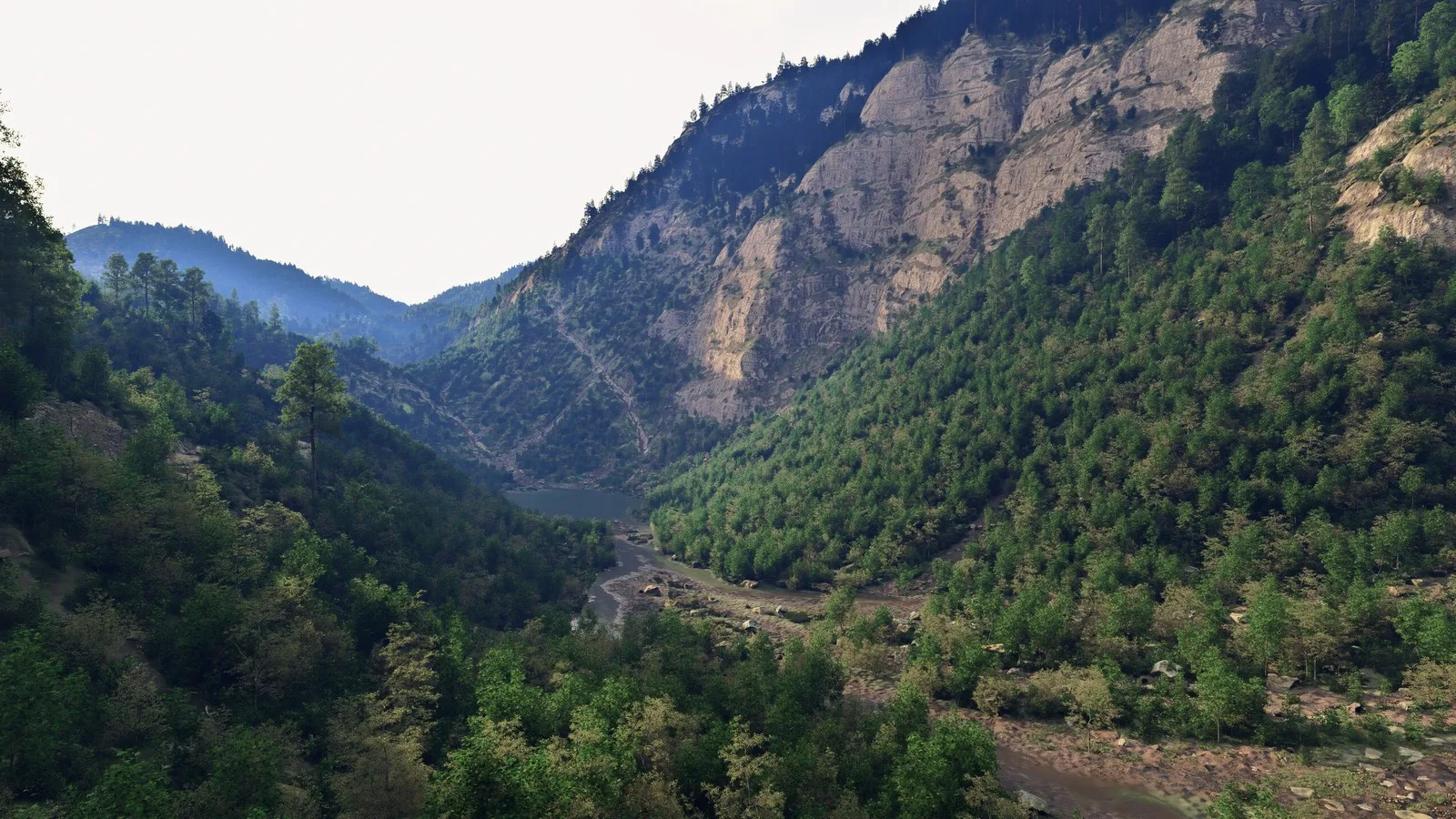 Image: Microsoft / Nvidia
What Clustered Geometry changes
Clustered Geometry breaks each object into small, reusable clusters of up to 256 triangles. Each cluster gets its own little acceleration structure, called a CLAS. An object's BLAS is then assembled from a list of these clusters instead of being built triangle by triangle.
Clusters are quick to build and can be reused, so a game can afford to ray trace the same full-detail geometry it draws on screen. Shadows and reflections then match what you actually see. The idea will sound familiar if you've read about Unreal Engine 5's Nanite, which also breaks meshes into clusters. Nvidia has offered this through its own RTX Mega Geometry feature, and Gears of War: E-Day is an early game using it. DirectX now makes it a standard that any GPU maker can support.
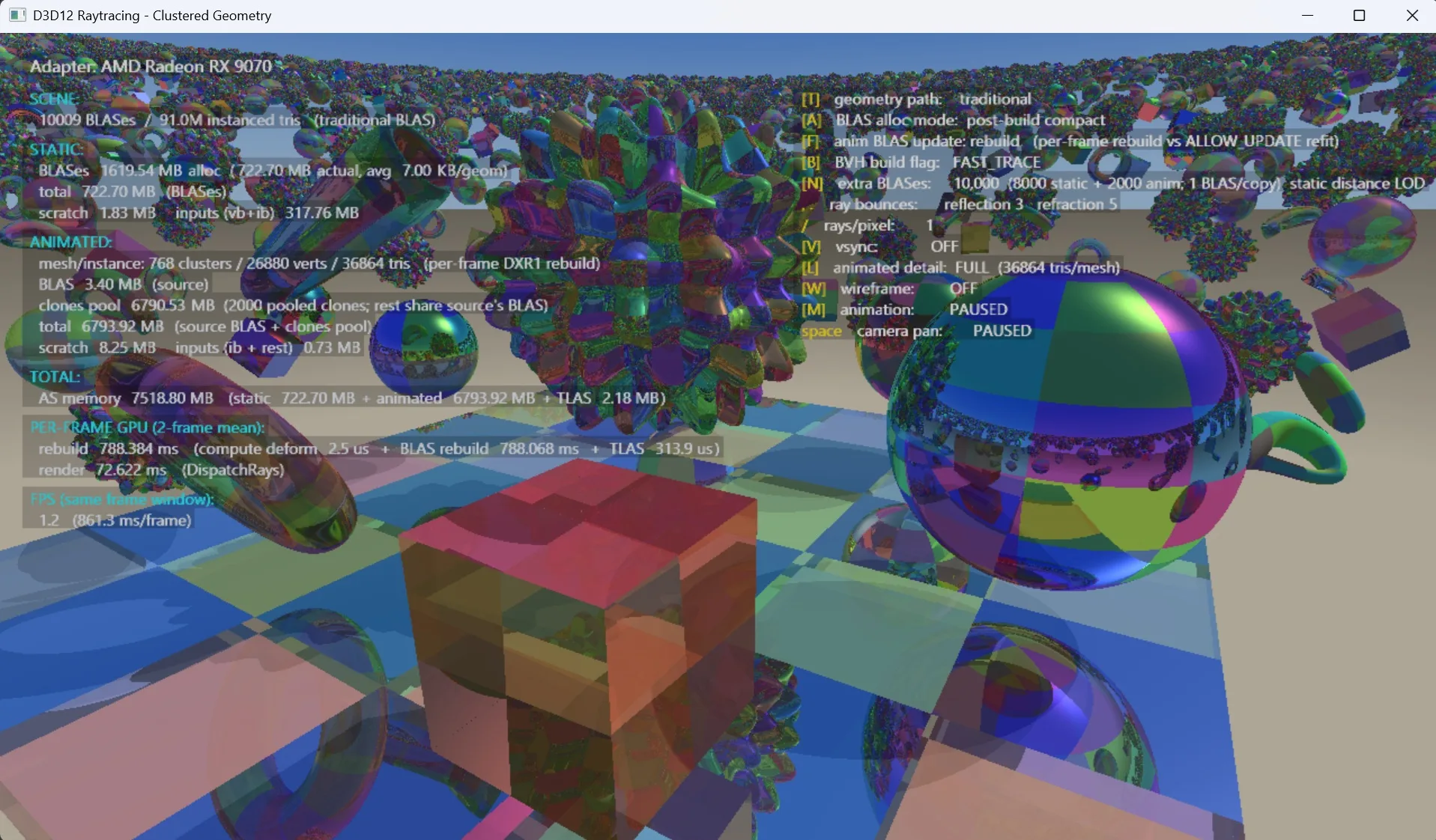 Image: Microsoft
 Image: Microsoft
Microsoft's numbers come from its own sample on an RX 9070, and it warns that results will vary:
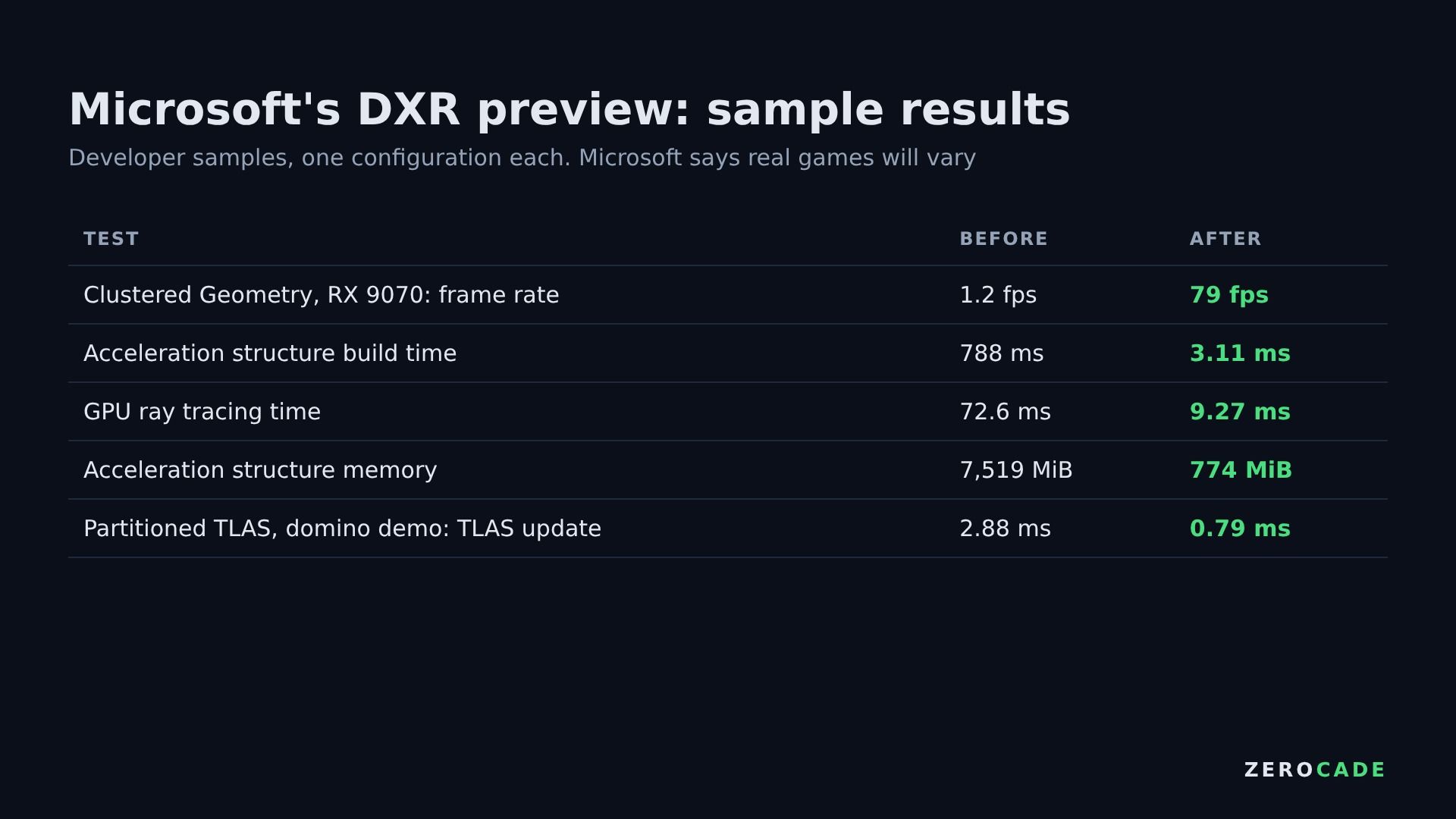 Image: Zerocade
The trade-off is temporary scratch memory during builds, which went up sharply in the same test. Clustered geometry also can't be quickly "refit" when a mesh deforms, so animated characters use cluster templates instead.
What Partitioned TLAS changes
The second feature tackles the top level. Normally, if a few objects move, the whole TLAS gets rebuilt. Partitioned TLAS splits the scene into areas, so only the areas where something changed get rebuilt. Objects that move all the time can sit in a separate global partition.
Microsoft's domino demo, contributed by Nvidia, shows the gain: a full TLAS rebuild took 2.88 ms a frame, while the partitioned version took 0.79 ms. At 60 fps, a frame only has about 16.7 ms in total, so 2 ms back is a lot. Tracing rays was very slightly slower, which is the cost of the split.
A third, smaller addition lets the GPU set up these builds itself, without waiting on the CPU.
Which GPUs support it
- Nvidia: all GeForce RTX cards.
- AMD: Radeon RX 9000 series, with a developer preview driver.
- Intel: Arc B-Series and Core Ultra 200V and Series 3 graphics, with a beta driver.
- Qualcomm: Snapdragon X2, with drivers targeted for early-to-mid 2027.
Support for older AMD and Intel ray tracing GPUs is still to be decided. The features live in Agility SDK 1.722 preview and the preview Shader Model 6.10. Microsoft expects Shader Model 6.10 in a regular Agility SDK release in early December.
How we got here
DXR debuted in 2018. Version 1.1 added inline ray tracing in 2019. Shader Execution Reordering and Opacity Micromaps, which speed up shading and foliage, were announced at GDC 2025 and shipped in February 2026. If you want the upscaling side of the story, see our DLSS explainer, and for the geometry side, mesh shading.
On paper, this is a bigger deal for the next wave of open-world games than for anything out today. Watch for engine support, especially Unreal Engine, and for the first games that use it without Nvidia-only code.