
The short version
- A PCB (printed circuit board) is the flat board every chip sits on. It's a sandwich of copper layers and glass-fibre insulation. The copper is etched into thin wires that carry power and data between parts.
- On October 29, 2026, Tom's Hardware reported a Nikkei Asia story: AI servers are using up PCB supply, and some orders now take up to 30 months to fill.
- One Taiwanese PC maker says copper clad laminate, the raw material boards are made from, costs at least 12 times more than it did in July. A leading laminate supplier is reportedly booked up to 2030.
- No price rises for motherboards or graphics cards have been announced yet, in India or anywhere else. But this is the same pattern that has already pushed up RAM and GPU prices this year.
What a PCB actually is
Open any PC, console or phone and you'll find a green, black or blue board covered in chips. That board is the printed circuit board. Its job is to hold every component in place and connect them all, so the CPU can talk to the RAM, the GPU can get power, and the USB ports can reach the chipset.
Before PCBs, electronics were wired up by hand, one wire per connection. A PCB "prints" those wires instead. A thin sheet of copper is bonded to an insulating board, and everything except the paths you need is etched away. What's left are traces: flat copper lines, often thinner than a hair, that do the job of wires.
The insulating part is usually FR-4, a woven glass-fibre cloth soaked in flame-resistant epoxy resin. It has been the standard board material since the late 1960s. A board with copper already bonded on but not yet etched is called a copper clad laminate, or CCL. That's the material at the centre of this shortage.
How a board is built, layer by layer
A cheap gadget might use a single copper layer. A gaming motherboard is far more complex: it's a stack of several copper layers with insulation between each one, pressed together under heat into one solid board.
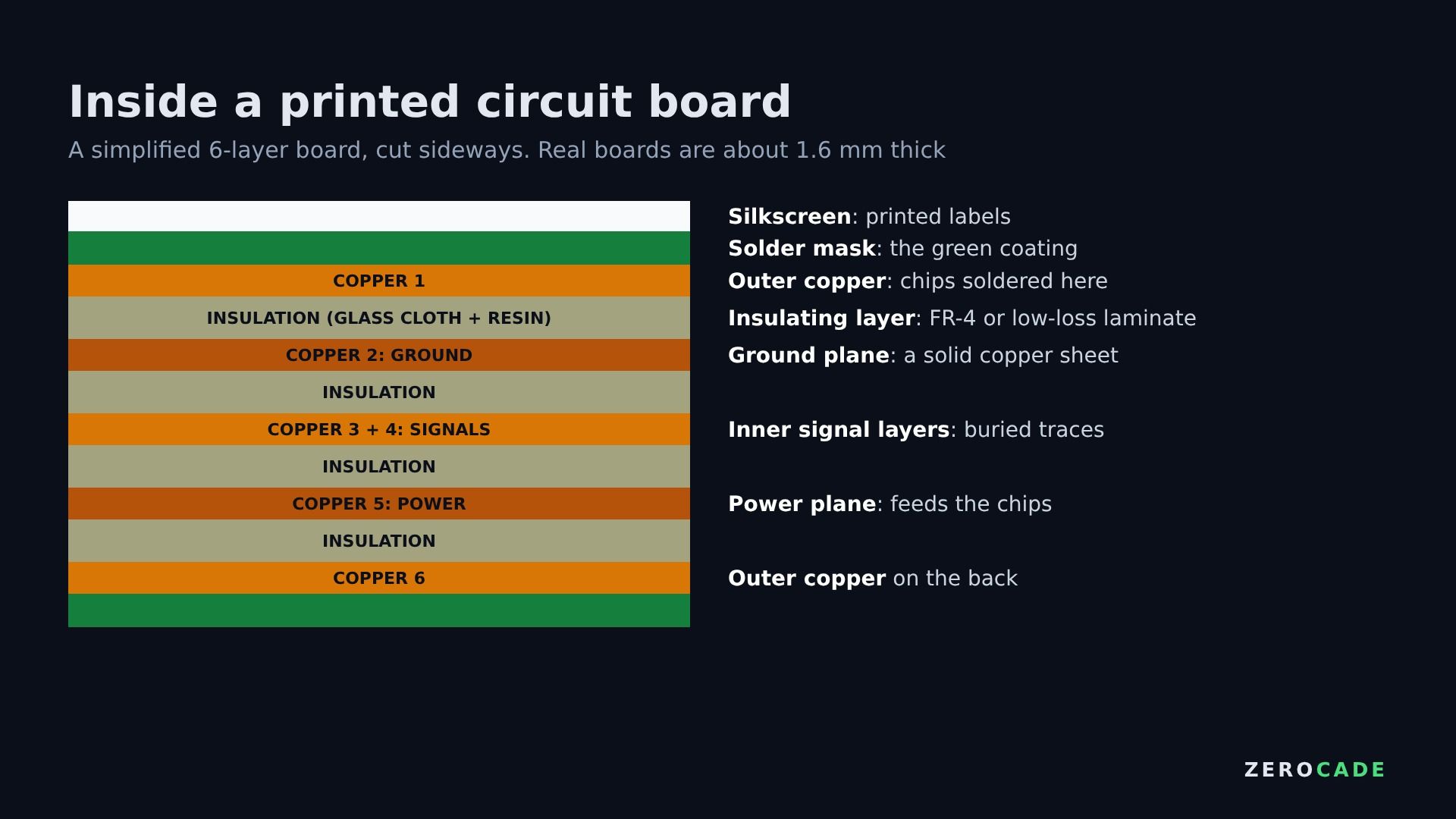 Image: Zerocade
From the outside in, a typical multi-layer board has:
- Silkscreen: the white printed labels, like "PCIE1" or "CPU_FAN".
- Solder mask: the coloured coating that gives a board its green or black look. It protects the copper and stops solder from bridging two traces.
- Outer copper layers: where the chips are soldered and short traces run.
- Insulating layers: FR-4 or a better laminate, keeping each copper layer separate.
- Inner copper layers: often whole sheets used as a ground plane or power plane, plus buried traces for fast signals.
Layers are connected by vias, tiny drilled holes plated with copper that let a signal jump from one layer to another. High-end boards use microvias, laser-drilled holes that only go through one or two layers, so more traces fit in the same space.
Board makers advertise the layer count because more layers give cleaner power and room to route fast signals. Many mid-range and high-end motherboards are sold as 6-, 8- or 10-layer designs. Some premium models also advertise "server-grade" low-loss PCB material.
Why fast hardware needs better boards
Here's the part that ties gaming PCs to AI servers. At low speeds, almost any board material works. At very high speeds, the board starts to absorb part of the signal before it reaches the other end.
Two numbers describe this. Dielectric constant is how strongly the material slows and affects a signal, and standard FR-4 sits at about 4.4. Loss tangent is how much signal energy the material soaks up as heat, about 0.02 for FR-4. That's fine for older hardware. For PCIe 5.0 graphics and SSD slots or fast DDR5 memory, makers increasingly use low-loss laminates with special glass cloth and resins. Those materials cost more, and they're the same ones AI servers need in huge amounts.
Why AI is causing a shortage
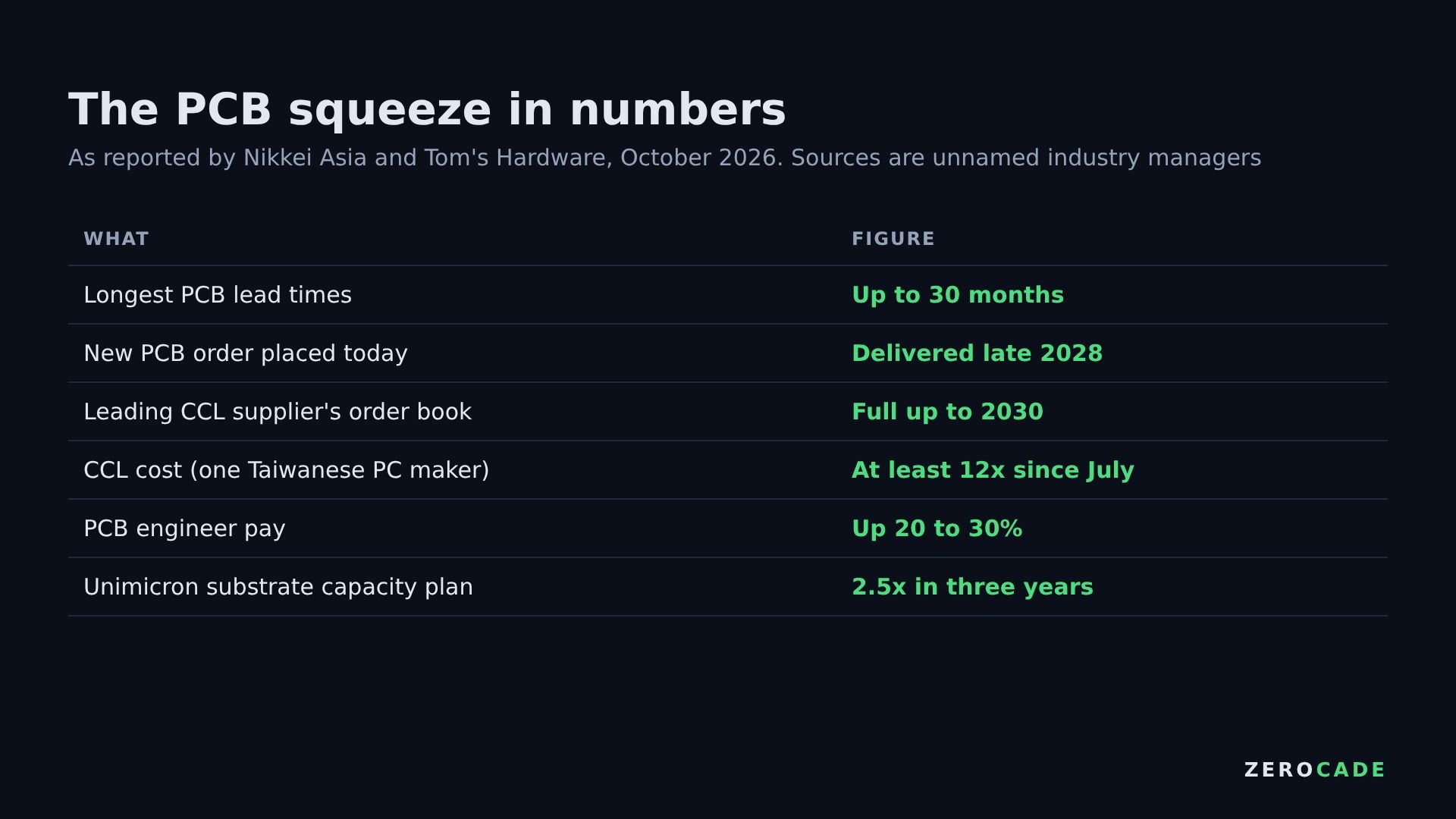 Image: Zerocade
AI servers are packed with big, dense boards. Each GPU module, switch and server motherboard uses many layers of premium low-loss laminate. Data centres are being built so fast that board makers can earn more from AI orders than from PCs. According to Tom's Hardware, standard PCB demand is "becoming underserved" as AI buyers outbid everyone else.
The numbers in the Nikkei report are stark:
- Some PCB orders now take up to 30 months to fill, and lead times on certain products have doubled.
- One PCB supplier said a new order placed today wouldn't arrive until late 2028.
- A leading CCL supplier has orders filling up to 2030, even though it plans to triple capacity by 2028.
- A Taiwanese PC maker says CCL costs have risen at least 12 times since July. That's one company's figure, not an industry average.
- Experienced PCB engineers have had pay rises of 20 to 30% across the industry.
These sources are unnamed industry managers, but the trend isn't new. DigiTimes reported in March 2026 that CCL lead times had already stretched to about six months, with suppliers rationing material. One American PC maker told Nikkei it was still struggling to get enough PCBs even though PC shipments could fall again next year.
Chips sit on tiny circuit boards too
There's a second, related squeeze. A CPU or GPU die doesn't solder straight onto the motherboard. It sits on a substrate, a tiny, ultra-dense circuit board that spreads the chip's thousands of connections out to a size the motherboard can handle. These are made by specialists. Nvidia has signed deals with three of the biggest, Ibiden (Japan), Samsung Electro-Mechanics (South Korea) and Unimicron (Taiwan). Unimicron alone plans to grow capacity 2.5 times over three years.
What it means for your next PC
Don't expect a 12x jump in motherboard prices. The laminate is only one part of a board's cost, and the chips, power parts and connectors cost far more. On paper, the risk is a slow creep: pricier premium motherboards and graphics cards, fewer budget models, and laptops costing more on top of memory prices that are already rising. We've seen how fast this can happen with the RTX 5080 and with RAM. If you want to understand the memory side, our HBM explainer covers why AI chips eat so much of it.
If you're planning a build in the next few months, watch motherboard and GPU prices in India over the festive and year-end sales. If they start to creep up without a new model launch, board costs are a likely reason.