

The short version
- GTA 6 launched today at 30fps on every console. Leaker Kepler_L2 says most PCs won't hit 60fps when it comes to PC, and Hardware Unboxed agreed that even a Ryzen 7 5800X3D isn't twice as fast as the PS5's CPU.
- Doubling the frame rate means the processor has to do twice the work every second, and that can't be fixed by lowering the resolution.
- Consoles also have dedicated chips for jobs a PC hands to its CPU, like decompressing game data. Xbox engineers have said matching that in software would take several extra CPU cores.
- On paper, that's why a CPU like the Ryzen 7 9800X3D (around ₹46,000-52,000 in India) keeps coming up for console ports.
The GTA 6 claim
Kepler_L2 posted the prediction on X today, based on how GTA 6 runs on PS5 and Xbox. Hardware Unboxed replied that Kepler was right and that no AM4 processor may be enough. Notebookcheck's headline put a Ryzen 7 9800X3D on it, though that's the site's reading rather than a quote.
Rockstar itself has only confirmed the 30fps target. The CPU explanation comes from analysts like Digital Foundry, which said 60fps on console was very unlikely because there was no way to win back enough GPU and "particularly CPU time". The PC version isn't announced; it's reportedly due by March 2027.
Step 1: the frame budget
At 30fps, a game has 33.3 milliseconds to prepare each frame. At 60fps it has 16.7.
Everything the CPU does per frame has to fit in that window: game logic, AI for every pedestrian and driver, physics, streaming the world in, and preparing instructions for the GPU, called draw calls. Going from 30 to 60fps means running all of it twice as often.
A graphics card can hit a higher frame rate by rendering fewer pixels. A processor can't, because the city still has the same number of people and cars in it. Our CPU-bound vs GPU-bound guide covers this in more detail.

Image: Capcom
Step 2: what the console CPUs are
Both current consoles use an 8-core AMD Zen 2 processor from 2019-2020:
| Console | CPU | Clock speed |
|---|---|---|
| PS5 | 8-core Zen 2 | Up to 3.5GHz (variable) |
| Xbox Series X | 8-core Zen 2 | 3.8GHz, or 3.6GHz with multithreading |
| PS5 Pro | Same Zen 2 | About 3.85GHz in a high-frequency mode (from leaks; Sony hasn't published it) |
A modern desktop chip is much faster per core. So why isn't it automatically twice as fast in a port?
Step 3: consoles cheat, in a good way
Consoles have hardware that takes work off the CPU.
Decompression. Game files are compressed to save space and loaded constantly as you move through an open world. The PS5 has a dedicated decompression unit, which Mark Cerny said was worth up to nine Zen 2 cores. Xbox's Andrew Goossen told Digital Foundry that doing the Series X's decompression in software would take about five Zen 2 cores including input and output work, and that matching the whole console would take the equivalent of 13.
On PC, that job usually lands on the CPU. Microsoft's DirectStorage 1.1 lets the graphics card decompress instead, but few games use it, and PC Gamer reported it hurt performance in Spider-Man 2's PC version.
Unified memory. A console has one pool of memory shared by CPU and GPU. A PC has system RAM and separate video memory, so data has to be copied between them. Nixxes, which ports Sony's games, had to build a separate memory management system for Spider-Man on PC for exactly that reason.
Fixed hardware and low-level access. Developers know exactly what's inside every PS5, and talk to it through Sony's own graphics interfaces. Shaders, the small programs that draw effects, are compiled ahead of time. On PC, they often compile on your machine, which costs CPU time and causes stutter.

Image: Sony Interactive Entertainment
Step 4: the PC's extra overheads
PCs also carry costs consoles don't. Graphics drivers translate every instruction for whichever GPU you own. Windows and background apps take their share; Goossen's estimate set aside one core just for Windows and its shell.
Nixxes' Michiel Roza summed it up in a Digital Foundry interview: even with a more powerful CPU than a PS5, "you might still end up with a lower frame-rate". His colleague Jurjen Katsman added that without decompression hardware, "that gets left to the CPU".
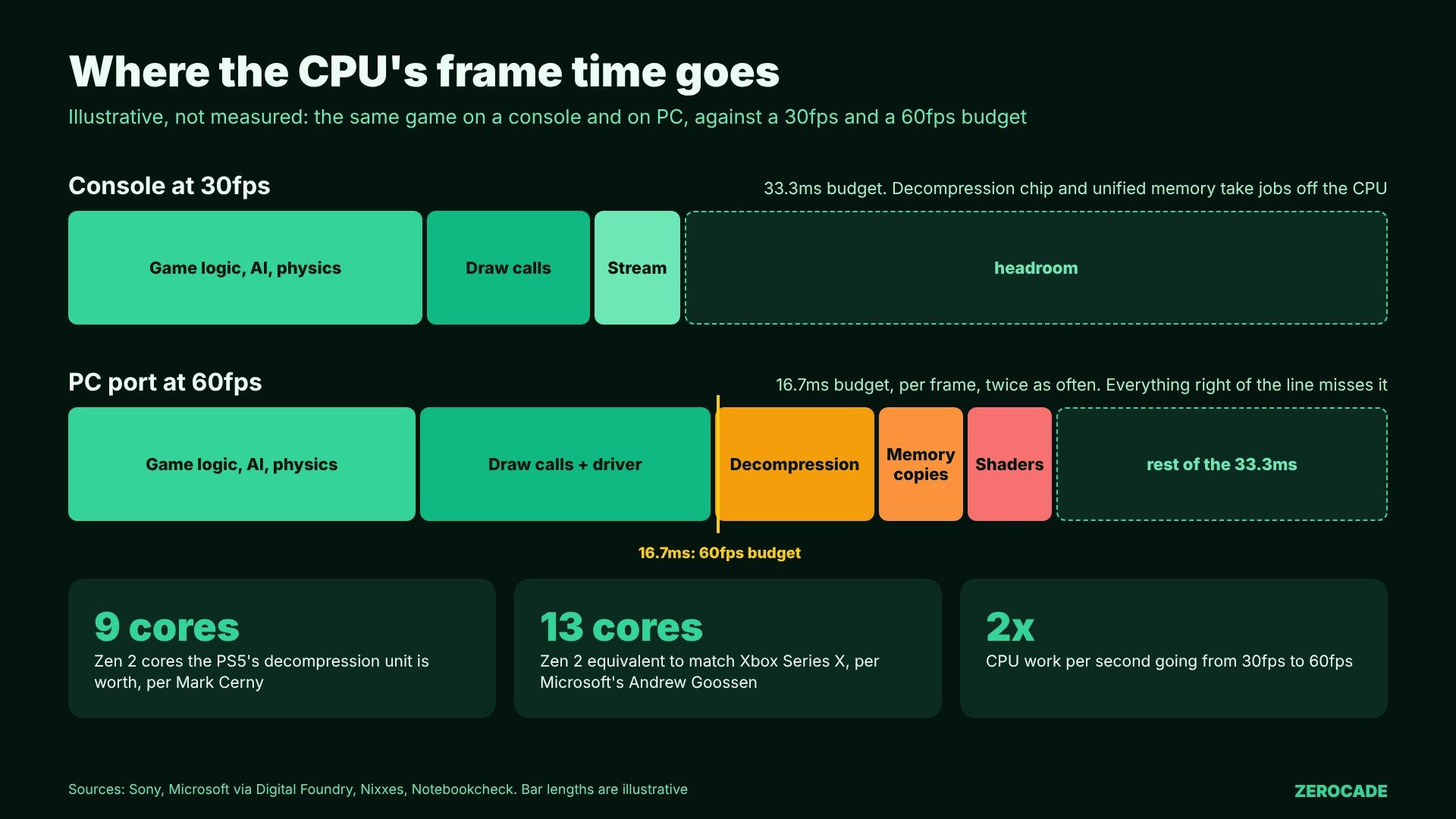
Image: Zerocade
Real examples
- Marvel's Spider-Man Remastered (PC, 2022): the CPU decompresses data and builds part of the ray-tracing structure for buildings, both jobs the PS5 handles differently.
- The Last of Us Part I (PC, 2023): players reported CPU use near 100%, especially while shaders compiled. Naughty Dog later patched texture streaming specifically to reduce CPU use.
- Dragon's Dogma 2 (2024): Capcom's team told Famitsu the CPU was the bottleneck, because it was busy running the "thoughts" of every NPC.
- Starfield (2023): locked at 30fps on Xbox, which Todd Howard said was for "fidelity".
History is a guide too. Red Dead Redemption 2 ran on the PS4's 1.6GHz Jaguar CPU, yet its PC version recommended an Intel Core i7-4770K or Ryzen 5 1500X.
Why X3D chips keep coming up
Open-world simulation jumps around large chunks of data. AMD's X3D chips stack extra cache on the processor, so the CPU waits on main memory less often. The Ryzen 7 9800X3D has 96MB of L3 cache, 8 cores and a 5.2GHz boost. Our 3D V-Cache guide explains how that works.
Prices seen in India today:
| CPU | Price |
|---|---|
| Ryzen 7 9800X3D | About ₹46,199-52,319 |
| Ryzen 7 7800X3D | ₹40,498 (out of stock at PrimeABGB) |
| Core Ultra 7 265K | About ₹33,000-34,600 |
| Ryzen 5 7600X | ₹17,236 |
On paper, if you're planning a PC for GTA 6, the processor matters more than usual. Until Rockstar publishes PC requirements, though, it's all prediction.
What to watch
Watch for Rockstar announcing the PC version and its system requirements, and for whether it supports DirectStorage to take decompression off the CPU.