
The short version
- Some gaming phones carry a second, smaller chip next to the main processor. iQOO calls its version the Q3 and puts it in the iQOO 15 and the new iQOO Neo 12, which launched in China on October 28 at CNY 4,199 (about ₹60,000).
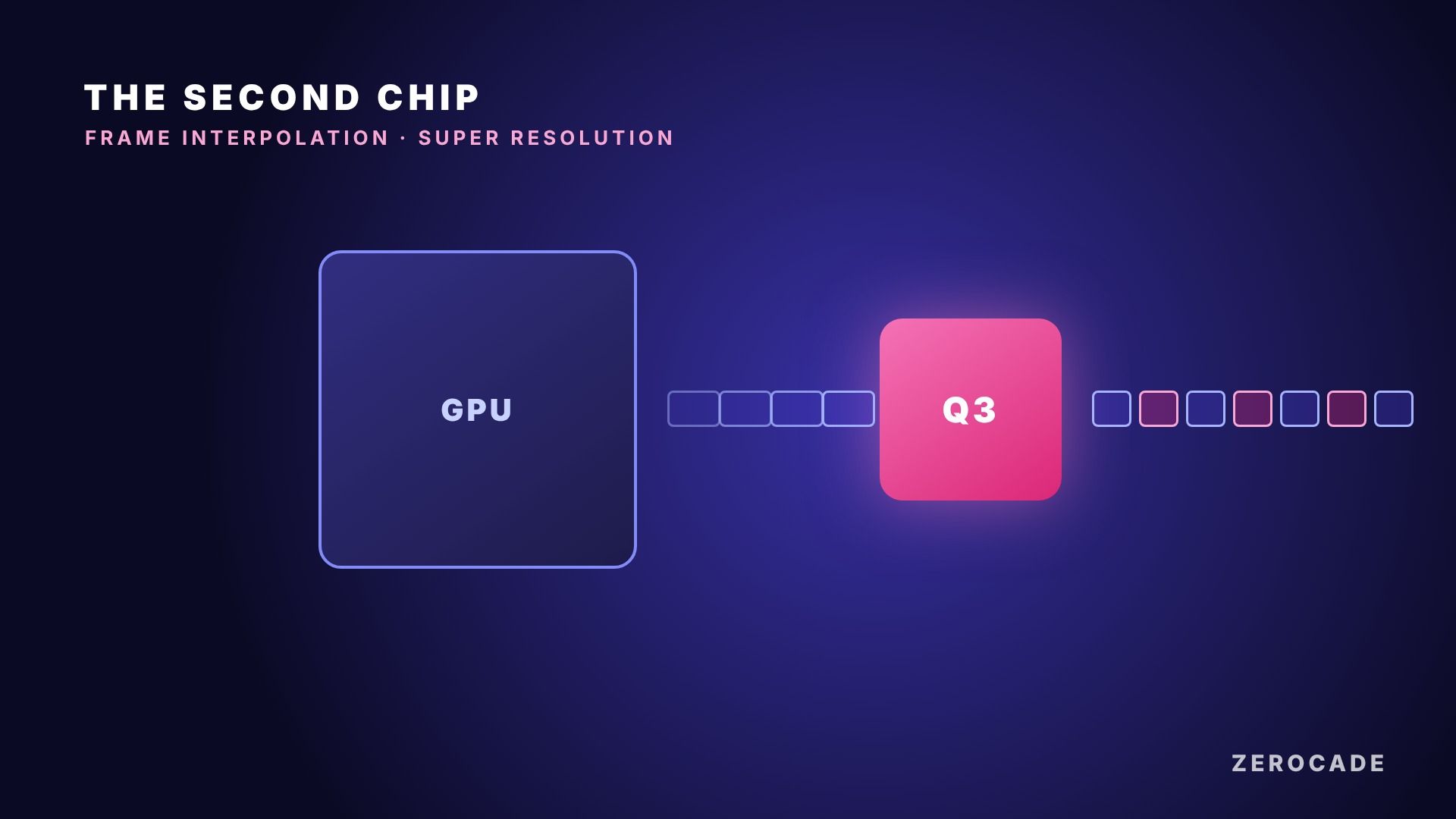
- The extra chip mainly does two jobs: frame interpolation, which adds made-up frames between real ones so a 60fps game looks like 120fps or more, and super resolution, which sharpens a lower-resolution image to look closer to 2K.
- The point is to take that work off the main chip, so the phone runs cooler and uses less battery than it would rendering every frame for real.
- The catch: it only works in selected games, it adds a little input delay, and generated frames can show artefacts in fast motion.
Why put a second chip in a phone?
A phone's main processor, like the Snapdragon 8 Elite Gen 5 in the iQOO Neo 12, does everything: runs the game's logic, draws the graphics, handles the camera, the modem and the screen. In a demanding game, the graphics part (the GPU) works the hardest, and that's what heats the phone up and drains the battery.
Most mobile games are designed to run at 60fps. Phone screens, though, now go to 144Hz or 185Hz. To fill those extra refreshes, the GPU would have to draw two or three times as many frames, which it often can't sustain without overheating. That's where a separate chip comes in. It doesn't make the GPU faster. It takes the frames the GPU has already made and turns them into more, or sharper, frames using far less power. Our thermal throttling guide explains why heat is the real limit on phone gaming.
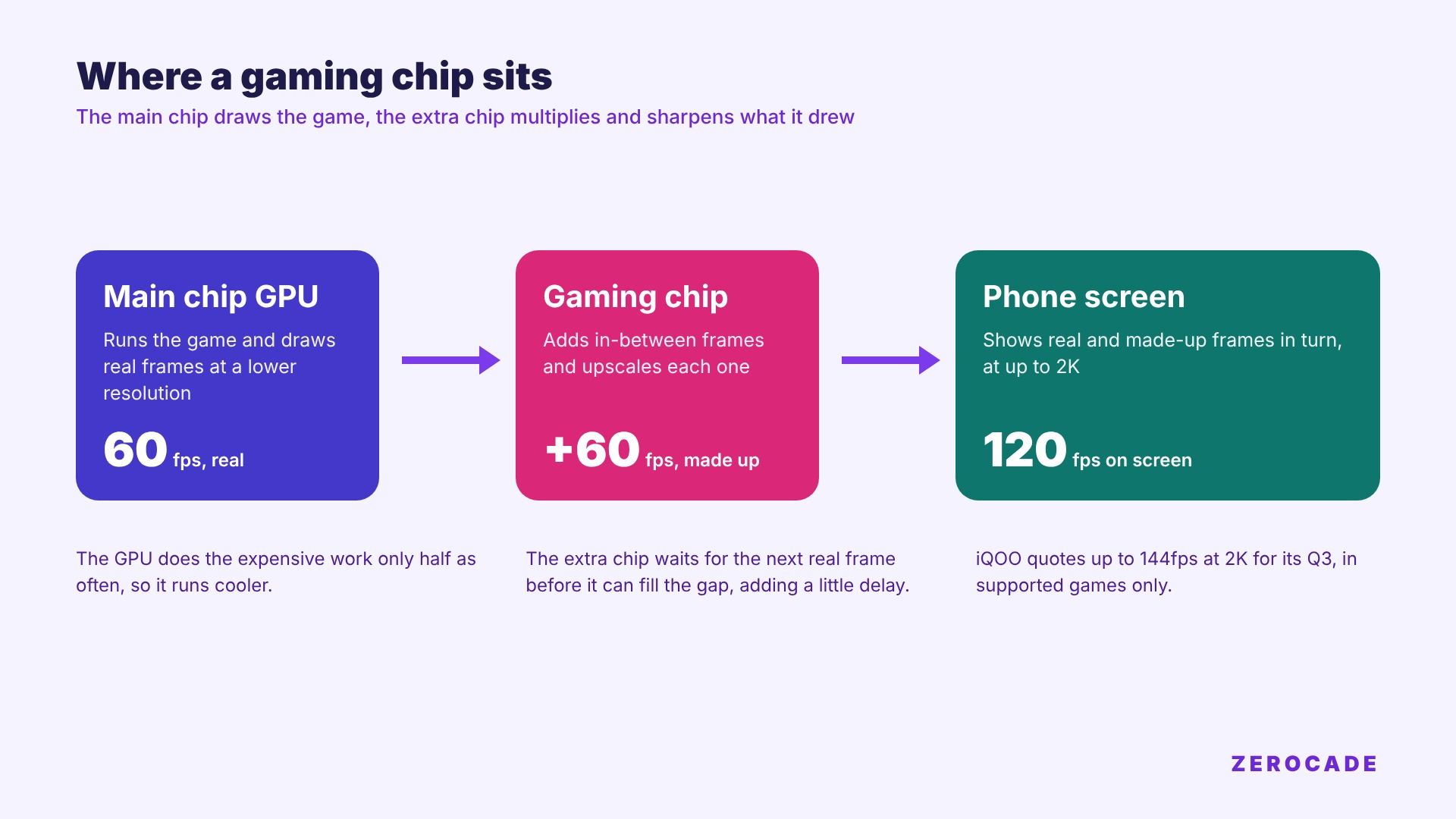
Image: Zerocade
What iQOO says the Q3 does
iQOO's product page for the iQOO 15 calls the Q3 a "mobile graphic chip" and lists these features:
- Frame interpolation up to 144fps, with what iQOO calls "ultra-low latency".
- Super resolution to 2K, sharpening textures and detail.
- Both at the same time: 2K and 144fps together.
- Its own ray tracing and a display enhancement mode, including a night vision setting for dark scenes.
iQOO says the Q3 works alongside the Snapdragon, which it describes as "co-engineered" with Qualcomm. Those are iQOO's claims. We haven't tested them.
How frame interpolation works, step by step
Frame interpolation is the same basic idea as the "motion smoothing" setting on many TVs:
- The GPU draws real frames, say at 60 per second. That's one new image every 16.7 milliseconds.
- The chip holds two frames in a row and compares them, working out how each part of the picture moved between them. These are called motion vectors.
- It builds a new frame in between, moving everything halfway along its path.
- The screen shows real, made-up, real, made-up, so 60 real frames become 120 on screen. Add more in-between frames and you can reach 144.
The result looks smoother, especially when you pan the camera. But the made-up frames don't come from the game. The chip has to wait for the next real frame before it can draw the one in between, so everything on screen is delayed slightly. That's the latency cost. It's the same trade-off PC players know from frame generation in DLSS and FSR, which our DLSS mods explainer touches on.
How super resolution works
Super resolution is about sharpness, not smoothness:
- The game renders at a lower resolution, which is much cheaper for the GPU.
- The chip scales the image up to the screen's resolution, for example to 2K.
- It sharpens edges and fills in detail using trained models rather than simple stretching.
Done well, you get something close to native 2K for a fraction of the GPU work. Done badly, you get halos around edges and smeared fine detail like hair or grass.
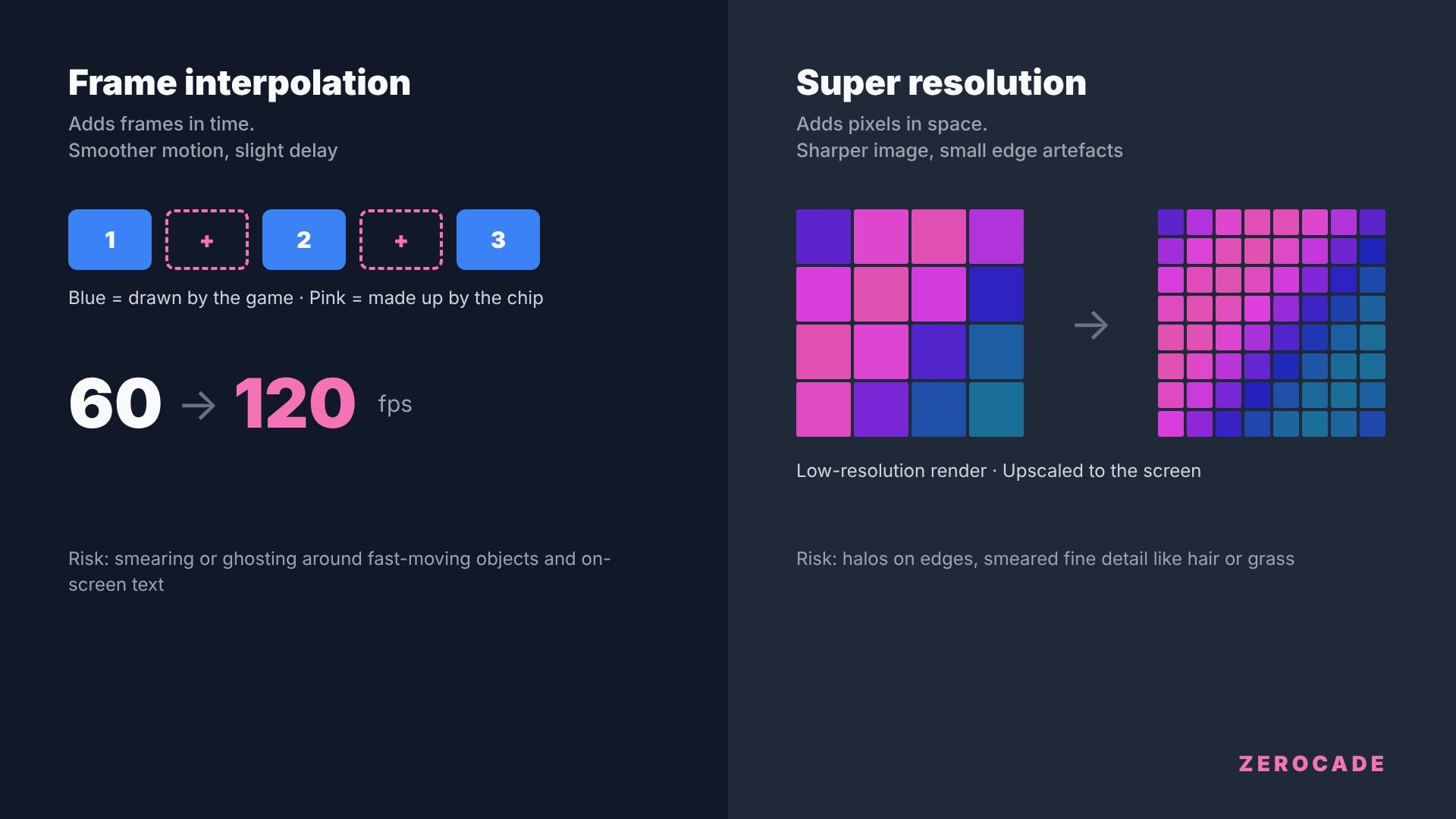
Image: Zerocade
Why it only works in some games
This is the part that matters most if you're thinking of buying one. iQOO's own small print says features like frame interpolation, super resolution and ray tracing "may vary by title". There are good reasons:
- The chip needs to know what it's looking at. Menus, maps and text overlays shouldn't be interpolated, or they shimmer. Each game needs tuning so the chip treats the 3D scene and the interface differently.
- Competitive games care about latency. In fast shooters, a few extra milliseconds of delay can matter more than extra smoothness. Some players will turn it off.
- Game makers have to cooperate. Phone brands work with big studios to support popular titles first. Smaller games may never be supported.
So the real-world value depends on whether your games are on the list. iQOO doesn't publish a full list on its product page, so check with the brand for the games you play.
Which phones have these chips?
The idea isn't unique to iQOO. Several gaming-focused brands have shipped phones with a separate visual or gaming processor alongside the main chip, and iQOO has made its Q-series a selling point across its flagship and Neo lines. In this latest wave, the iQOO Neo 12 is the only one of China's three new performance phones with an extra gaming chip. The Redmi K100 and OnePlus Ace 7 rely on the main Snapdragon alone. Our comparison of those three phones has their full specs and prices.
Is it worth caring about?
On paper, a gaming chip makes the most sense if you play long sessions of a supported game on a high-refresh screen, and you want smoothness without the phone getting hot. If you mostly play competitive shooters, or games that aren't supported, it adds little. If the Neo 12 reaches India, check the supported game list before treating the Q3 as a reason to buy.